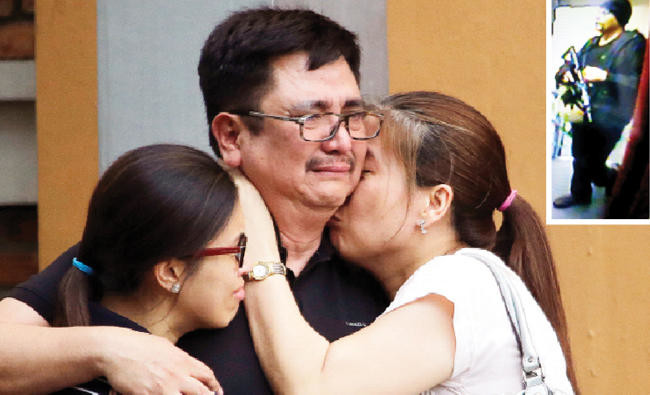
JEDDAH: A masked gunman set fire to a gaming room at a casino in the Philippine capital on Friday, igniting a toxic blaze that killed 37 people.
Daesh claimed responsibility for the attack, but the Philippine government insisted it was not terror-related.
The victims suffocated inside one of the main gambling venues of the upscale Resorts World Manila, while dozens of other people were injured in a panicked crush to escape, police said.
The gunman committed suicide by setting himself on fire about five hours after storming the casino with an M4 assault rifle and a bottle of petrol that he used to start the fire, police chief Ronald Dela Rosa said.
Dela Rosa and other police officials said the assailant was not carrying out a terrorist attack as he did not shoot anyone. They said it appeared to be a bizarre robbery attempt by a “deranged” man.
“This is not an act of terror. There is no element of violence, threat or intimidation that leads to terrorism,” Dela Rosa told reporters.
Baker Atyani, a veteran journalist who has covered militant groups in the Philippines for two decades, said this was undoubtedly “a Daesh attack,” adding that it had issued an official statement claiming responsibility.
“They even named the attacker as Abul Kheir Al-Arkhebieli,” he told Arab News on Friday. “His aim was to inflict maximum damage and take as many lives as he could.”
The fact that he was able to kill 37 people indicates that he succeeded in his goal, said Atyani, adding that he would not classify the attack as an isolated incident.
“This was a well-planned, well-executed operation in the heart of the Philippine capital,” he said.
“If you see the CCTV footage and the images from the resort, it’s very clear that this man was heavily armed and well-equipped. He wasn’t some angry man with a gun who just barged into the hotel. This was a well-planned attack that was meant to cause maximum damage to human lives, and it did.”
This means Daesh has the wherewithal and a huge network of foot soldiers to move fast in Philippine cities and carry out such deadly attacks, Atyani said. “Before they were only confined to the south. No more.”
Local police chief Tomas Apolinario told AFP that 37 people died from inhaling smoke from a fire that spread quickly because of flammable carpet on the gaming room floors. Four of the victims were from Taiwan, according to the Taiwanese government.
The gunman initially disappeared into the chaos of smoke and running people, leading to a five-hour manhunt in the complex, which also includes a hotel and shops, said Dela Rosa.
He added that the assailant, who appeared to be a foreigner because he spoke English and looked Caucasian, was found just before dawn in a hotel room, having committed suicide.
“He lay down on the bed, covered himself with a thick blanket, apparently poured petrol on the blanket and burned himself,” Dela Rosa said.
Daesh’s Aamaq news agency carried a brief message in Arabic on Telegram, which said: “Daesh fighters carried out the attack in Manila in the Philippines on Thursday.”
In a later statement posted on Telegram from one of Daesh’s regular and authenticated accounts, the group provided the gunman’s nom de guerre and boasted of killing and injuring nearly 100 Christians during the rampage.
But Philippine officials were adamant it was not terror-related, and was the work of an individual.
“This particular situation in Manila is not related in any way to a terrorist attack,” presidential spokesman Ernesto Abella told reporters.
Dela Rosa said the man, acting alone, walked into one of the gaming rooms and fired the rifle at a large television screen, then poured gasoline onto a gambling table and set it alight.
Atyani said Daesh militants — who have their back to the wall in the southern city of Marawi, where Philippine security forces have been pounding their positions and hideouts for the last 11 days — have tried to open another front to ease the pressure on them in Marawi.
“In Marawi, the security forces have almost succeeded in flushing out the militants, and they now seem to have dispersed into the jungles,” he said.
The Marawi operation was launched to capture Isnilon Totoni Hapilon, who has been named by the Daesh leadership in Raqqa, Syria, as its emir in the Philippines. “He seems to have escaped from Marawi and is believed to be in Mindanao,” said Atyani.
“The attack in Manila can be seen, from the perspective of Daesh, as revenge for the Marawi operation.”
On why the Philippine government is refusing to acknowledge the presence of Daesh in the country, Atyani said there is an element of denial.
“Even during the early days of the operation in Marawi, they said there was no Daesh in the Philippines,” he said. “They have to admit now that Daesh is there in their midst.”
The other reason for Daesh to carry out this attack in Manila was to frighten tourists away and hurt the Philippine economy, he added.
“If the government officially accepts the presence of Daesh, then tourists will think twice before coming to the Philippines,” he said. “An attack in the heart of Manila on a resort is bad news for the tourism industry.”
— With input from AFP


![]()
Deadly Manila resort blaze no doubt a 'Daesh attack’, expert tells Arab News
Deadly Manila resort blaze no doubt a 'Daesh attack’, expert tells Arab News

Latest updates


© 2026 SAUDI RESEARCH & PUBLISHING COMPANY, All Rights Reserved And subject to Terms of Use Agreement.