


Gunman sets himself on fire after robbing casino in Philippines — police

1 / 2
SWAT members of the Philippine National Police rush towards the entrance to the Resorts World Manila complex in suburban Pasay city, metropolitan Manila, on Friday, after masked gunman stormed a hotel-casino complex, shooting up a TV screen, torching gambling tables and stuffing a backpack with casino chips before fleeing. (AP Photo/Bullit Marquez)
2 / 2
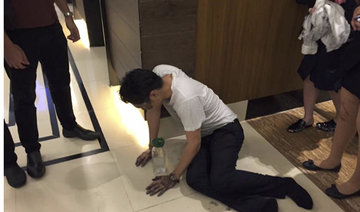
An injured hotel guest is seen outside of a hotel after a shooting incident inside Resorts World Manila in Pasay City, Metro Manila, on Friday. (REUTERS)
Updated 02 June 2017
Follow

Gunman sets himself on fire after robbing casino in Philippines — police

MANILA: A gunman killed himself after bursting into a Manila casino, firing shots and setting gaming tables alight, Philippine police said, sowing panic in a country on high alert after martial law was declared in the south.
Police said earlier the man’s motive was likely robbery and that the incident was not terror-related.
National police chief Ronald dela Rosa told DZMM radio the lone gunman had not aimed his assault rifle at people at the Resorts World Manila entertainment complex during the hours-long drama that began shortly after midnight (1600 GMT), and may have been trying to steal casino chips.
Around dawn, the body of the suspected gunman was found in a hotel room in the complex, which is close to Ninoy Aquino International Airport and an air force base.
Police said it appeared the suspect had killed himself after firing at armed officers searching the still-smoking building.
“He burned himself inside the hotel room 510,” dela Rosa told a media conference. “He lay down on the bed, covered himself in a thick blanket and apparently doused himself in gasoline.”
One security guard at the complex died after accidentally shooting himself, he said.
Officials said at least 54 people were hurt, some seriously, as they rushed to escape what at first had been feared as a militant attack.
“Don’t panic, this is not a cause for alarm. We cannot attribute this to terrorism,” dela Rosa said.
“We are looking into a robbery angle because he did not hurt any people and went straight to the casino chips storage room. He parked at the second floor and barged into the casino, shooting large TV screens and poured gasoline on a table setting it on fire,” he said.
Police said the gunman was tall with a pale complexion and spoke English.
Videos posted earlier on social media showed people fleeing as several loud bangs were heard.
Jeri Ann Santiago, who works in the emergency room at the San Juan de Dios hospital, said patients were suffering the effects of smoke inhalation and some had injuries such as fractures. None had gunshot wounds, she said.

’Pray for the injured'
Kimberly Molitas, a spokeswoman for the capital’s police office, said 113 million Philippine pesos ($2.27 million) worth of casino chips stolen during the raid had been recovered.
“Please help pray for the injured and the loss of lives due to suffocation,” she said in a message to reporters.
Dela Rosa could not confirm if anyone had died from suffocation.
The Philippines has been on heightened alert amid a crisis in the south of the country, where troops have been battling Islamist rebels since May 23.
President Rodrigo Duterte declared martial law on the southern island of Mindanao, an island of 22 million people, last week and has warned it could become a haven for supporters fleeing Iraq and Syria.
Dela Rosa said there had been no specific, credible terror threat in Manila so far.
US President Donald Trump said Washington was closely monitoring events unfolding in Manila.
The US embassy in Manila told Americans there to exercise caution and to review their personal security.
Dozens of police trucks and a handful of huge Special Action Force vans and armored personnel carriers lined side streets near the hotel, casino and shopping mall complex as the drama unfolded.
Gil Yonco, 54, stood weeping in the street at around 5 a.m. His daughter had been on the second floor inside Resorts World and called her father for help because she was being suffocated by smoke.
He tried calling back but there was no answer. “I am very worried as a parent, I need to find her,” he said.
A casino worker from the third floor of the complex, named Julio, told DZMM radio he heard many gunshots and saw people running up the stairs from the second floor.
Ronald Romualdo, a maintenance worker at Resorts World, told the station he saw a woman fall from an upper floor while trying to escape. “Several people were injured,” he said.
Ramadan tests Pakistan’s daily wage workers but faith endures

Updated 13 sec ago
Follow

Ramadan tests Pakistan’s daily wage workers but faith endures

  • Reduced work hours during fasting month cut already fragile incomes
  • Charities, local businesses step in as laborers try to support families back home

ISLAMABAD: Abdul Waqif grips a worn-out shovel and digs into the earth beneath the harsh midday sun, his body bent with age but still moving steadily.

Moments later, the 70-year-old hoists a heavy bag of cement onto his shoulders and carries it toward an under-construction house, all while fasting.

For Waqif and thousands of daily wage laborers across Pakistan, Ramadan is not just a month of spiritual devotion. It is also a month of shrinking incomes.

Waqif migrated from Mohmand tribal district in northwestern Pakistan to Islamabad two decades ago in search of work.

Like many laborers from rural and former tribal areas, he left behind limited local opportunities to earn a living in larger cities such as Islamabad, Lahore and Karachi.

In Pakistan, daily wage workers, particularly in construction and manual labor, are among the most economically vulnerable.

They are paid only for days worked, receive no job security or benefits, and often rely on informal arrangements. Any slowdown in economic activity directly affects their ability to feed their families.

Economic activity typically slows during Ramadan, when Muslims fast from dawn to sunset. Employers often reduce work hours or postpone physically demanding projects to ease the burden on fasting workers. While intended as a gesture of consideration, it means fewer working hours and fewer earnings.

For laborers such as Waqif, who earns between 1,000-1,200 rupees ($3.59-$4.31) a day, even a slight reduction in work can be devastating.

His suhoor, the pre-dawn meal before fasting begins, usually consists of a few chapatis from a nearby hotel. The hunger and thirst that follow him through the day are constant companions as he lifts bricks and mixes cement in the heat. But so is his faith.

“Allah gives me courage. I am hungry and thirsty, but I keep working,” Waqif said while wiping the sweat from his brow.

Back in Mohmand district, his wife, four daughters and two sons depend on the money he sends home. Every rupee matters.

“I support them with this work,” Waqif said. “I eat three meals a day here and I also have to save money for my children and send it to them.”

The reduction in work during Ramadan weighs heavily on him. “I don’t find much work in Ramadan, and I’m worried for my family,” Waqif said.

Finding food for suhoor is sometimes a challenge. On some mornings, someone offers him a piece of flatbread. Other times, he buys what little he can afford from a nearby eatery.

Muhammad Sajid, owner of Al-Hadi restaurant in Islamabad’s G-15 sector, says he tries to ease that burden by offering meals to laborers at half price.

“We don’t let anyone go hungry,” Sajid told Arab News. “We offer sehri and iftar as much as anyone can afford.”

The restaurant serves tea, yogurt, several types of curries and parathas.

Charity groups also expand operations during Ramadan, when community support traditionally increases. The Junaid Welfare Foundation runs a roadside dastarkhwan, or communal meal spread, serving hundreds daily.

Haq Rawan Shareefi, a manager at the foundation, said about 500 people are provided iftar meals each day. The cost of one person’s iftar is 200 rupees.

“That means, on iftar and sehri, our expenses range from 150,000 rupees to 200,000 rupees,” Shareefi said.

For Waqif, breaking his fast at sunset brings temporary relief from the physical strain of the day. But the financial uncertainty remains.

“I ask Allah for this,” he said. “May Allah give me strength to earn an honest living for my children.”