WASHINGTON: The US military said on Thursday it had bolstered its “combat power” in southern Syria, warning that it viewed Iran-backed fighters in the area as a threat to nearby coalition troops fighting Daesh.
The remarks by a Baghdad-based spokesman for the US-led coalition battling Daesh was the latest sign of tension in the region, where the US has forces at the base around the Syrian town of At Tanf supporting local fighters.
“We have increased our presence and our footprint and prepared for any threat that is presented by the pro-regime forces,” said the spokesman, US Army Col. Ryan Dillon, referring to Iran-backed forces supporting Syrian President Bashar Assad.
Dillon estimated that a small number of Iran-backed forces had remained inside a so-called “deconfliction” zone meant to ensure the safety of US-led coalition forces since a May 18 US strike on their advancing formation.
Meanwhile, a larger number had been massing directly outside the zone, which was agreed between the US and Russia, which is supporting Assad. “We see that as a threat,” Dillon said.
The US military has also dropped about 90,000 leaflets this week warning the fighters inside the zone to depart, one US official said. Reuters had previously reported on the leaflet drop, citing Hammurabi Justice, a website linked to US-backed Syrian opposition forces known as the Maghawir Al-Thawra group.
A copy of the leaflets provided to Reuters by the Pentagon told the Iran-backed fighters that any movement toward the At Tanf garrison “will be seen as hostile intent and we will defend our forces.”
“You are within an established deconfliction zone, leave the area immediately,” another read.
This southeastern area of the Syrian desert, known as the Badia, has become an important front in Syria’s civil war between Assad, backed by Iran and Shiite militias, and fighters seeking to oust him.
They are competing to capture land held by Daesh, which is retreating as it comes under intense attack in Iraq and along Syria’s Euphrates basin.
Western-backed Syrian fighters said on Wednesday that Russian jets attacked them as they tried to advance against Iran-backed militias.
US-backed fighters took Tanf from Daesh last year, and regional intelligence sources say they mean to use it as a launchpad to capture Bukamal, a town on Syria’s border with Iraq and an important terrorist supply route.
The coalition’s presence in Tanf, on the Damascus-Baghdad highway, was also meant to stop Iran-backed groups from opening an overland route between Iraq and Syria, the sources say.
Damascus has declared the Badia and Deir Ez-Zor priorities in its campaign to re-establish control over Syria, which has been shattered by six years of a war that has killed hundreds of thousands of people.
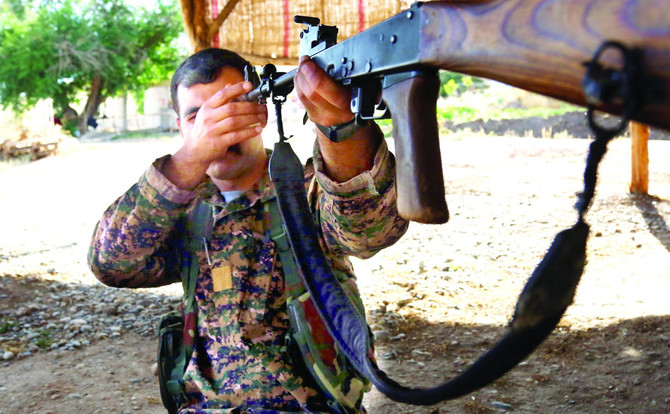
Meanwhile, the US military offered assurances to Turkey on Thursday over supplying arms to Kurdish fighters against Daesh, after Ankara called the move “extremely dangerous.”
“We are being transparent with Turkey on the details on what we are providing,” said Dillon.
“We are maintaining full accountability of the weapons we are providing the SDF,” he said, referring to the Syrian Democratic Forces, a Kurdish-Syrian Arab alliance now moving in on Daesh’s Syria stronghold of Raqaa.
The SDF includes fighters from the Kurdish Peoples’ Protection Units (YPG), which Turkey links to Kurdistan Workers’ Party (PKK) separatists it calls a terror group.
In May, US President Donald Trump approved arming the YPG to support the assault on Raqqa.
Turkey on Tuesday said arming the YPG was an “extremely dangerous” move and urged Washington to reverse its “mistake.”
The arms going to the SDF could include anti-armor weapons like rocket-propelled grenades or TOW missiles, in addition to vehicles, AK-47s and small-caliber machine guns.
Dillon said any arms provided will be recorded by serial number.
“We will maintain that in our database, and we will share that information with allies to the north that are concerned about the weapons we are providing,” he said.


![]()
US hikes ‘combat power’ in Syria, with an eye on Iran-backed militia
US hikes ‘combat power’ in Syria, with an eye on Iran-backed militia


Latest updates


© 2026 SAUDI RESEARCH & PUBLISHING COMPANY, All Rights Reserved And subject to Terms of Use Agreement.