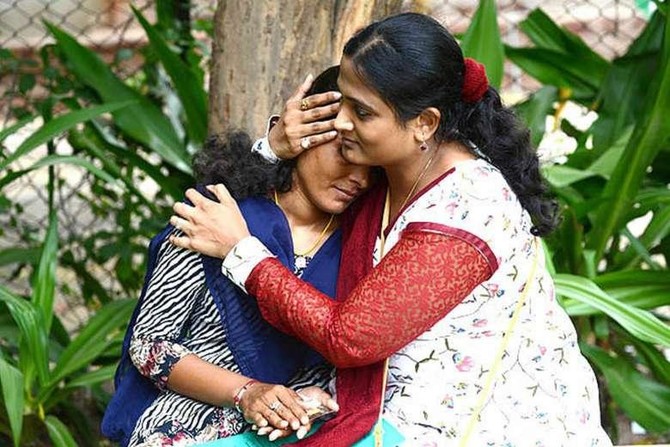
Child brides are on the rise in India’s towns and cities

(AFP)
Updated 02 June 2017
Follow

Child brides are on the rise in India’s towns and cities

NNEW DELHI:An increasing number of underage girls in India’s towns and cities are being married off, a study has revealed, challenging long-held assumptions that child marriage in the country is largely a rural phenomenon.
Child marriage is illegal in India, but it is deeply rooted and accepted in society, and remains widespread in parts of the country. Data from the 2011 census shows more than 5 million girls were married before the legal age of 18 — a marginal decrease from 2001.
Yet while the number of underage brides has declined by 0.3 percent in rural areas since 2001, they have increased by 0.7 percent in urban parts, said a report by the National Commission for the Protection of Child Rights and the charity Young Lives.
Experts said these percentage figures appear insignificant, but considering India has a population of 1.3 billion, this means tens of thousands more underage girls were married in towns and cities in the decade to 2011.
“What is interesting is that one didn’t expect a lot of the urban areas to figure in the high incidence districts, especially around the big metros,” Renu Singh, Young Lives’ country director, told a news conference late on Thursday.
“Also it is surprising that in the 10 to 14 age group, there are still large numbers of girls being married in urban areas. One was hoping and thinking that would not exist at all.”
The study — the first to break down India’s census data on child marriage — found nearly one out of four girls in rural areas and one out of five in urban areas was married below 18.
Some urban districts in states such as Uttar Pradesh in the north and Telangana, Andhra Pradesh and Karnataka in the south showed a rise in the number of underage brides from 2001 to 2011, the report said.
Singh said it was too early to know why incidence rates in certain towns and cities had inched higher, adding that more research was needed to understand the causes.
Along with Niger, Guinea, South Sudan, Chad and Burkina Faso, India is among the top 10 countries with the highest prevalence rates of child marriage, despite moves to empower girls and women and toughen penalties against the crime.
Poverty, weak enforcement of laws, patriarchal social norms and concerns about family honor are factors contributing to early marriage.
But the practice violates child rights — cutting across every part of women’s development and creating a vicious cycle of malnutrition, poor health and ignorance, experts say.
A child bride is more likely to drop out of school and have serious complications during pregnancy and childbirth. Her children are more likely to be underweight and will be lucky to survive beyond the age of five.


’Without any humanity’: Eritrea human trafficker gets 20 years

Updated 5 sec ago
Follow

’Without any humanity’: Eritrea human trafficker gets 20 years

  • The court said the man had treated migrants “without any humanity” as they were transported from Eritrea to Europe via Libya
  • Gang members abused thousands of migrants before detaining them in overcrowded and dirty camps in Libya

THE HAGUE: A Dutch court on Tuesday sentenced an Eritrean man to 20 years in prison for operating a human trafficking ring in which migrants were tortured and their families extorted.
The court said the man, identified as Amanuel Walid, had treated migrants “without any humanity” as they were transported from Eritrea to Europe via Libya.
“Your only aim was to earn as much money as possible from people who were looking for a better future,” presiding judge Rene Melaard told Walid.
Gang members abused thousands of migrants before detaining them in overcrowded and dirty camps in Libya, extorting their families for large sums of money.
The court in the northern Dutch city of Zwolle heard how gang members tortured victims while on the phone to their families in the Netherlands, demanding payments to make the abuse stop.
Only once family members had transferred money were the victims put on rickety boats for the perilous trip across the Mediterranean Sea. Many drowned in the crossing.
Prosecutors had called for the maximum sentence of 20 years, accusing him of leading a criminal organization with the intent to commit human trafficking, extortion, hostage-taking, and sexual offenses.
“The court finds that the seriousness and the extent of those crimes justifies such a 20-year sentence,” said Melaard.
He noted Walid had never expressed remorse for his actions and that a psychiatric observation center had judged him mentally fit to take criminal responsibility.
Melaard said he was also imposing the maximum sentence “because of the particularly cruel, violent, and degrading treatment to which the defendant and his accomplices subjected the migrants.”
The court ruled however it had no jurisdiction over the charges of hostage-taking and sexual offenses as these alleged crimes did not take place on Dutch soil.
Walid has been in custody in the Netherlands since October 2022. There is confusion over both his name and his age. He says he has a different name and is 46, not 42.
He made no substantive comments in court, except to deny the charges. He said it is a case of mistaken identity.
But the judge dismissed this claim, saying: “The court finds that it is beyond reasonable doubt that you are the person who was active as a trafficker in Bani Walid in Libya.”
His lawyers also argued that he has already been tried in Ethiopia over largely the same allegations and therefore could not be put on trial again.
Melaard said that the sentence in the Ethiopian case had not yet been applied but that Walid could appeal if it is.

- ‘Freedom and dignity’ -

Prosecutors believe Walid was one of the “most prolific” smugglers on the route from conflict-torn regions in Africa via Libya to Europe.
Walid “deprived the victims of their freedom and dignity,” the public prosecutor argued in court.
“He held them in appalling conditions, starved them, tortured them, and denied them essential medical care,” said the prosecutor.
The Dutch investigation into the operation lasted several years and was carried out with other international bodies such as the International Criminal Court and Interpol.
Libya has struggled to recover from chaos that erupted after a NATO-backed uprising in 2011 overthrew longtime dictator Muammar Qaddafi.
Smugglers and human traffickers have taken advantage of the instability, with the country facing criticism over conditions for migrants and rights groups levelling accusations of extortion and slavery.