



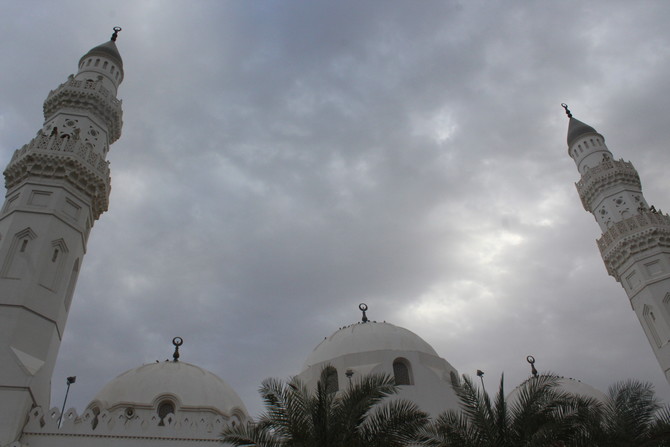
JEDDAH: Quba mosque has a special and unique place in the hearts of Muslims due to its association with the prophet Muhammed -peace be upon him- as it is the first mosque ever built.
It is also known to be the second largest and prominent mosque in Madina after the Prophet’s Mosque.
It is considered by many to be the third most sacred shrine in Saudi Arabia, and an all-but-mandatory stop for pilgrims visiting Madina.
According to several sources, 622 AD was the founding date of the mosque right after prophet Muhammed arrived on his emigration from holy capital of Saudi Arabia, Makkah.
Quba Mosque is located on the outskirts of Madina, where the prophet used to go to Cuba Mosque every Saturday, “The Prophet used to go to the Mosque of Quba every Saturday (sometimes) walking and (sometimes) riding,” Ibn ‘Umar (may Allah be pleased with him) said narrated by Abdullah bin Dinar.Among many prestigious characteristics of Quba Mosque, Prophet Muhammed said: “Whoever makes ablutions in this house and offers one prayer therein, will be rewarded the equivalent of one Umrah.”
Many interpretations say that the following verse was said in reference to Quba Mosque: “A mosque founded on righteousness from the first day is more worthy for you to stand in. Within it are men who love to purify themselves; and Allah loves those who purify themselves.” Surah Tawbah [9:108].
The first renovation was made by the third Caliph Uthman Ibn Affan. Umayyad Caliph Omar bin Abdul Aziz built the first minaret of the mosque. Abu Yali Al-Husaini renovated the mosque again in 435 A.H. He constructed a prayer place known as the “Mihrab”, also known as a prayer niche.
There are 7 major entrances and 12 supplementary ones. The mosque is cooled by three middle units, each with a capability of one million and eighty thousand cooling units.
The northern section is reserved for women worshippers. The mosque now has four minarets and 56 domes connected to a house of Imams and muezzins, a library, a place for the guards in a part of 112 sq. meters, and a marketable center with 12 shops covering an area of 450 sq. meters.
The mosque has 64 toilets for men and 32 toilets for women, and 42 units for ablution.


