JEDDAH: The commander of the east Libyan forces has accused Qatar and other countries of supporting terrorist organizations linked to Al-Qaeda in Libya.
Field Marshal Khalifa Haftar, leader of the Libyan National Army (LNA), said some other countries were also aiding terror outfits, but he did not name them.
Haftar said on Sunday that the LNA is monitoring foreign communities in Libya who, he said, entered the country because of lack of border control.
These communities are “supported by regional countries and terrorism-sponsoring countries,” he said, specifically naming Qatar.
He said these countries fund militias fighting on Libyan soil, according to local media sources close to Haftar, including Iwan Libya.
He said some of these figures received “sums of money from Qatar and other countries, and from terrorist elements represented by some terrorist militias in Libya, linked to Al-Qaeda.”
Haftar added that Libya welcomes the presence of foreign communities that contribute to the country’s development.
He stressed that relations with them are based on neighborly ties, but “if they engage in terrorism and fighting on Libyan soil, Libyan forces will limit their activities and hold them accountable.”
He reiterated that “the armed forces are monitoring them, and that they will be firmly dealt with by security agencies.”
He added that foreigners in Libya are not allowed to own weapons, even if they claim to be helping the Libyan people. “Any foreigner who carries weapons in Libya will be arrested and fought — collectively or individually.”
Haftar also announced that his forces have started preparations for the battle to defend Tripoli.
“Militias representing militant political Islam lost control of the capital Tripoli; they deviated from the national path and started destroying institutions and citizens’ property. They began using heavy weaponry in the capital with no regard to the safety and security of citizens,” he said.
He called on regional countries, Arab League and the international community to support the Libyan people and their armed forces to protect and save Libya and the Libyan people, “who are being threatened, killed and raped by criminal gangs.”
Haftar also instructed units of the armed forces in the western region “to prepare for the defense of Tripoli, fight terrorism, expel and destroy terrorist bases and help the national forces defend the capital.”
He also called on the leaders of the armed forces “to declare a state of emergency in all sectors, government institutions and units in order to prepare for the confrontation and protect the defenseless citizen.”


Haftar: Doha aiding terror outfits in Libya
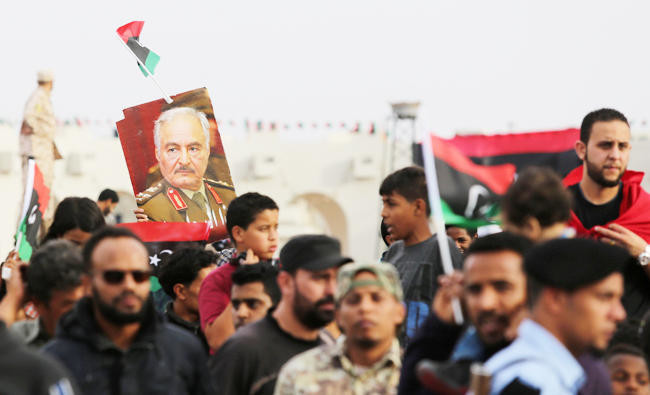
Haftar: Doha aiding terror outfits in Libya



Israel police to deploy around Al-Aqsa for Ramadan, Palestinians report curbs
- The Al-Aqsa compound is a central symbol of Palestinian identity and also a frequent flashpoint
JERUSALEM: Israeli police said Monday that they would deploy in force around the Al-Aqsa Mosque during the Muslim holy month of Ramadan, which begins this week, as Palestinian officials accused Israel of imposing restrictions at the compound.
Over the course of the month of fasting and prayer, hundreds of thousands of Palestinians traditionally attend prayers at Al-Aqsa — Islam’s third-holiest site, located in east Jerusalem, which Israel captured in 1967 and later annexed.
Arad Braverman, a senior Jerusalem police officer, said forces would be deployed “day and night” across the compound, known to Jews as the Temple Mount, and in the surrounding area.
He said thousands of police would also be on duty for Friday prayers, which draw the largest crowds of Muslim worshippers.
Braverman said police had recommended issuing 10,000 permits for Palestinians from the occupied West Bank, who require special permission to enter Jerusalem.
He did not say whether age limits would apply, adding that the final number of people would be decided by the government.
The Palestinian Jerusalem Governorate said in a separate statement it had been informed that permits would again be restricted to men over 55 and women over 50, mirroring last year’s criteria.
It said Israeli authorities had blocked the Islamic Waqf — the Jordanian?run body administering the site — from carrying out routine preparations, including installing shade structures and setting up temporary medical clinics.
A Waqf source confirmed the restrictions and said 33 of its employees had been barred from entering the compound in the week before Ramadan.
The Al-Aqsa compound is a central symbol of Palestinian identity and also a frequent flashpoint.
Under long?standing arrangements, Jews may visit the compound — which they revere as the site of their second temple, destroyed by the Romans in 70 AD — but they are not permitted to pray there.
Israel says it is committed to maintaining this status quo, though Palestinians fear it is being eroded.
Braverman reiterated Monday that no changes were planned.
In recent years, a growing number of Jewish ultranationalists have challenged the prayer ban, including far?right politician Itamar Ben-Gvir, who prayed at the site while serving as national security minister in 2024 and 2025.