Sanctions, leaving military base ‘possible options against Qatar’

Robert Gates. (Courtesy: U.S. Department of Defense)
Updated 27 May 2017
Follow

Sanctions, leaving military base ‘possible options against Qatar’

WASHINGTON: Qatar was under increasing pressure in Washington this week as Congressman Ed Royce and former Defense Secretary Robert Gates raised possible sanctions and the moving of the US military base out of the country if Doha does not change its ways.
The news comes after a recent diplomatic spat between Qatar and its Gulf neighbors, as well as signs of lukewarm relations between Doha and the Donald Trump administration.
At a conference hosted by the Foundation for Defense of Democracies this week, Royce and former US officials from both Democratic and Republican administrations called for a more hawkish response to what they described as Qatar’s support for the Muslim Brotherhood, as well as groups such as Hamas, the Palestinian group designated as terrorist by the US.
Royce, who chairs the House Foreign Affairs committee, lambasted Qatar for its alleged support for Hamas. “Qatar hosts the worst of the worst of Hamas’ leaders,” Royce said, adding that his committee is putting together an “acid test legislation” to target Hamas’ backers.
The congressman said that “if it doesn’t change, Qatar will be sanctioned under a new bill I’m introducing to punish Hamas backers.”
Royce also appeared willing to have Congress consider having the US military leave Al-Udeid air base, where the US has been operating since 2003. “If their behavior doesn’t change, we in Congress would absolutely be looking at other options including moving out of Al-Udeid base.”
The change of behavior that Washington appears to be seeking from Qatar is related to cracking down on alleged terror funding activities and “commitments on terror support behavior,” as Royce indicated.

Gates was also open to the idea of ratcheting up pressure on Qatar. Responding to a question on moving the base from Qatar, Gates said: “My attitudes toward Al-Udeid and any other facility is that the United States military doesn’t have any irreplaceable facility.”
Gates criticized the apparent lack of strong action from Qatar against radical groups. “I don’t know instances in which Qatar aggressively goes after (terror finance) networks of Hamas, Taliban, Al-Qaeda,” he said.
He urged both Congress and the Trump administration to “tell Qatar to choose sides or we will change the nature of the relationship, to include downscaling the base.”
The former defense secretary, who served under George W. Bush and Barack Obama, added: “Qatar has long had the welcome mat out for the Muslim Brotherhood.” He called the group “science fiction shape shifters.” Gates referred to a generational split within the Brotherhood and said “it’s a mistake to see it as a solid group,” leaving the decision to designate it to Congress.
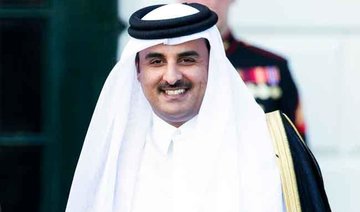
Jake Sullivan, former Obama official and aide to Hillary Clinton, also advocated a harder line against terror financing. Sullivan said that “terror financing needs to be a persistent issue we bring out from behind closed doors and continually have on the table.” While many Arab leaders have flocked to Washington, Qatar Emir Tamim bin Hamad Al-Thani has not made a visit to the White House since Trump took office.
The highest-level visit of a Qatari official to Washington this year was made by Foreign Minister Mohammed bin Abdulrahman Al-Thani, who met US Secretary of State Rex Tillerson earlier this month.
The concerns raised in the US follow tensions in the Gulf earlier this week, after a series of controversial comments attributed to Qatar’s emir.
Sheikh Tamim alleged comments, carried by the official state news agency QNA, apparently saw him endorse Iran, Hamas and Hezbollah — strongly diverging from the stance of Qatar’s Gulf neighbors. Doha claimed the report was the result of a hacking attack.
Criticizing the event, Qatari Foreign Minister Sheikh Mohammed bin Abdul Rahman Al-Thani said that no Qatari official was invited to attend the event.


In an increasingly hostile world, migrants are hopeful as Spain moves to integrate them

Updated 5 sec ago
Follow

In an increasingly hostile world, migrants are hopeful as Spain moves to integrate them

  • The “sin papeles” (Spanish for “without papers”) are often exploited, marginalized and invisible
  • Sánchez said the country was opening a legal path for “people who have, together with us, built progress in this country”

BARCELONA: More than half a million immigrants are believed to live in Spain without legal permission.
They work jobs that few Spaniards want: picking fruits and vegetables in the fields, caring for children and the elderly, cleaning homes and hotel rooms. Some wind up homeless.
The “sin papeles” (Spanish for “without papers”) are often exploited, marginalized and invisible.
Now, Spain wants to integrate them. Earlier this week, the government announced it would grant residency and work permits to all foreigners who arrived in the country before Dec. 31, 2025, have lived in Spain for at least five months, and have no criminal record.
Pedro Sánchez, Spain’s socialist prime minister, said the country was opening a legal path for “people who have, together with us, built progress in this country” in a video posted to social media Friday.
The unexpected move contrasted with harsh rhetoric and deportation efforts ramping up in the United States and other European Union countries.
Here are three people who are hoping to get their residency and work permits under Spain’s new policy.
A Colombian asylum-seeker
“A week ago, I was living with constant anxiety,” said Ale Castañeda, an asylum-seeker from Colombia whose temporary permit was about to expire in February. “I didn’t know what would happen to me, if I would be able to stay or not, if I would have to start from scratch again.”
Now, if his asylum case gets rejected, Castañeda has another legal pathway to remain in Spain. He just wants to be able to work and get access to “basic things,” like opening a bank account. One thing he wants to make clear is that he doesn’t plan to rely on public benefits.
Castañeda says he’s found odd jobs when he can but is currently out of work.
Like many of the Latin Americans who make up the majority of immigrants in Spain, Castañeda arrived legally on a tourist visa and decided to stay. A queer man, he fled discrimination in Colombia to more progressive, gay-friendly Argentina. But after right-wing, anti-woke Javier Milei was elected, the mood in the country changed and Castañeda was brutally attacked. “I just had to leave,” he said.
In Spain, he finally felt safe.
While Castañeda celebrated Spain’s immigration opening — “It’s the best news of 2026!” — he and other foreigners know that the devil is in the details. The government has shared the basic requirements but the fine print has yet to be published in the official state bulletin.
Castañeda knows how lengthy immigration procedures can be. Even the most basic step, getting an appointment at the immigration office, is such an impossible task that criminal groups are selling them for 50 euros ($60). He wonders how the government will process hundreds of thousands of applications in only a few months.
Spain’s Minister of Migration Elma Saiz vowed that her ministry will dedicate additional resources to make sure things run smoothly. “We want this to be a success,” she said.
A former architect from Chile
Paulina Valenzuela still can’t believe the news. “I still can’t stop smiling,” she told The Associated Press by phone.
A former architect, Valenzuela moved to Spain after losing her job in Chile. She’s struggled to legalize her status for the past three years, falling for costly scams and getting her immigration applications rejected twice without understanding why.
Like many educated Latinas who have moved to Spain, Valenzuela has taken up cleaning jobs to make a living. “I’ll work in anything,” she said. At one point, she was responsible for cleaning 40 apartments listed on Airbnb, an intense and stressful job that paid little, she said.
The booming tourism sector depends heavily on cheap and informal immigrant labor. A record 97 million tourists visited Spain last year and spent more than 130 billion euros. Immigrants see only a tiny fraction of that revenue.
Physically and emotionally drained, Valenzuela quit in November and has resorted to social services to get food on the table.
She’s hoping the new residency permits will lift her out of poverty. Valenzuela can’t help but be suspicious of things that seem too good to be true.
“There’s always an obstacle at the last minute,” she said. “But at least I have hope I didn’t have before.”
A struggling man from Pakistan
Hussain Dar, 30, has been in Spain for almost a year and is struggling without papers.
He left his native Pakistan, where jobs are scarce, to pursue a master’s degree in the United Kingdom.
But he was unable to stay in the UK due to its harsher immigration laws and headed to Spain. Still unable to work legally, he’s used up all his savings, sold his computer, and is now thinking of selling his phone. Late on his rent payment, he’s spent several nights sleeping on the streets.
“It’s been tough,” he told AP as he stood in an eight-hour line outside the Pakistani consulate in Barcelona this week.
Dar is among some 15,000 Pakistani citizens living in the northeastern region of Catalonia without permission, according to Murad Ali Wazir, Pakistan’s consul general in Barcelona.
One of the requirements — a certificate of clear criminal record — has swamped the consulate. The window to apply for legal residency in Spain will be short: from April and to the end of June only, Spanish officials say. To help its citizens get the required documents in time, the consulate announced it will even open on weekends.
“I didn’t expect that this country was going to be so good, the weather, the people, the culture,” Dar said. With permits, he and others will be able to work and pay Spanish taxes, contributing to the Spanish economy, he said. They’ll also be allowed to visit family back home that they haven’t seen in years, Dar said with a smile.
“Viva España! Viva Pedro Sánchez! We love that guy,” he exclaimed.