MANILA: The EU’s ambassador to the Philippines said on Tuesday that grant money from his grouping is meant to promote development, not system change, in foreign countries.
The ambassador said he will seek clarification about Manila’s decision to reject new grants from his grouping, while he defended the foreign aid program as promoting development.
Ambassador Franz Jessen told reporters he will meet next week with Philippine Foreign Secretary Alan Peter Cayetano to discuss the matter.
Philippine officials said last week that President Rodrigo Duterte approved the Department of Finance’s recommendation not to accept €250 million (nearly $280 million) in EU grants for 2017 to 2020 to discourage the bloc from interfering in Philippine internal affairs and requiring a review of the country’s adherence to the rule of law.
The EU is among the critics of Duterte’s war on drugs, which has left thousands dead.
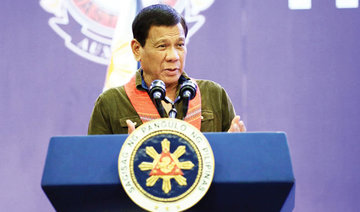
Duterte has bristled at the criticisms and warned against outsiders meddling in domestic policies.
Jessen said on Tuesday that the EU has a standard set of conditions on all its development assistance and they apply to all countries, not just the Philippines. They include ensuring no corruption and that funds go to their intended beneficiaries.
Human rights is tackled under EU political dialogue with the Philippines and is in a sense unrelated to development assistance, he added.
“We are not withdrawing any amount,” he said. “We are in contact with the government on how best to work on our development assistance.”
In a speech at a human rights forum in Manila, Jessen defended the EU’s development aid.
“It’s not a question of trying to change the system but trying to work hand-in-hand with governments around the world to make sure that the countries in need develop in the best possible way,” he told the forum.
Jessen said experience has shown countries with economic freedom and human rights grow faster. This was seen in the former East Germany and central Europe when economic freedom changed dramatically there, and in China and Vietnam when those countries made progress on economic freedom and human rights, he added.
The Philippine foreign secretary said earlier that Manila’s relations with the EU, a top source of investment, could be a “rocky, rollercoaster ride.”
Cayetano said the government would have accepted the aid had the EU not imposed conditions related to Duterte’s war on drugs.
Duterte has arrived in Russia for a four-day official visit, where he will meet with President Vladimir Putin and witness the signing of several agreements, including on defense cooperation and trade.
In his departure speech, Duterte said the visit underscores his independent foreign policy and desire to forge closer ties with Russia, which “must cease to be on the margins of Philippine diplomacy.”
“Overdependence on traditional partners has limited our room to maneuver in a very dynamic, international arena,” he said. “This is a strategic oversight that has led to many missed opportunities for our country. I am determined to correct this.”
Since taking office last June, Duterte has lashed out at then-President Barack Obama and his administration for criticizing his war on drugs. But he has been on friendlier terms with US President Donald Trump.
Contrastingly, he has reached out to China and Russia — whose leaders he met recently — in a dramatic shift in foreign policy for the Philippines, Washington’s longtime treaty ally.
“Russia is a country that we must work with — there are opportunities that cannot be ignored,” Duterte said.
“With its geographic footprint in the Asia-Pacific region and its strategic interest in the region, a positive engagement is required to find areas of synergies and interests.”
Ties between the two countries were established 40 years ago, but Duterte said the doors of cooperation have opened “ever so slightly” and “now we can work together to open those doors even wider.”
Legislators, Cabinet officials and business leaders are accompanying him on the trip.
The trip is at the invitation of Putin, whom Duterte met in Peru in November on the sidelines of the Asia-Pacific leaders’ summit.
Duterte is also expected to deliver a policy speech at the Moscow State Institute of International Relations, bring Filipino business leaders to the Philippine-Russia Business Forum and meet with the Filipino community in Russia.
In a sign of warming bilateral ties, the two countries will set up offices of their defense attaches in each other’s capitals, Natividad said.
Agreements to be signed during the visit include those on defense cooperation, military and technical cooperation, a treaty on mutual legal assistance in criminal matters, an extradition treaty, and a memorandum of understanding on cooperation in the field of security between the two countries’ national security councils.


![]()

EU envoy defends grants after Philippines’ aid rejection
EU envoy defends grants after Philippines’ aid rejection

Latest updates





© 2026 SAUDI RESEARCH & PUBLISHING COMPANY, All Rights Reserved And subject to Terms of Use Agreement.