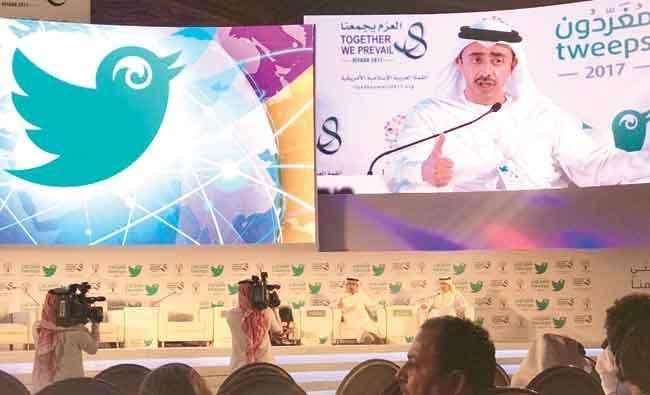
RIYADH: The UAE’s foreign minister has warned Europe that some countries could be classified as “incubators of terrorism” if they fail to better address extremism.
Sheikh Abdullah bin Zayed Al-Nahyan said that such countries should be publicly identified if they did not do more to address terror.
“Saudi Arabia is more keen to fight terrorism than the… Europeans,” Sheikh Abdullah said during the Tweeps Forum 2017. “The voices we hear calling for murder and shedding blood and stealing the wealth of people are in London, Germany, Spain and Italy.
“There will come a day when we see far more radicals, extremists and terrorists coming from Europe because of (a) lack of decision-making, and trying to be politically correct.
“From now on, we will name and shame these countries. We will classify them as incubators of terror if they don’t address this problem of terrorism in their lands.”
The Saudi and UAE foreign ministers took part of a panel discussion on digital responses to extremism, which was moderated by Francine Lacqua, anchor and editor-at-large at Bloomberg TV.
The two ministers discussed tackling the promotion of extremism on social media, with Al-Nahyan calling for wider criminalization of terrorist content on the Internet.
“Social media (players) must realize that there is content that is exploited by extremist and terrorist groups that want to recruit our sons and daughters and want to hijack religion,” the UAE minister said.
“Unfortunately, there is a legislative vacuum at the international level to criminalize this content.”
He pointed out that there is a responsibility for countries to legislate their national laws with the participation of international organizations and conventions.
He added that the establishment of a Global Center for Combatting Extremist Ideology, which was one of the outcomes of the US-Saudi summit, is a huge step by the Kingdom to confront radical thought.
Meanwhile, Saudi Foreign Minister Adel Al-Jubeir said that one of the challenges is not knowing the identity of users on social media sites.
However, companies have began to cooperate more by identifying those who instigate or plan terrorist acts, and it is only a matter of time before there is an effective mechanism that doesn’t affect the freedom of legitimate users.
“There must be a way of knowing who will misuse these means,” Al-Jubeir said.

UAE foreign minister warns Europe over terror threat

Experimental farm in Al-Lith looks into future of Saudi Arabian agriculture
- Research initiative reflects strategic transformation
JEDDAH: An experimental farm in Saudi Arabia’s Al-Lith Governorate is one of the research initiatives reflecting the strategic transformation taking place in the Kingdom’s agricultural sector.
The farm uses highly efficient, sustainable production models that combine scientific research with commercial application, contributing to strengthening the country’s food security system and the sustainability of water resources.
Located in the Ghumaiqa Center on an area of about 10 hectares, the cutting-edge farm is a testing platform for modern agricultural technologies that tackle the challenge of water scarcity.
The farm includes developed open fields and modern greenhouses, supported by smart irrigation encompassing drip and sprinkler irrigation alongside surface and subsurface technologies.
All the systems operate via smart controls that enable the monitoring of water consumption and ensure improved efficiency, thereby achieving a balance between agricultural production and water conservation.
The farm also uses treated and diluted low-salinity seawater.
It aims to diversify agricultural water sources, reduce reliance on freshwater, and open new horizons for agriculture in coastal and semi-arid environments.
The project represents a promising investment opportunity in the field of smart agriculture, enabling the development of commercially scalable production models, particularly for high-value vegetables and fruits, while reducing operational costs associated with water and energy, enhancing the economic feasibility of future agricultural projects.
In addition, the project contributes to transferring and localizing agricultural expertise, supporting local food supply chains, and creating an attractive environment for agricultural investment.
This aligns with Sustainable Development Goals and enhances the efficiency of the private sector in adopting innovative agricultural solutions.
Yahya bin Abdulrahman Al-Mahabi, the director of the Ministry of Environment, Water and Agriculture office in Al-Lith Governorate, told the Saudi Press Agency that the project represented the future of agriculture in the Kingdom.
He explained that the vision was based on investing in technology, enhancing the return on water per unit, and integrating scientific research with investment opportunities.
Al-Mahabi spoke of the experimental farm as a modern, scalable and replicable model applicable in several regions of the Kingdom, particularly in coastal environments.
Al-Mahabi highlighted the Ministry of Environment, Water and Agriculture’s commitment to supporting distinctive projects that contributed to achieving food security while developing rural areas and enhancing agricultural production efficiency, in line with the objectives of the Kingdom’s Vision 2030.