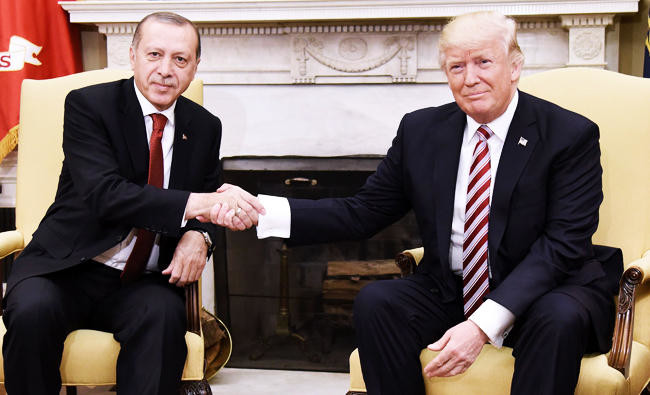
ANKARA: Turkish President Recep Tayyip Erdogan and his US counterpart Donald Trump met for the first time on Tuesday at the White House.
The Syrian conflict and the allies’ disagreements over how to fight Daesh reportedly dominated the 20-minute meeting.
During the joint press conference afterward, Trump said the US “offers its support to the Turkish nation in their fight against terrorist groups like Daesh and the PKK (Kurdistan Workers’ Party).”
He added: “I look forward to working with President Erdogan in achieving peace in the Middle East.”
While Trump emphasized the strength of US-Turkish ties, Erdogan said the visit marks a historic turning point in relations
“We are committed to fighting all forms of terror without any discrimination… Terror groups have no future in the Middle East,” he said.
The US believes the fastest way to recapture Raqqa, Daesh’s self-proclaimed capital, is by backing Syrian Kurds, or the People’s Protection Units (YPG), as a local partner with significant battlefield expertise.
But Turkey considers the YPG a terrorist group due to its close links with the country’s outlawed PKK group, which has been waging a bloody insurgency in Turkey for more than three decades.
Last week, Trump approved Pentagon generals’ controversial plan to arm the YPG with heavy weapons to boost its urban warfare capabilities in the impending battle for Raqqa.
This decision was taken on the day Turkey’s intelligence and army chiefs were at the White House.
The only promise the Pentagon gave was to monitor all weapons provided to the YPG so Turkey does not face any “additional security risks,” and to supply weapons that will be limited to the scope of specific operations.
Lisel Hintz, visiting assistant professor at Columbia University’s Barnard College, said it is reasonable to expect that Erdogan had high hopes for this meeting, given his measured response to the US announcement that it will support Syrian Kurdish forces in the fight against Daesh — a decision that formalizes a position held by Trump’s predecessor Barack Obama and was recommended by National Security Adviser H.R. McMaster.
“Erdogan likely believes he can convince Trump to change his mind, and he may assume he has leverage for such negotiations given the past importance of Turkey’s southern Incirlik Air Base to US efforts against Daesh,” Hintz told Arab News.
“However, the US has been reportedly searching for alternative access points in northern Iraq and elsewhere as a contingency plan should Incirlik be closed,” Hintz said. “Given Erdogan’s adamant position against arming the YPG, along with the apparent declining importance of Incirlik and the weakening of the Turkish Armed Forces’ capacity following the post-putsch purge, it will be difficult to identify any common ground of substance on which the two leaders can work on the Syria issue.”
Ozgur Unluhisarcikli, Ankara office director of the German Marshall Fund of the United States, said the two presidents appeared to agree to disagree on issues on the agenda.
“While Erdogan made a clear list of Turkey’s expectations from the Trump administration, Trump didn’t have any good news to deliver, and so preferred to talk in general about the importance of the US-Turkey relationship,” Unluhisarcikli told Arab News.
Megan Gisclon, managing editor of the Istanbul Policy Center, said the press conference focused more on surface-level interests such as preserving the partnership and highlighting the historical ties and strengths of each ally.
“Erdogan made it obvious that the US and Turkey will continue to disagree on the YPG, as he particularly emphasized this point,” Gisclon told Arab News.
“While Trump certainly alleviated some tension by saying the PKK, along with Daesh, will have ‘no safe quarter,’ it’s unlikely that behind closed doors Erdogan was able to get in everything he wanted to say.”
Gisclon said both parties indicated that they will continue to seek to work together against Daesh, but how such cooperation will be realized will have to be seen in future policy-making from the US amid more pressing domestic concerns.


![]()
No concessions on YPG from Erdogan-Trump meeting
No concessions on YPG from Erdogan-Trump meeting

Latest updates


© 2026 SAUDI RESEARCH & PUBLISHING COMPANY, All Rights Reserved And subject to Terms of Use Agreement.