AM MAN: Long before Palestinian parliamentary elections, Palestinian radio and TV, and regular public opinion polls, elections — any elections — had a political meaning.
Elections for student councils, charitable organizations, sports clubs or trade unions had political significance.
Municipal elections for sure had a political message. Before the Oslo Accords, Palestinians proudly showed their loyalty and support to the Palestine Liberation Organization (PLO) by electing names that were clearly identified with one or more of the PLO factions.
But nowadays, alas, elections have a little political value the way it used to.
Palestine’s leading university held student council elections on May 10, but the results did not seem to matter very much to anyone.
At Birzeit University, which was the stepping stone into political life for imprisoned leading legislator Marwan Barghouti (now leading Palestinians on a hunger strike in Israeli prisons), students close to Hamas received the highest number of votes — 3,778, while students supporting Fatah got 3,340 and those loyal to Popular Front for the Liberation of Palestine (PFLP) garnered 619 votes.
The two leftists organizations, the Democratic Front and the People’s Party, only managed 50 and 40 votes respectively.
In the presence of legal political parties, many would argue that student council elections are no longer a barometer of public support.
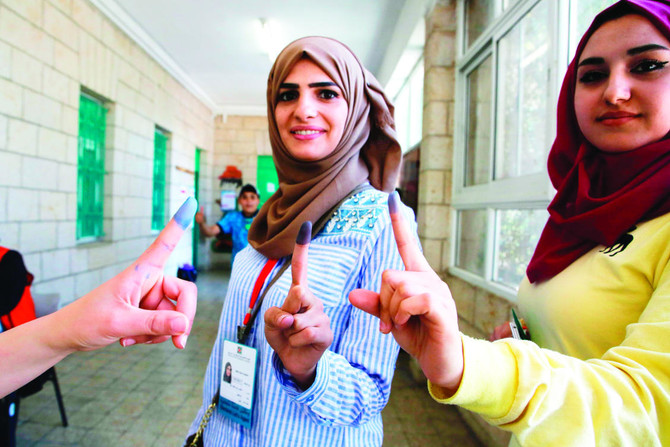
The same can be said about local council elections, held in the West Bank, only, on May 14.
Hamas officially boycotted these elections and so did the Popular Front, so most of the slates were either tribal lists or competing Fatah groups.
According to the Palestinian Independent Elections Commission, 420,682 Palestinians voted out of 787,386 registered voters in 2017 — 53.4 percent, similar to that of 2012.
The May 14 elections were scheduled for Oct. 8, last year, but were postponed by the Palestinian High Court when the Hamas-appointed courts in Gaza invalidated a number of lists that belonged to the competing Fatah movement.
After much deliberation, the court decided that elections would first be held in the West Bank on May 14.
Palestinian government and political officials, as well as the head of the elections commission, called on Hamas to allow the people of Gaza to participate in follow-up municipal elections in Gaza.
Wafa Adel Rahman, a Gazan living in Ramallah, was so upset about the elections not taking place in Gaza that she decided not to vote in her current place of residence, Ramallah.
Abdel Rahman, who runs the non-governmental organization (NGO) Falastinat, a media organization that supports the equitable discourse of youth and women, told Arab News that she decided not to participate in the current elections, because she did not feel it was necessary or urgent.
“At a time when we have not reached a political consensus and the divisions between the West Bank and Gaza have meant that Gaza has been removed from the occasion, plus the prisoners’ strike, I have decided personally not to participate.”
The sentiment is similar in the West Bank’s business capital Nablus.
Kaid Miari, who runs the Shahed think tank, told Arab News that the city witnessed the lowest voting percentage because of a lackluster election campaign and the prisoner strike.
“A coalition list was made up of a mix of pro-Fatah and pro-Hamas figures, and this left very little competition in the elections. Furthermore, the call by the prisoners’ support committee for a postponement of the elections also caused many to stay away.”
Anees Sweidan, an official in the PLO’s Ramallah office, told Arab News that many families of prisoners who are on hunger strike heeded the call to boycott the elections.
“Many stayed away for that reason; a small percentage, 2 percent, actually cast votes with the words hunger strike written on them.”
In some of the other major cities, it seems that the elections were not held on a political basis.
Fatah versus Fatah lists were featured in Ramallah, Hebron and Bethlehem.
In many villages, elections did not take place because there was consensus on the candidates, so there was no reason to hold elections. In addition, Gaza elections were not held in East Jerusalem either.
Palestinian officials have not been able to carry out any election procedure in East Jerusalem, which Israel annexed shortly after the 1967 occupation.
Hazem H. Kawasmi, head of operations in the Municipal Development and Lending Fund in the West Bank, told Arab News that the Palestinian government did not try very hard to have East Jerusalemites participate in these elections.
“We all know that the Palestinian leadership has many cards it could use to force Israel to allow the 330,000 residents of East Jerusalem to participate in the elections,” said Kawasmi.
According to him, the Palestinian government can use the threat of going to the International Court of Justice and to UN agencies if Israel prevents Palestinians in East Jerusalem from participating.
While student councils and municipal elections cannot be used anymore as political barometers of political tendencies in Palestine, they are still seen as important features in the continuity and sustainability of daily life, irrespective of political progress or lack thereof.
For the Palestinian president, holding local elections, whether at universities or for municipal councils, is proof of the democratic nature of the Palestinian leadership, in contrast with the undemocratic tendencies of the Hamas movement in Gaza, which has not allowed any sort of elections.
What most Palestinians want, of course, is the renewal of parliamentary and presidential elections.
The last time President Mahmoud Abbas was elected was in 2005, and the last time Palestinians participated in legislative elections (in which East Jerusalemites and Gazans participated ) was in 2006.
Since then, these important general elections have not taken place and in the meantime different groups came to be in charge of the West Bank and Gaza.
Abbas, who won the presidential election, and his government are in firm control of the West Bank, while in Gaza, Hamas, whose followers won the parliamentary elections in 2006, refuse to recognize Abbas’ authority and created a renegade regime.
All attempts at reconciliation and agreements signed between Fatah and Hamas include the need to hold new elections as the best way to resolve differences.
Neither the student council elections at Birzeit University, in which Hamas sympathizers received the highest votes, nor the municipal elections in the West bank, in which pro-Fatah names won in most locations, will do much to break the larger logjam.
Until general elections take place in all of the occupied territories, including Gaza and East Jerusalem, with all political groups participating, the fractured nature of Palestinian politics will continue.


![]()

Palestinian elections fail to provide political answers
Palestinian elections fail to provide political answers
Freezing rain floods Gaza camps
- Over the weekend, tents in Khan Younis were soaked, leaving families struggling to stay dry
- At least 12 people have died from hypothermia or building collapses since December 13
KHAN YOUNIS, Gaza: Rain lashed the Gaza Strip over the weekend, flooding makeshift encampments with ankle-deep puddles as Palestinians displaced by the two-year war attempted to stay dry in tents frayed by months of use.
Muddy water soaked blankets and mattresses in tents in a camp in Khan Younis and fragile shelters were propped up with old pieces of wood. Children wearing flip-flops and light clothing ill-suited for winter waded through the freezing puddles, which turned dirt roads into rivers. Some people used shovels to try to push the water out of their tents.
Nowhere to escape the rain
“We drowned last night,” said Majdoleen Tarabein, a woman displaced from Rafah in southern Gaza. “Puddles formed, and there was a bad smell. The tent flew away. We don’t know what to do or where to go.”
She showed blankets and the remaining contents of the tent, completely soaked and covered in mud, as she and family members tried to wring them dry by hand.
“When we woke up in the morning, we found that the water had entered the tent,” said Eman Abu Riziq, also displaced in Khan Younis, as she pointed to a puddle just outside. “These are the mattresses — they are all completely soaked. My daughters’ belongings were soaked. The water is entering from here and there,” she said, gesturing toward the ceiling and the corners of the tent. Her family is still reeling from her husband’s recent death, and the constant struggle to stay dry in the winter rains.
At least 12 people, including a 2-week-old infant, have died since Dec. 13 from hypothermia or weather-related collapses of war-damaged homes, according to Gaza’s Health Ministry, part of the Hamas-run government.
Emergency workers warned people not to stay in damaged buildings because they could collapse at any moment. But so much of the territory reduced to rubble, there are few places to escape the rain. In July, the United Nations Satellite Center estimated that almost 80 percent of the buildings in Gaza have been destroyed or damaged.
Since a ceasefire between Israel and Hamas went into effect on Oct. 11, 414 people have been killed and 1,142 wounded in Gaza, according to the Health Ministry. The overall Palestinian death toll from the war has risen to at least 71,266. The ministry, which does not distinguish between militants and civilians in its count, is staffed by medical professionals and maintains detailed records viewed as generally reliable by the international community.
More shelter desperately needed in Gaza as aid falls short
Aid deliveries into Gaza are falling far short of the amount called for under the US-brokered ceasefire, according to an Associated Press analysis of the Israeli military’s figures. The Israeli military body in charge of humanitarian aid said in the past week that 4,200 trucks full of humanitarian aid entered Gaza, plus eight garbage trucks to assist with sanitation, as well as tents and winter clothing as part of the winterization efforts. But it refused to elaborate on the number of tents. Humanitarian aid groups have said the need far outstrips the number of tents that have entered.
Since the ceasefire began, approximately 72,000 tents and 403,000 tarps have entered, according to the Shelter Cluster, an international coalition of aid providers led by the Norwegian Refugee Council.
“Harsh winter weather is compounding more than two years of suffering. People in Gaza are surviving in flimsy, waterlogged tents and among ruins. There is nothing inevitable about this. Aid supplies are not being allowed in at the scale required,” Philippe Lazzarini, the commissioner-general of the top UN group overseeing aid in Gaza, wrote on X.
Netanyahu travels to Washington for talks about second stage of ceasefire
Israeli Prime Minister Benjamin Netanyahu traveled to Washington to meet with US President Donald Trump in Florida about the second stage of the ceasefire. Netanyahu is expected to meet with Trump at Mar-a-Lago on Monday.
Though the ceasefire agreement has mostly held over the past 2 1/2 months, its progress has slowed. Israel has said it refuses to move on to the next stage of the ceasefire while the remains of the final hostage killed in the attack on Oct. 7, 2023, that sparked the war are still in Gaza. Challenges in the next phase of the ceasefire include the deployment of an international stabilization force, a technocratic governing body for Gaza, the disarmament of Hamas and further Israeli troop withdrawals from the territory.
Both Israel and Hamas have accused each other of truce violations.
Muddy water soaked blankets and mattresses in tents in a camp in Khan Younis and fragile shelters were propped up with old pieces of wood. Children wearing flip-flops and light clothing ill-suited for winter waded through the freezing puddles, which turned dirt roads into rivers. Some people used shovels to try to push the water out of their tents.
Nowhere to escape the rain
“We drowned last night,” said Majdoleen Tarabein, a woman displaced from Rafah in southern Gaza. “Puddles formed, and there was a bad smell. The tent flew away. We don’t know what to do or where to go.”
She showed blankets and the remaining contents of the tent, completely soaked and covered in mud, as she and family members tried to wring them dry by hand.
“When we woke up in the morning, we found that the water had entered the tent,” said Eman Abu Riziq, also displaced in Khan Younis, as she pointed to a puddle just outside. “These are the mattresses — they are all completely soaked. My daughters’ belongings were soaked. The water is entering from here and there,” she said, gesturing toward the ceiling and the corners of the tent. Her family is still reeling from her husband’s recent death, and the constant struggle to stay dry in the winter rains.
At least 12 people, including a 2-week-old infant, have died since Dec. 13 from hypothermia or weather-related collapses of war-damaged homes, according to Gaza’s Health Ministry, part of the Hamas-run government.
Emergency workers warned people not to stay in damaged buildings because they could collapse at any moment. But so much of the territory reduced to rubble, there are few places to escape the rain. In July, the United Nations Satellite Center estimated that almost 80 percent of the buildings in Gaza have been destroyed or damaged.
Since a ceasefire between Israel and Hamas went into effect on Oct. 11, 414 people have been killed and 1,142 wounded in Gaza, according to the Health Ministry. The overall Palestinian death toll from the war has risen to at least 71,266. The ministry, which does not distinguish between militants and civilians in its count, is staffed by medical professionals and maintains detailed records viewed as generally reliable by the international community.
More shelter desperately needed in Gaza as aid falls short
Aid deliveries into Gaza are falling far short of the amount called for under the US-brokered ceasefire, according to an Associated Press analysis of the Israeli military’s figures. The Israeli military body in charge of humanitarian aid said in the past week that 4,200 trucks full of humanitarian aid entered Gaza, plus eight garbage trucks to assist with sanitation, as well as tents and winter clothing as part of the winterization efforts. But it refused to elaborate on the number of tents. Humanitarian aid groups have said the need far outstrips the number of tents that have entered.
Since the ceasefire began, approximately 72,000 tents and 403,000 tarps have entered, according to the Shelter Cluster, an international coalition of aid providers led by the Norwegian Refugee Council.
“Harsh winter weather is compounding more than two years of suffering. People in Gaza are surviving in flimsy, waterlogged tents and among ruins. There is nothing inevitable about this. Aid supplies are not being allowed in at the scale required,” Philippe Lazzarini, the commissioner-general of the top UN group overseeing aid in Gaza, wrote on X.
Netanyahu travels to Washington for talks about second stage of ceasefire
Israeli Prime Minister Benjamin Netanyahu traveled to Washington to meet with US President Donald Trump in Florida about the second stage of the ceasefire. Netanyahu is expected to meet with Trump at Mar-a-Lago on Monday.
Though the ceasefire agreement has mostly held over the past 2 1/2 months, its progress has slowed. Israel has said it refuses to move on to the next stage of the ceasefire while the remains of the final hostage killed in the attack on Oct. 7, 2023, that sparked the war are still in Gaza. Challenges in the next phase of the ceasefire include the deployment of an international stabilization force, a technocratic governing body for Gaza, the disarmament of Hamas and further Israeli troop withdrawals from the territory.
Both Israel and Hamas have accused each other of truce violations.
Latest updates


© 2025 SAUDI RESEARCH & PUBLISHING COMPANY, All Rights Reserved And subject to Terms of Use Agreement.