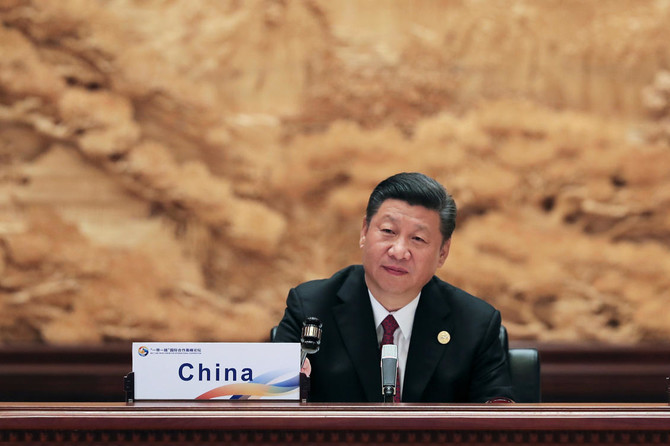
BEIJING: Chinese President Xi Jinping on Monday urged major multilateral institutions to join his new Belt and Road Initiative, stressing the importance of rejecting protectionism in seeking global economic growth.
Addressing other world leaders at a summit on the initiative in Beijing, Xi said it was necessary to coordinate policies with the development goals of institutions including the Asia-Pacific Economic Cooperation (APEC), ASEAN, African Union and the European Union.
Xi pledged $124 billion on Sunday for his new Silk Road which aims to bolster China’s global leadership ambitions by expanding links between Asia, Africa, Europe and beyond, as US President Donald Trump promotes “America First.”
“We need to improve policy coordination and reject beggar-thy-neighbor practices,” Xi said on Monday.
“This is an important lesson that can be drawn from the global financial crisis and is still very relevant to the development of the world economy today,” he said.
“We need to seek win-win results through greater openness and cooperation, avoid fragmentation, refrain from setting inhibitive thresholds for cooperation or pursuing exclusive arrangements and reject protectionism.”
The Belt and Road initiative is seen as part of China’s answer to the Trans-Pacific Partnership (TPP) deal, a regional trade pact involving Pacific Rim countries, but excluding China.
The TPP, touted by the previous US administration of President Barack Obama, has effectively been killed by Trump, who has withdrawn US support.
In contrast, Xi said China’s Belt and Road plan would be inclusive and open to all. He said deep-seated problems in global development had yet to be addressed effectively, with international trade and investment sluggish, and economic globalization encountering headwinds.
“In a world of growing interdependency and challenges, no country can tackle the challenges, also the world’s problems, on its own,” Xi said.
Leaders from 29 countries attended the Belt and Road forum, as well as the heads of the United Nations, International Monetary Fund and World Bank.
But some Western diplomats have expressed unease about both the summit and the plan as a whole, seeing it as an attempt to promote Chinese influence globally. They are also concerned about transparency and access for foreign firms to the scheme.


![]()
China’s Xi says Belt and Road needs to reject protectionism
China’s Xi says Belt and Road needs to reject protectionism
Latest updates


© 2026 SAUDI RESEARCH & PUBLISHING COMPANY, All Rights Reserved And subject to Terms of Use Agreement.