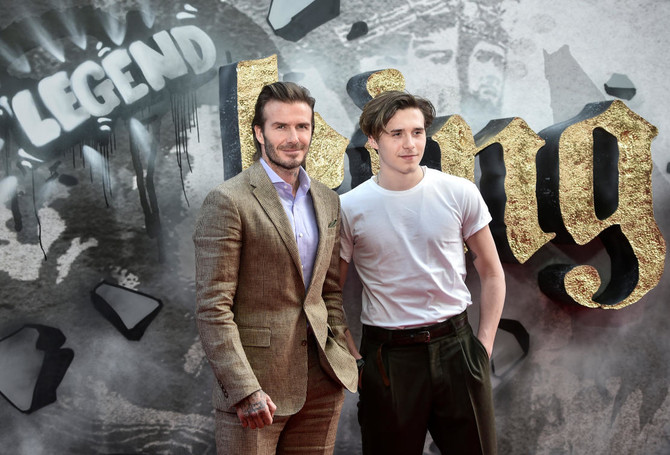
David Beckham ‘great on screen’ — Guy Ritchie

David Beckham and his son Brooklyn pose at the European premiere of “King Arthur: Legend of the Sword” in London, on Wednesday. (AFP)
Updated 12 May 2017
Follow

David Beckham ‘great on screen’ — Guy Ritchie

LONDON: David Beckham has received some scathing reviews in the British press for his cameo in the film “King Arthur: Legend of the Sword,” but director Guy Ritchie has given the former soccer star the thumbs up for his performance.
“I love him and I think he’s great on screen. I find him very talented,” Ritchie told Reuters at the film’s European premiere, when asked if Beckham had the potential to be as good at acting as at soccer.
Ritchie’s take on the medieval legend follows King Arthur, played by Charlie Hunnam, who is robbed of his birthright and has a tough upbringing. But once he pulls the Excalibur sword from the stone, he is forced to acknowledge his true legacy.
Beckham, the former Manchester United and Real Madrid midfielder known for his bending kicks, plays the soldier Trigger in the sword-pulling scene.
Beckham “shows just about enough dramatic range to have played the stone the sword got stuck in,” The Telegraph said in its review, adding that he had “sabotaged” the scene.
“It’s a misguided, fist-biter of a performance,” Empire said.
Beckham, who also had a cameo in Ritchie’s previous movie, “The Man from U.NC.L.E.,” said it was “nice to be involved” in the film.
“I think people are going to love it. You know obviously with Guy’s movies you know what you’re going to get but there’s a few surprises, a bit of comedy along the way,” said Beckham, who attended the premiere with his son Brooklyn.
Hunnam, of “Sons of Anarchy” fame, said he had to convince Ritchie to let him audition for the role.


Judge declares 4 men wrongly accused of 1991 Austin yogurt shop murders innocent

Updated 19 February 2026
Follow

Judge declares 4 men wrongly accused of 1991 Austin yogurt shop murders innocent

  • The declaration was aimed at closing a dark chapter for the men and their families
  • Investigators chased thousands of leads and several false confessions before the four men were arrested in late 1999

TEXAS, USA: A Texas judge on Thursday declared four men who were wrongfully accused of the 1991 Austin yogurt shop murders innocent, formally clearing their names in a courtroom for the first time since the killings of four teenage girls that haunted the city for decades.
“You are innocent,” state District Judge Dayna Blazey said during a hearing in a packed Austin courtroom.
The declaration was aimed at closing a dark chapter for the men and their families, and for a city that was shaken by the brutality of the crime and investigators’ inability to solve it for decades. Blazey called her order “an obligation to the rule of law and the obligation to the dignity of the individual.”
Cold case detectives announced last year that they had connected the killings to a suspect who died in a 1999 standoff with police in Missouri.
Two of the original four suspects, Michael Scott and Forrest Welborn, were in the packed courtroom with family members to hear prosecutors tell the judge that they are innocent. Robert Springsteen, who was initially convicted and spent several years on death row, did not attend. Maurice Pierce died in 2010.
“Over 25 years ago, the state prosecuted four innocent men ... (for) one of the worst crimes Austin has ever seen,” Travis County First Assistant District Attorney Trudy Strassburger said at the opening of the hearing. “We could not have been more wrong.”
A declaration of “actual innocence” would also be a key step for the men and their families to seek financial compensation for years they spent in jail or in prison.
“All four lived under the specter of the yogurt shop murders. These four never had the chance to live normal lives,” Strassburger said.
The murders shocked Austin and confounded investigators for years
Amy Ayers, 13; Eliza Thomas, 17; and sisters Jennifer and Sarah Harbison, ages 17 and 15, were bound, gagged and shot in the head at the “I Can’t Believe It’s Yogurt” store where two of them worked. The building was set on fire.
Investigators chased thousands of leads and several false confessions before the four men were arrested in late 1999.
Springsteen and Scott were convicted based largely on confessions they insisted were coerced by police. Both convictions were overturned in the mid-2000s.
Welborn was charged but never tried after two grand juries refused to indict him. Pierce spent three years in jail before the charges were dismissed and he was released.
Prosecutors wanted to try Springsteen and Scott again, but a judge ordered the charges dismissed in 2009 when new DNA tests that were unavailable in 1991 had revealed another male suspect.
“Let us not forgot that Robert Springsteen could be dead right now, executed at the hands of the state of Texas,” Springsteen attorney Amber Farrelly said at the hearing.
Connection to a new suspect revealed
The case effectively went cold until 2025. It got new public attention when an HBO documentary series explored the unsolved crime.
Investigators announced in September that new evidence and reviews of old evidence pointed to Robert Eugene Brashers as the killer.
Since 2018, authorities had used advanced DNA evidence to link Brashers to the strangulation death of a South Carolina woman in 1990, the 1997 rape of a 14-year-old girl in Tennessee and the shooting of a mother and daughter in Missouri in 1998.
The link to the Austin case came when a DNA sample taken from under Ayers’ fingernail came back as a match to Brashers from the 1990 murder in South Carolina.
Austin investigators also found that Brashers had been arrested at a border checkpoint near El Paso two days after the yogurt shop killings. In his stolen car was a pistol that matched the same caliber used to kill one of the girls in Austin.
Police also noted similarities in the yogurt shop case to Brashers’ other crimes: The victims were tied up with their own clothing, sexually assaulted and some crime scenes were set on fire.
Brashers died in 1999 when he shot himself during an hourslong standoff with police at a motel in Kennett, Missouri.