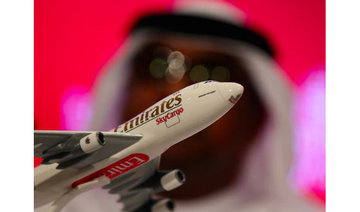
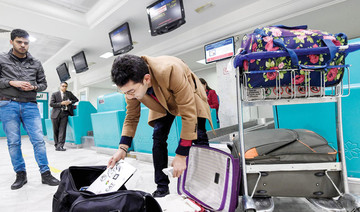
MONTREAL/PARIS: A UN agency has launched an effort to craft global guidance for the use of laptops and other portable electronics in passenger aircraft cabins after selective bans by the US and Britain upset airline passengers as well as Middle Eastern carriers.
The International Civil Aviation Organization (ICAO) met on Tuesday to debate the issue after the UAE, Egypt and other countries complained their airlines had been unduly penalized by the decision to relegate laptops to the cargo hold on some flights due to security concerns, three sources familiar with the matter said.
But while ICAO aims to come up with global recommendations to counter the risk from hidden explosives in laptops, the agency cannot override or prevent national measures such as the US and UK bans, said one of the aviation industry sources, who spoke on condition of anonymity because the talks are private.
In March, the US announced laptop restrictions on flights originating from 10 airports in countries including the UAE, Qatar and Turkey. Britain quickly followed suit with restrictions on a slightly different set of routes.
An ICAO working paper seen by Reuters threw its weight behind concerns that laptops are a greater security risk in the passenger cabin than in the hold, because of the threat that hidden explosives could be detonated manually.
“The threat to aircraft from concealed improvised explosive devices has been the greatest security risk to commercial aircraft for some years,” it warned.
But ICAO has also asked its experts to weigh this against the safety risk of storing a larger number of flammable batteries unattended in a commercial aircraft’s baggage compartment.
European regulators have warned placing what could be hundreds of devices in the hold on long-haul flights could compromise safety by increasing the risk of fire from poorly deactivated lithium-ion batteries.
Patrick Ky, the head of the European Aviation Safety Agency told Reuters that it wants airlines to be careful about how they store laptops by avoiding placing them in a single container, for example.
“Should we go further? I don’t think so for the time being. But in case we have a fire risk that we think is high, then of course we would take the necessary actions,” Ky added.
ICAO’s aviation security panel is expected to make recommendations by mid-June, an ICAO spokesman said.
ICAO, which is headquartered in Montreal, does not impose binding rules, but wields clout through safety and security standards that are usually followed by its 191-member countries.
ICAO has been asked “to identify a possible global approach to mitigate the security risk associated with large portable electronic devices,” according to the paper.
Some countries, such as Australia, are introducing new security checks, but not bans, on flights from specific Middle East countries to combat the risk of hidden bombs.
During an informal ICAO briefing in April, some countries including the UAE complained that the ban risks creating “market distortions,” the three sources said.
The ban is seen as a problem for fast-growing Gulf airlines serving business-class passengers, who want to work on their laptops on flights out of key hubs like Dubai and Doha.
But aviation and security sources have largely dismissed reports that the partial bans are a form of protectionism against the Gulf carriers, saying they are based on concrete security concerns. UAE regulators could not be reached for comment.

UN aviation agency seeks global approach to laptop ban
Moderate candidate wins emphatically over a populist in Portugal’s presidential runoff
LISBON: Center-left Socialist candidate António José Seguro recorded a thumping victory over hard-right populist André Ventura in Portugal’s runoff presidential election Sunday, according to official results with 99 percent of votes counted.
Seguro won a five-year term in Lisbon’s riverside “pink palace” with 66.7 percent of votes, compared with 33.3 percent for Ventura.
The ballot was an opportunity to test the depth of support for Ventura’s brash style, which has struck a chord with voters and helped make his Chega (Enough) party the second-biggest in the Portuguese parliament, as well as gauge the public appetite for Europe’s increasing shift to the right in recent years.
European Commission President Ursula von der Leyen congratulated Seguro and said on social media that “Portugal’s voice for our shared European values remains strong.”
Seguro, a longstanding Socialist politician, positioned himself as a moderate candidate who will cooperate with Portugal’s center-right minority government, repudiating Ventura’s anti-establishment and anti-immigrant tirades.
He won the backing of other mainstream politicians on the left and right who want to halt the rising populist tide.
In Portugal, the president is largely a figurehead with no executive power. Traditionally, the head of state stands above the political fray, mediating disputes and defusing tensions.
However, the president is an influential voice and possesses some powerful tools, being able to veto legislation from parliament, although the veto can be overturned. The head of state also possesses what in Portuguese political jargon is called an “atomic bomb,” the power to dissolve parliament and call early elections.
In May, Portugal held its third general election in three years in the country’s worst bout of political instability for decades, and steadying the ship is a key challenge for the next president.
Ventura, an eloquent and theatrical politician, rejected political accommodation in favor of a more combative stance.
Ventura said he will keep working to bring about a political “transformation” in Portugal.
“I tried to show there’s a different way … that we needed a different kind of president,” he told reporters.
Making it through to the runoff was already a milestone for Ventura and his party, which have recalibrated Portuguese politics.
One of Ventura’s main targets has been what he calls excessive immigration, as foreign workers have become more conspicuous in Portugal in recent years.
“Portugal is ours,” he said.
During the campaign, Ventura put up billboards across the country saying, “This isn’t Bangladesh” and “Immigrants shouldn’t be allowed to live on welfare.”
Although he founded his party less than seven years ago, its surge in public support made it the second-largest party in Portugal’s parliament in the May 18 general election.
Seguro will next month replace center-right President Marcelo Rebelo de Sousa, who has served the constitutional limit of two five-year terms.
Seguro won a five-year term in Lisbon’s riverside “pink palace” with 66.7 percent of votes, compared with 33.3 percent for Ventura.
The ballot was an opportunity to test the depth of support for Ventura’s brash style, which has struck a chord with voters and helped make his Chega (Enough) party the second-biggest in the Portuguese parliament, as well as gauge the public appetite for Europe’s increasing shift to the right in recent years.
European Commission President Ursula von der Leyen congratulated Seguro and said on social media that “Portugal’s voice for our shared European values remains strong.”
Seguro, a longstanding Socialist politician, positioned himself as a moderate candidate who will cooperate with Portugal’s center-right minority government, repudiating Ventura’s anti-establishment and anti-immigrant tirades.
He won the backing of other mainstream politicians on the left and right who want to halt the rising populist tide.
In Portugal, the president is largely a figurehead with no executive power. Traditionally, the head of state stands above the political fray, mediating disputes and defusing tensions.
However, the president is an influential voice and possesses some powerful tools, being able to veto legislation from parliament, although the veto can be overturned. The head of state also possesses what in Portuguese political jargon is called an “atomic bomb,” the power to dissolve parliament and call early elections.
In May, Portugal held its third general election in three years in the country’s worst bout of political instability for decades, and steadying the ship is a key challenge for the next president.
Ventura, an eloquent and theatrical politician, rejected political accommodation in favor of a more combative stance.
Ventura said he will keep working to bring about a political “transformation” in Portugal.
“I tried to show there’s a different way … that we needed a different kind of president,” he told reporters.
Making it through to the runoff was already a milestone for Ventura and his party, which have recalibrated Portuguese politics.
One of Ventura’s main targets has been what he calls excessive immigration, as foreign workers have become more conspicuous in Portugal in recent years.
“Portugal is ours,” he said.
During the campaign, Ventura put up billboards across the country saying, “This isn’t Bangladesh” and “Immigrants shouldn’t be allowed to live on welfare.”
Although he founded his party less than seven years ago, its surge in public support made it the second-largest party in Portugal’s parliament in the May 18 general election.
Seguro will next month replace center-right President Marcelo Rebelo de Sousa, who has served the constitutional limit of two five-year terms.
© 2026 SAUDI RESEARCH & PUBLISHING COMPANY, All Rights Reserved And subject to Terms of Use Agreement.