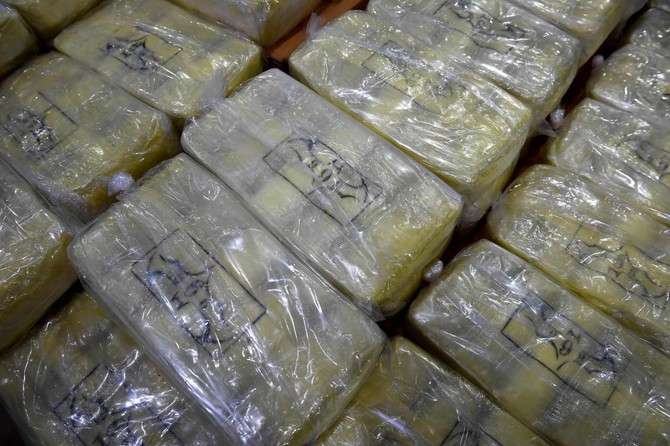
Bangkok: Compared to their ultra-violent Central and Latin American cousins, the drug dealers of Southeast Asia’s Golden Triangle use their low-profile to remain beyond the long arm of the law.
But they control the world’s second largest drug producing region, manufacturing and moving meth and heroin out off hidden labs in a remote, mountainous wedge of land that cuts across Myanmar, Laos, Thailand and China.
A series of recent arrests in Thailand and Laos have shone a rare spotlight on some of the key middlemen pushing product from the Golden Triangle across Asia. Here are a few of them.
The flurry of police action started with the arrest of 50-year-old Laotian Khonpasong in early January.
The was picked up on the way back from a wedding in Laos near the capital Vientiane as a dragnet closed in on drug runners and their associates.
Laos authorities swiftly seized hotels, cash and cars belonging to a man accused of getting rich on the proceeds of meth, sex venues and illegal casinos.
Since his arrest, three networks shuttling drugs from Myanmar through Laos, Thailand and onto Malaysia have been hit by raids and arrests.
Press reports in the tightly-controlled Communist country said officials rejected a $800,000 bribe to release Xiengther and his associates.
Heavily built and tattooed, Xaysana — dubbed “Mr X” by law enforcement officials — was detained on 19 January while transiting through Bangkok’s main airport on his way back home to Laos.
Thai police arrested him in front of TV cameras and stunned travelers.
Investigators in Bangkok accuse Xaysana of running a multi-million dollar drug transport network, ferrying meth, ice and ecstasy pills from the Golden Triangle through Thailand to Malaysia and beyond.
His social media posts pointed to a life of luxury and connections — photographed alongside Thai “hi-so” (high society) celebrities, at a wedding attended by the daughter of Laos’ former prime minister and next to a bevy of supercars.
Some of those Thai celebs are now being probed for allegedly laundering Xaysana’s cash.
Fond of riding thoroughbred horses at his stables on the outskirts of the Laos capital Vientiane, Sisouk has an unlikely profile for a man accused of large-scale drug running.
He is a local Laos celebrity, well-known on the party scene who conducted several television interviews on his love of horses — including one he bought from America for $25,000.
He was arrested in early April after cops linked him to Xaysana, partly through his active social media life.
Sisouk’s Facebook profile revealed a penchant for fast cars, which he sold through his garage in the Laos capital, as well as a proclivity for partying — including with Mr.X.
His garage and stables have been seized.
A Thai national born in the kingdom’s “deep south,” Usman is one of the region’s most wanted drug men.
He is accused of being a key player in the drug chain from Laos to Malaysia.
He has achieved notoriety among drug cops for his ingenuity in avoiding jail, supposedly even faking his own death.
Canny and connected, he has been linked with several major yaba pill seizures.
A 2005 raid on a Bangkok house belonging to him saw an SUV impounded. Four years later police who had been using his vehicle found 10 million baht ($290,000) stashed in rear panels in the vehicle.
Recent police operations may have shaken him from his apparent hideout in Laos, with authorities hinting he could now be in Cambodia, Malaysia or at large in Thailand.
A year ago Thai cops seized nearly 300-kilogrammes of crystal meth in the far south.
Eventually it led them to Thai-based Malaysian Tun Hung Seong, who allegedly headed a network running ice and turning huge drug profits into legitimate businesses.
He was arrested on April 19 this year at Hat Yai airport in the Thai south where he is accused of acting as a gatekeeper to the Malaysian drug market.
The drug money was laundered through a series of business, according to Thai cops, including karaoke bars, restaurants, hotels and bars which circulated up to 1 billion baht ($29 million) in narco-profits at any one time.

The Mekong middlemen running drugs across Asia
Campaigning starts for Bangladesh’s first national election after Hasina’s ouster
- Major political parties hold campaign rallies in the capital, Dhaka, and elsewhere ahead of Feb. 12 election
- Tarique Rahman, the son of former Prime Minister Khaleda Zia, is widely seen as a leading contender for prime minister
DHAKA: Campaigning began Thursday for Bangladesh’s first national elections since the 2024 uprising that ousted longtime Prime Minister Sheikh Hasina.
The major political parties held campaign rallies in the capital, Dhaka, and elsewhere ahead of Feb. 12 election, which is seen as the most consequential in Bangladesh’s history as it follows Hasina’s ouster and is being held under an interim government with voters also deciding on proposed political reforms.
The interim government led by Nobel Peace Prize laureate Muhammad Yunus has pledged to hold a free and fair election, but questions were raised after his administration banned Hasina’s former ruling Awami League party. The Awami League and the Bangladesh Nationalist Party have historically dominated the country’s electorate.
There are also concerns about the country’s law and order situation, but the government says they will keep the voting peaceful.
Yunus assumed office three days after Hasina left the country for India on Aug. 5, 2024, following the deaths of hundreds of protesters and others in a violent crackdown.
With the Awami League excluded from the election, a 10-party alliance led by Jamaat-e-Islami, an Islamist party, is seeking to expand its influence. Jamaat-e-Islami has long faced criticism from secular groups who say its positions challenge Bangladesh’s secular foundations. A new party formed by student leaders of the uprising, the National Citizen Party, or NCP, is also part of the alliance.
Tarique Rahman, BNP chairman and the son of former Prime Minister Khaleda Zia, is widely seen as a leading contender for prime minister. His party has drawn strong support rooted in the political legacy of his mother, who died last month. Rahman returned to Bangladesh last month after 17 years in exile in the United Kingdom.
Rahman is launching his campaign in the northwestern city of Sylhet with an address to a rally later Thursday and is scheduled to visit several other districts in the coming days.
Jamaat-e-Islami and the NCP are set to begin their campaigns in the capital, Dhaka.
The election will also include a referendum on a national charter, with the interim government seeking campaigning for voters to support what it describes as a new political course built on reforms. The charter was signed last year by 25 of the country’s 52 registered political parties. The Awami League opposed the idea and several other parties declined to sign the document.
The July National Charter, named after the uprising that began in July 2024 and led to the fall of Hasina, is currently nonbinding, but the supporters of the charter say a referendum is needed to make it legally binding and a part of the constitution. Only Parliament can change the constitution in Bangladesh.
The interim government says the charter would bring more checks and balances to avoid authoritarian administrations, including by giving the presidency more authority to balance what had been a powerful prime minister position. It also proposes term limits for legislators, and measures to prevent conflicts of interest, money laundering and corruption.
The major political parties held campaign rallies in the capital, Dhaka, and elsewhere ahead of Feb. 12 election, which is seen as the most consequential in Bangladesh’s history as it follows Hasina’s ouster and is being held under an interim government with voters also deciding on proposed political reforms.
The interim government led by Nobel Peace Prize laureate Muhammad Yunus has pledged to hold a free and fair election, but questions were raised after his administration banned Hasina’s former ruling Awami League party. The Awami League and the Bangladesh Nationalist Party have historically dominated the country’s electorate.
There are also concerns about the country’s law and order situation, but the government says they will keep the voting peaceful.
Yunus assumed office three days after Hasina left the country for India on Aug. 5, 2024, following the deaths of hundreds of protesters and others in a violent crackdown.
With the Awami League excluded from the election, a 10-party alliance led by Jamaat-e-Islami, an Islamist party, is seeking to expand its influence. Jamaat-e-Islami has long faced criticism from secular groups who say its positions challenge Bangladesh’s secular foundations. A new party formed by student leaders of the uprising, the National Citizen Party, or NCP, is also part of the alliance.
Tarique Rahman, BNP chairman and the son of former Prime Minister Khaleda Zia, is widely seen as a leading contender for prime minister. His party has drawn strong support rooted in the political legacy of his mother, who died last month. Rahman returned to Bangladesh last month after 17 years in exile in the United Kingdom.
Rahman is launching his campaign in the northwestern city of Sylhet with an address to a rally later Thursday and is scheduled to visit several other districts in the coming days.
Jamaat-e-Islami and the NCP are set to begin their campaigns in the capital, Dhaka.
The election will also include a referendum on a national charter, with the interim government seeking campaigning for voters to support what it describes as a new political course built on reforms. The charter was signed last year by 25 of the country’s 52 registered political parties. The Awami League opposed the idea and several other parties declined to sign the document.
The July National Charter, named after the uprising that began in July 2024 and led to the fall of Hasina, is currently nonbinding, but the supporters of the charter say a referendum is needed to make it legally binding and a part of the constitution. Only Parliament can change the constitution in Bangladesh.
The interim government says the charter would bring more checks and balances to avoid authoritarian administrations, including by giving the presidency more authority to balance what had been a powerful prime minister position. It also proposes term limits for legislators, and measures to prevent conflicts of interest, money laundering and corruption.
© 2026 SAUDI RESEARCH & PUBLISHING COMPANY, All Rights Reserved And subject to Terms of Use Agreement.