ALBI, France: Allegations of fake news and hacking attempts dominated France’s tense presidential campaign Thursday, with just two days left for independent Emmanuel Macron and his far-right rival Marine Le Pen to win over voters before Sunday’s high-stakes runoff.
Paris prosecutors launched a preliminary investigation Thursday into whether fake news is being used to influence the voting, as front-runner Macron and populist Le Pen rallied thousands at their last big campaign events — in opposite parts of the divided country.
There has been intense anxiety in France over the possibility that viral misinformation or hackers could influence the presidential vote, as in the US election last year. Those fears have largely failed to materialize.
Then Thursday, Macron’s campaign filed suit against an unknown source “X” after Le Pen suggested during their only one-on-one debate Wednesday night that the former banker could have an offshore account.
“I hope we won’t find out you have an offshore account in the Bahamas,” Le Pen said.
She appeared to be referring to two sets of apparent forgeries, published just hours before the televised showdown, that purported to show Macron was somehow involved with a Caribbean bank and a firm based on the island of Nevis.
Macron’s camp said the former investment banker was victim of a “cyber-misinformation campaign.” Speaking on France Inter radio, Macron blamed Le Pen for spreading “fake news” and said he never held a bank account “in any tax haven whatsoever.”
“All this is factually inaccurate,” Macron said.
In a subsequent twist, Le Pen’s campaign said a far-left hacker was arrested this week and confessed to repeatedly targeting its website. In a statement Thursday, the campaign gave few details about the seriousness of the interference, which could range from attempts at defacing the website to flooding it with bogus traffic.
Police referred questions to prosecutors, who wouldn’t comment.
Le Pen herself gave a fiery speech in a field in northern France Thursday, with an emotional appeal to desperate farmers, the jobless and the disillusioned.
Painting herself as the “voice of the people,” she said her rival would continue the painful status quo.
Thousands of supporters from far and wide climbed on hay bales and packed onto a field in the northern village of Ennemain to hear her speak, chanting “We love you Marine” and “Marine President!“
Le Pen said she represents “the widow of the farmer who killed himself because he couldn’t stand it anymore ... the company chief” who sees a public bid go to a foreign competitor, and the taxi driver who lost his job to “uberization.”
In each instance she targeted the suffering she wants to heal.
“Don’t let them steal the election,” she warned, summoning voters to join Sunday’s “rendez-vous with history.” The crowd went wild.
Gaelle Vincent, 35, wore a French flag in her hair to hear Le Pen speak.
“People think little villages like us vote National Front because we don’t like Arabs and are racist,” Vincent told The Associated Press. “We’re not racist. We have to preserve our land and our values.”
Macron, meanwhile, was on France’s southern edge in the Pyrenees town of Albi, visiting disgruntled workers Thursday at a glass factory before holding his last campaign rally in which he called on voters from the left and the right to choose his reformist, pro-European platform.
Macron arrived to booing and slogan-shouting from dozens of protesting workers. But after 15 minutes of talking, the 39-year-old front-runner managed to calm some of their anger.
Union leader Michel Parraud called Macron “very kind and very polite,” although he said he didn’t think the pro-business centrist would do much for factory workers.
Macron pledged to “give strength back to the country” and “build a more efficient and fair society,” speaking from an open-air stage in Albi’s central square.
Le Pen’s suggestion that Macron might have an offshore account cuts to the heart of her portrayal of him as an elitist former banker far removed from the people’s worries. She later backed away from the suggestion of an offshore account, but prosecutors launched a probe into suspicions of forgery and the spreading of false news in order to divert votes.
In the alleged documents spread online, the “M” in Macron’s purported signature didn’t match his genuine sign-off, and whoever wrote the documents appeared confused as to whether the firm was a limited company or a limited liability corporation.
Metadata embedded in the document suggest it was created just before being posted online — undermining the anonymous poster’s claim to have circulated the documents to “hundreds of French journalists” who had “all sat on this.”
There are hints tying the faked documents to far-right circles in California. One document purports to have been drawn up under the laws of Nevis but actually draws some of its language from a guide to forming limited liability companies in California. The documents first appeared on Mixtape, a relatively new northern California-based file sharing service.
The Macron campaign identified the first tweet referring to the documents as coming from the Twitter account of Nathan Damigo, a far-right activist and convicted felon based in northern California. Damigo is known on social media for punching a female anti-fascist in the face at a Berkeley protest.
In an exchange on Twitter, Damigo said he had nothing to do with the apparent forgery, saying he “just stumbled upon it and figured it would be interesting to share.”
He added: “I am glad it is now being talked about.”
Macron, meanwhile, got support from across the ocean.
In a message posted Thursday on Macron’s Twitter account, former US President Barack Obama said he was endorsing the centrist candidate “because of how important this election is.”
“I have admired the campaign that Emmanuel Macron has run. He has stood up for liberal values. He put forward the vision for the important role that France plays in Europe and around the world. And he has committed to a better future for French people.”
Obama ended his message with the words “En Marche” — which is the name of Macron’s political movement — and “Vive La France.”
___
Ganley reported from Ennemain, France. Raphael Satter, Samuel Petrequin and Thomas Adamson in Paris contributed.


![]()
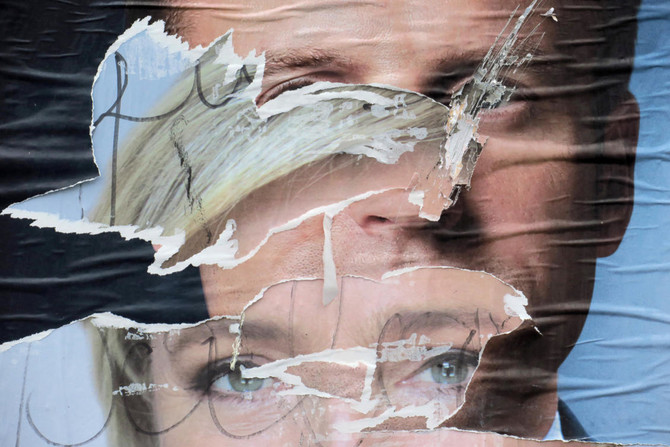
Hacking arrest, fake news in tense French presidential race
Hacking arrest, fake news in tense French presidential race
Latest updates


Recommended


© 2026 SAUDI RESEARCH & PUBLISHING COMPANY, All Rights Reserved And subject to Terms of Use Agreement.