

Trump throws his hat into Mideast peace process ring

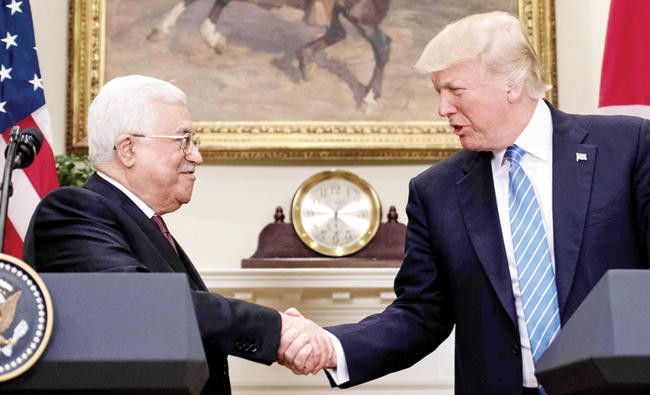
US President Donald Trump and Palestinian President Mahmoud Abbas at the White House Wednesday. (AFP)
Updated 04 May 2017
Follow

Trump throws his hat into Mideast peace process ring

WASHINGTON DC: Walking in the footsteps of many of his predecessors who delved into Israeli-Palestinian peacemaking — but ultimately failed — US President Donald Trump launched Wednesday his own “process which hopefully will lead to peace.”
Trump, striking an optimistic note during his meeting with Palestinian President Mahmoud Abbas, pledged that “we will get this done.”
The Trump-Abbas meeting concluded a series of consultations the new US president held with regional leaders since assuming office. He hopes to resume Israeli-Palestinian negotiations that have been stalled since March 2014.
An analyst, however, pointed to an ever widening gap between the two sides, lowering the chance of any final agreement in the short term.
In statements from the Roosevelt room at the White House flanked by both the American and the Palestinian flags, Trump gave a much-needed boost to Abbas ahead of a working lunch with the delegation. “I want to support you in being the Palestinian leader who signs his name to the final and most important peace agreement that brings safety, stability, and prosperity to both peoples and to the region,” Trump said.
Abbas has been marginalized following the breakdown of talks three years ago. His meeting with Trump, according to former White House official and peace envoy Dennis Ross, gives him “relevance and a boost” on both the Palestinian front and the regional arena.
Ross, a fellow at the Washington Institute for Near East Policy, told reporters that “the gap between the parties has probably never been greater” but not impossible for Trump to overcome with a gradual trust-building approach.
Trump, while sounding hopeful about a peace deal, warned that “any agreement cannot be imposed by the United States... Palestinians and Israelis must work together to reach an agreement.”

The former real estate mogul promised to “do whatever is necessary to facilitate the agreement — to mediate, to arbitrate anything they’d like to do.”
Trump even extended another possible invite to Abbas in “welcoming him back as a great marker of progress and, ultimately, toward the signing of a document with the Israelis and with Israel toward peace.”
Abbas lavished Trump with praise for his leadership on the issue. “I believe that we are capable under your leadership and your stewardship — your courageous stewardship and your wisdom, as well as your great negotiating ability — that we can be partners, true partners, to you to bring about a historic peace treaty,” Abbas said.
Abbas who has been in office since 2005 and was part of two failed US attempts to negotiate peace under George W. Bush and Barack Obama, reiterated the Palestinian principles for peace.
“Our strategic option, our strategic choice is to bring about peace based on the vision of the two-state — a Palestinian state with its capital of East Jerusalem that lives in peace and stability with the state of Israel based on the borders of 1967,” Abbas said.
US Vice President Mike Pence contended ahead of the meeting that the White House is “seriously considering” moving the US Embassy in Israel from Tel Aviv to Jerusalem.
Abbas decried the Israeli occupation, saying “it’s about time for Israel to end its occupation of our people and of our land after 50 years.”
Both leaders avoided mentioning any specifics on the way forward beyond a US push to counter incitement and hate rhetoric from the Palestinian side. Trump concluded his statement challenging the naysayers, and said “let’s see if we can prove them wrong.”
Bangladesh halts controversial relocation of Rohingya refugees to remote island

Updated 29 December 2025
Follow

Bangladesh halts controversial relocation of Rohingya refugees to remote island

  • Administration of ousted PM Sheikh Hasina spent about $350m on the project
  • Rohingya refuse to move to island and 10,000 have fled, top refugee official says

DHAKA: When Bangladesh launched a multi-million-dollar project to relocate Rohingya refugees to a remote island, it promised a better life. Five years on, the controversial plan has stalled, as authorities find it is unsustainable and refugees flee back to overcrowded mainland camps.

The Bhasan Char island emerged naturally from river sediments some 20 years ago. It lies in the Bay of Bengal, over 60 km from Bangladesh’s mainland.

Never inhabited, the 40 sq. km area was developed to accommodate 100,000 Rohingya refugees from the cramped camps of the coastal Cox’s Bazar district.

Relocation to the island started in early December 2020, despite protests from the UN and humanitarian organizations, which warned that it was vulnerable to cyclones and flooding, and that its isolation restricted access to emergency services.

Over 1,600 people were then moved to Bhasan Char by the Bangladesh Navy, followed by another 1,800 the same month. During 25 such transfers, more than 38,000 refugees were resettled on the island by October 2024.

The relocation project was spearheaded by the government of former Prime Minister Sheikh Hasina, who was ousted last year. The new administration has since suspended it indefinitely.

“The Bangladesh government will not conduct any further relocation of the Rohingya to Bhasan Char island. The main reason is that the country’s present government considers the project not viable,” Mizanur Rahman, refugee relief and repatriation commissioner in Cox’s Bazar, told Arab News on Sunday.

The government’s decision was prompted by data from UN agencies, which showed that operations on Bhasan Char involved 30 percent higher costs compared with the mainland camps in Cox’s Bazar, Rahman said.

“On the other hand, the Rohingya are not voluntarily coming forward for relocation to the island. Many of those previously relocated have fled ... Around 29,000 are currently living on the island, while about 10,000 have returned to Cox’s Bazar on their own.”

A mostly Muslim ethnic minority, the Rohingya have lived for centuries in Myanmar’s western Rakhine state but were stripped of their citizenship in the 1980s and have faced systemic persecution ever since.

In 2017 alone, some 750,000 of them crossed to neighboring Bangladesh, fleeing a deadly crackdown by Myanmar’s military. Today, about 1.3 million of them shelter in 33 camps in the coastal Cox’s Bazar district, making it the world’s largest refugee settlement.

Bhasan Char, where the Bangladeshi government spent an estimated $350 million to construct concrete residential buildings, cyclone shelters, roads, freshwater systems, and other infrastructure, offered better living conditions than the squalid camps.

But there was no regular transport service to the island, its inhabitants were not allowed to travel freely, and livelihood opportunities were few and dependent on aid coming from the mainland.

Rahman said: “Considering all aspects, we can say that Rohingya relocation to Bhasan Char is currently halted. Following the fall of Sheikh Hasina’s regime, only one batch of Rohingya was relocated to the island.

“The relocation was conducted with government funding, but the government is no longer allowing any funds for this purpose.”

“The Bangladeshi government has spent around $350 million on it from its own funds ... It seems the project has not turned out to be successful.”