’Baghdaddy’: New York turns Iraq war into musical

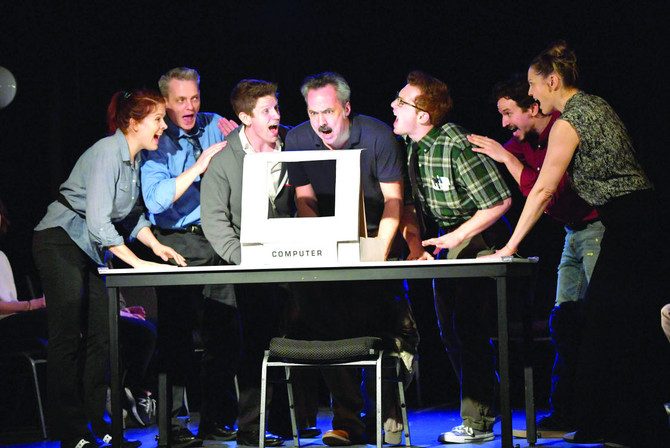
Cast members of the Musical comedy Baghdaddy perform a scene during a dress rehearsal at the St. Luke's Theater in New York. (AFP)
Updated 02 May 2017
Follow

’Baghdaddy’: New York turns Iraq war into musical

NEW YORK: The Iraq war may not sound like musical comedy, but an Off-Broadway revival is spinning intelligence failures and tragedy into a farce that offers potent messages for Donald Trump’s America.
“Baghdaddy” officially opened on Monday, telling the true story of an Iraqi defector, code named Curveball, whose claims about weapons of mass destruction became justification for the US-led invasion in 2003.
“If you put ‘Hamilton’ and ‘The Office’ in a blender you would have this show,” said producer Charlie Fink of the Broadway smash hit about American founding father Alexander and the US television sitcom.
The plot opens in the present day with disgraced CIA spies gathering at a support group — think Spooks Anonymous — as they seek understanding and redemption for mistakes that haunt them years later.
The action then switches back in time to Frankfurt airport, where the informant offers to trade apparent secrets about Saddam Hussein’s presumed bio-weapons program for political asylum.
German intelligence consults the CIA, where analysts driven by ambition, office crushes and intransigent bosses see Curveball as a ticket out of everyday routine and a fast-track to promotion.
But the growing farce quickly gives way to the 9/11 attacks, swapping comedy for tragedy and the onset of a war still being fought today, 14 years after an invasion found no weapons of mass destruction.
It is a fast-paced script woven into a tight score that blends traditional musical theater and camp dancing with hip-hop tracks that carry a stark warning that history should not repeat itself.
Fink said it is more relevant than ever in today’s climate of “fake news” and “alternative facts” as some fear that Trump could drag the country into another conflict, if not in Syria then over North Korea.
“It has an immediacy that it didn’t have in 2015 and a sense that we’re doing this all again,” said Fink, referring to a short run two years ago.
“It feels like a time when rules are being rewritten and authority is listening to its instincts, rather than listening to facts and analysis. And that’s scary,” said Fink.


St. Francis relics go on public show for first time in Italy

Updated 22 February 2026
Follow

St. Francis relics go on public show for first time in Italy

Assisi, Italy: Saint Francis of Assisi’s skeleton is going on public display from Sunday for the first time for the 800th anniversary of his death, drawing hundreds of thousands of visitors.
Inside a nitrogen-filled plexiglass case with the Latin inscription “Corpus Sancti Francisci” (The Body of St. Francis), the remains are being shown in the Italian hill town’s Basilica of St. Francis of Assisi.
St. Francis, who died on October 3, 1226, founded the Franciscan order after renouncing his wealth and devoting his life to the poor.
Giulio Cesareo, director of communications for the Franciscan convent in Assisi said he hoped the display could be “a meaningful experience” for believers and non-believers alike.
Cesareo, a Franciscan friar, said the “damaged” and “consumed” state of the bones showed that St. Francis “gave himself completely” to his life’s work.
His remains, which will be on display until March 22, were transferred to the basilica built in the saint’s honor in 1230.
But it was only in 1818, after excavations carried out in utmost secrecy, that his tomb was rediscovered.
Apart from previous exhumations for inspection and scientific examination, the bones of Saint Francis have only been displayed once, in 1978, to a very limited public and for just one day.
Usually hidden from view, the transparent case containing the relics since 1978 was brought out on Saturday from the metal coffer in which it is kept, inside his stone tomb in the crypt of the basilica.
The case is itself inside another bullet-proof and anti-burglary glass case.
Surveillance cameras will operate 24 hours a day for added protection of the remains.
St. Francis is Italy’s patron saint and the 800th anniversary commemorations of his death will also see the restoration of an October 4 public holiday in his honor.
The holiday had been scrapped nearly 50 years ago for budget reasons.
Its revival is also a tribute to late pope Francis who took on the saint’s name.
Pope Francis died last year at the age of 88.

‘Not a movie set’

Reservations to see the saint’s remains already amount to “almost 400,000 (people) coming from all parts of the world, with of course a clear predominance from Italy,” said Marco Moroni, guardian of the Franciscan convent.
“But we also have Brazilians, North Americans, Africans,” he added.
During this rather quiet time of year, the basilica usually sees 1,000 visitors per day on weekdays, rising to 4,000 on weekends.
The Franciscans said they were expecting 15,000 visitors per day on weekdays and up to 19,000 on Saturdays and Sundays for the month-long display of the remains.
“From the very beginning, since the time of the catacombs, Christians have venerated the bones of martyrs, the relics of martyrs, and they have never really experienced it as something macabre,” Cesareo said.
What “Christians still venerate today, in 2026, in the relics of a saint is the presence of the Holy Spirit,” he said.
Another church in Assisi holds the remains of Carlo Acutis, an Italian teenager who died in 2006 and who was canonized in September by Pope Leo XIV.
Experts said the extended display of St. Francis’s remains should not affect their state of preservation.
“The display case is sealed, so there is no contact with the outside air. In reality, it remains in the same conditions as when it was in the tomb,” Cesareo said.
The light, which will remain subdued in the church, should also not have an effect.
“The basilica will not be lit up like a stadium,” Cesareo said. “This is not a movie set.”