Syrian photographer highlights migrant odyssey in Milan

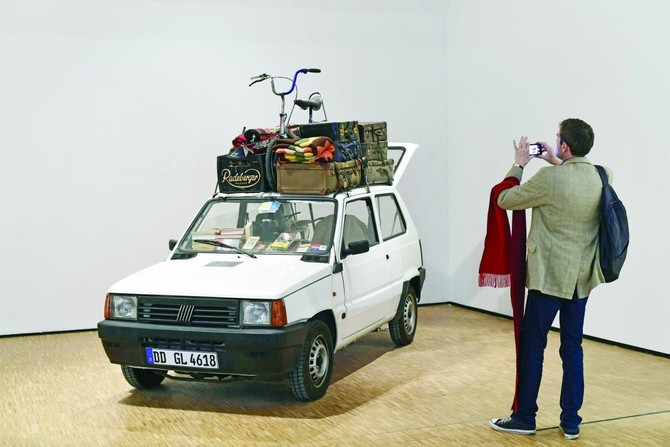
A man takes pictures of the art work called “Nowhere is home” by Syrian artist Manaf Halbouni as part of the exhibition on migrants odissey organized by the Trussardi foundation. (AFP)
Updated 01 May 2017
Follow

Syrian photographer highlights migrant odyssey in Milan

MILAN: An exhibition in Milan is offering through the lens of 65 photographers an original look at the topic of immigration and the migrant crisis.
The Restless Earth, organized by the Nicola Trussardi foundation, is being presented by the Visual Arts Program of Milan’s Triennale (www.triennale.org), the title alluding to works by Caribbean poet Edouard Glissant on how different cultures can live together.
The exhibition with works from photographers from some 40 countries, including Syria and Turkey, is an “exercise in empathy, understanding, inter-cultural dialogue” to facilitate “a future together,” Trussardi said.
Their works are designed to show migrants’ experiences but also hint at perceptions of new arrivals amid the worst refugee crisis Europe has known since World War II.
Italy has been in the front line of the crisis, receiving tens of thousands of migrants attempting the dangerous sea crossing from Libya in vessels that often are barely seaworthy.
Included in the exhibition, which runs through Aug. 20, are 26 powerful images taken by AFP photographer Aris Messinis depicting their hazardous journeys.
Another powerful exhibit is Syrian Manaf Halbouni’s “Nowhere is Home,” comprising a car crammed full of objects to symbolize the transient existence of refugees with nowhere to call their own.
Also throwing into stark relief the human cost of the migrant crisis is an exhibit of passports, damaged mobile phones and other personal items from refugees who drowned off Lampedusa, an island near Sicily where hundreds of Africans drowned when their vessels capsized in 2013.
Milan itself is an industrial economic hub in the north of Italy where the anti-immigrant Northern League has sought to extract political capital from the migrant crisis, a divisive issue across the country.


Arts festival’s decision to exclude Palestinian author spurs boycott

Randa Abdel Fattah. (Photo/Wikipedia)
Updated 12 January 2026
Follow

Arts festival’s decision to exclude Palestinian author spurs boycott

  • A Macquarie University academic who researches Islamophobia and Palestine, Abdel-Fattah responded saying it was “a blatant and shameless act of anti-Palestinian racism and censorship,” with her lawyers issuing a letter to the festival

SYDENY: A top Australian arts festival has seen ​the withdrawal of dozens of writers in a backlash against its decision to bar an Australian Palestinian author after the Bondi Beach mass shooting, as moves to curb antisemitism spur free speech concerns.
The shooting which killed 15 people at a Jewish Hanukkah celebration at Sydney’s Bondi Beach on Dec. 14 sparked nationwide calls to tackle antisemitism. Police say the alleged gunmen were inspired by Daesh.
The Adelaide Festival board said last Thursday it would disinvite Randa ‌Abdel-Fattah from February’s ‌Writers Week in the state of South Australia because “it ‌would not ​be ‌culturally sensitive to continue to program her at this unprecedented time so soon after Bondi.”

FASTFACTS

• Abdel-Fattah responded, saying it was ‘a blatant and shameless act of anti-Palestinian racism and censorship.’

• Around 50 authors have since withdrawn from the festival in protest, leaving it in doubt, local media reported.

A Macquarie University academic who researches Islamophobia and Palestine, Abdel-Fattah responded saying it was “a blatant and shameless act of anti-Palestinian racism and censorship,” with her lawyers issuing a letter to the festival.
Around 50 authors have since withdrawn from the festival in protest, leaving it in doubt, local media reported.
Among the boycotting authors, Kathy Lette wrote on social media the decision to bar Abdel-Fattah “sends a divisive and plainly discriminatory message that platforming Australian Palestinians is ‘culturally insensitive.'”
The Adelaide Festival ‌said in a statement on Monday that three board ‍members and the chairperson had resigned. The ‍festival’s executive director, Julian Hobba, said the arts body was “navigating a complex moment.”

 a complex and ‍unprecedented moment” after the “significant community response” to the board decision.
In the days after the Bondi Beach attack, Jewish community groups and the Israeli government criticized Prime Minister Anthony Albanese for failing to act on a rise in antisemitic attacks and criticized protest marches against Israel’s war in ​Gaza held since 2023.
Albanese said last week a Royal Commission will consider the events of the shooting as well as antisemitism and ⁠social cohesion in Australia. Albanese said on Monday he would recall parliament next week to pass tougher hate speech laws.
On Monday, New South Wales state premier Chris Minns announced new rules that would allow local councils to cut off power and water to illegally operating prayer halls.
Minns said the new rules were prompted by the difficulty in closing a prayer hall in Sydney linked to a cleric found by a court to have made statements intimidating Jewish Australians.
The mayor of the western Sydney suburb of Fairfield said the rules were ill-considered and councils should not be responsible for determining hate speech.
“Freedom ‌of speech is something that should always be allowed, as long as it is done in a peaceful way,” Mayor Frank Carbone told Reuters.