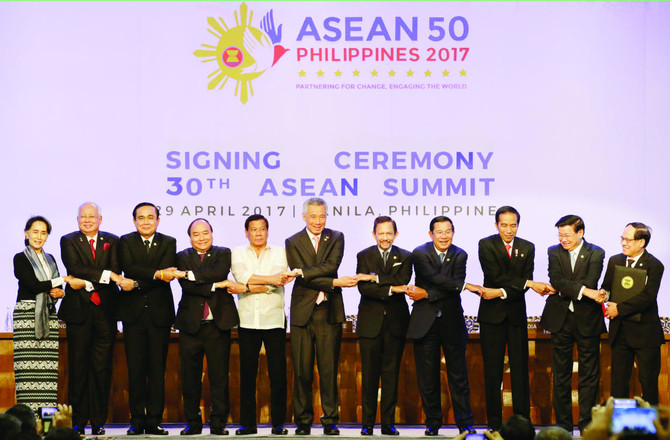
MANILA: Southeast Asian countries have altered a statement to be issued at Saturday’s ASEAN Summit to include references to militarization and island-building in the South China Sea, the latest draft shows, in a move likely to frustrate Beijing.
Chinese Embassy representatives in Manila had sought to influence the content of the communique by lobbying Philippine officials, two ASEAN diplomatic sources told Reuters.
However, four ASEAN member states disagreed with omitting “land reclamation and militarization” — terms included in the statement issued last year in Laos, but not featured in an earlier draft of this year’s statement seen on Wednesday.
China is not a member of the Association of South East Asian Nations, and is not attending the summit. China Embassy officials in Manila could not be reached and China’s Foreign Ministry did not immediately respond to request for comment.
ASEAN references to the South China Sea issue typically do not name China. Beijing is extremely sensitive to anything it perceives as a veiled reference to its expansion of its seven manmade islands in the Spratly archipelago, including with hangers, runways, radars and missiles.
The final version of the statement has yet to be agreed, but changes so far indicate ASEAN is resisting moves by China to keep its contentious activities in the strategic waterway off ASEAN’s official agenda.
China’s lobbying, and its burgeoning friendship with Philippine President Rodrigo Duterte, may not have been enough to influence Manila’s position either.
“The Philippines is under too much pressure,” one of the sources said.
This year’s summit comes at a time of uncertainty about US interests in the region and whether it will maintain its maritime presence to counter China’s assertiveness.
Chinese officials pressed for words that might allude to last year’s international arbitration ruling to be kept out of the statement, the diplomats said, particularly the term “full respect for legal and diplomatic processes.”
The latest draft still includes that, although it was moved out of the South China Sea section to another.
“They do not want any phrase linked to the arbitration case,” one source said.
The Hague ruling, in a case brought by the Philippines in 2013, angered China because it invalidated China’s claim of sovereignty over almost the entire South China Sea. China refuses to recognize the decision.
As part of his engagement with China, Duterte has decided not to press it to abide by the arbitration award anytime soon. On Thursday he said it was pointless for ASEAN to pressure China.
ASEAN and China are hoping to this year agree on a framework to create a code of conduct over the South China Sea, 15 years after committing to draft it. Some ASEAN diplomats doubt China is sincere about agreeing to a set of rules.
In unusually direct comments for an ASEAN Secretary General, Le Luong Minh on Thursday told Reuters the code needed to be legally binding to put a stop to “unilateral actions,” because a previous commitment to play fair had been ignored.


ASEAN firms up S.China Sea stance as Beijing lobbies over statement
ASEAN firms up S.China Sea stance as Beijing lobbies over statement

Starmer and Xi call for deeper UK-China ties as Trump shakes up global relations
- Neither Prime Minister Keir Starmer nor President Xi Jinping publicly mentioned Donald Trump
- But the US president’s challenge to the post-Cold War order was clearly on their minds
BEIJING: The leaders of Britain and China called Thursday for a “strategic partnership” to deepen ties between their nations at a time of growing global turbulence as they sought to thaw relations after years of chill.
Neither Prime Minister Keir Starmer nor President Xi Jinping publicly mentioned Donald Trump, but the US president’s challenge to the post-Cold War order was clearly on their minds.
“I think that working together on issues like climate change, global stability during challenging times for the world is precisely what we should be doing as we build this relationship in the way that I’ve described,” Starmer told Xi at the start of their meeting in Beijing.
The two met for 80 minutes — double the scheduled time — in the Great Hall of the People as their nations try to improve relations after several years of acrimony. Relations have deteriorated over allegations of Chinese spying in Britain, China’s support for Russia in the Ukraine war and the crackdown on freedoms in Hong Kong, the former British colony that was returned to China in 1997. Starmer is the first British prime minister to visit in eight years.
Xi said that “China-UK relations experienced twists and turns in previous years, which was not in the interests of either country.”
“In the current turbulent and ever-changing international situation ... China and the UK need to strengthen dialogue and cooperation to maintain world peace and stability,” he said.
Chinese state broadcaster CCTV said Xi had stressed, without mentioning the US directly, that “major powers” must adhere to international law or the world would regress into a “jungle.”
Relationship is in ‘a good place’
Starmer’s Downing Street office said Britain wanted “a consistent, long-term, and strategic partnership that will benefit both countries.”
After the meeting, Starmer said the leaders had made “really good progress” on issues including slashing Chinese tariffs on Scotch whisky and introducing visa-free travel for British visitors.
“The relationship is in a good place, a strong place,” the British leader said.
Xi appeared to acknowledge the criticism that Starmer has faced for reaching out to China despite national security and human rights concerns. The UK recently approved controversial plans for a huge Chinese Embassy in London, removing a sticking point in relations but also overriding fears that the “mega-embassy” would make it easier for China to conduct espionage and intimidate dissidents.
“Good things often come with difficulties,” Xi said. “As long as it is the right thing to do in accordance with the fundamental interests of the country and its people, leaders will not shy away from difficulties and will forge ahead bravely.”
Starmer’s visit comes less than two months after a Hong Kong court convicted Jimmy Lai, a former newspaper publisher and British citizen, under a national security law that Beijing imposed on the territory after massive pro-democracy protests in 2019.
Starmer said he raised human rights issues with Xi and the two men had a “respectful discussion.”
Starmer, who was elected in July 2024, has said he will protect national security while keeping up diplomatic dialogue and economic cooperation with China. He told Xi that it has “been far too long” since a UK prime minister visited.
“I made a promise 18 months ago when we were elected into government, that I would make Britain face outward again,” the leader of the center-left Labour Party said. “Because as we all know, events abroad affect everything that happens back in our home countries, from prices on the supermarket shelves to how secure we feel.”
Starmer’s government has struggled to deliver the economic growth it promised and ease a cost-of-living crisis for millions of households and he sees China as a potential source of growth.
More than 50 UK business executives have joined him on the trip, along with the leaders of major cultural organizations, as he seeks to expand opportunities for British companies in China and secure Chinese investment in the UK
Trump tariffs spur new trade talks
The disruption to global trade under Trump has made expanding trade and investment more imperative for many governments. Vietnam and the European Union upgraded ties to a comprehensive strategic partnership Thursday, two days after the EU and India announced a free trade accord.
“At a moment when the international rules-based order is under threat from multiple sides, we need to stand side by side as reliable and predictable partners,” European Council President Antonio Costa said in Hanoi, Vietnam.
Starmer is the fourth leader of a US ally to visit Beijing this month, following those of South Korea, Canada and Finland. The German chancellor is expected to visit next month.
The UK leader also met Thursday with Zhao Leji, the chairman of China’s legislature, the National People’s Congress, and Premier Li Qiang, who told Starmer his efforts to improve relations had been “widely welcomed” in both countries.
The two countries were expected to sign a number of agreements. One will try to disrupt the trade in Chinese boat engines used by smugglers to bring people across the English Channel to Britain. More than half the engines come from China, the British government said. Under the agreement, U.K law enforcement agencies will work with Chinese authorities and manufacturers to prevent engines from ending up in the hands of criminal gangs.


