US could speed up North Korea sanctions in response to missile test — official

1 / 2
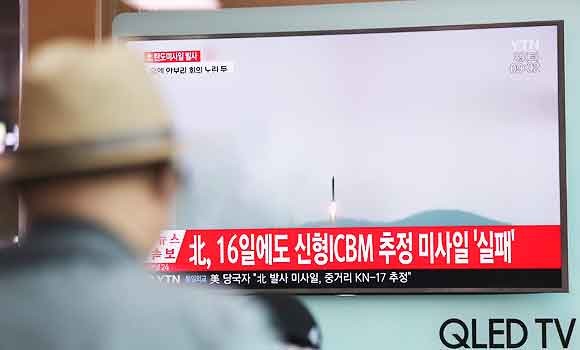
A man watches a TV news program reporting about North Korea's missile firing with a file footage, at Seoul Train Station in Seoul, South Korea, on Saturday. (AP)
2 / 2
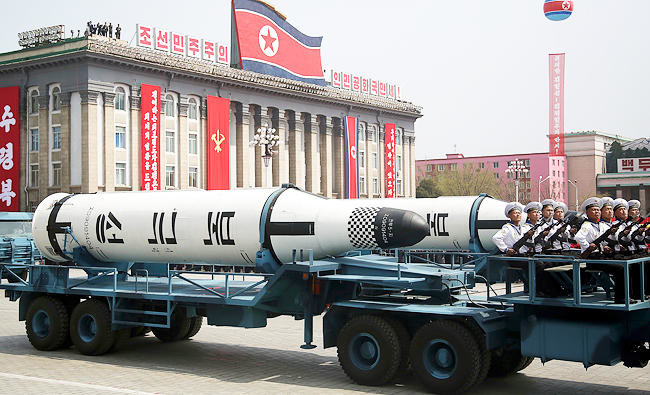
In this April 15, 2017, photo, a submarine-launched ballistic missile is displayed in Kim Il Sung Square during a military parade in Pyongyang, North Korea, to celebrate the 105th birth anniversary of Kim Il Sung, the country's late founder and grandfather of current ruler Kim Jong Un. (AP)
Updated 29 April 2017
Follow

US could speed up North Korea sanctions in response to missile test — official

WASHINGTON: The Trump administration could respond to North Korea’s latest failed missile test by speeding up its plans for new US sanctions against Pyongyang, including possible measures against specific North Korean and Chinese entities, a US official told Reuters on Friday.
With North Korea acting in defiance of pressure from the United States and North Korea’s main ally, China, Washington could also conduct new naval drills and deploy more ships and aircraft in the region as a show of force, the official said, speaking on condition of anonymity.
“It’s possible that something could be sped up,” the official said of the potential for imposing a limited package of targeted sanctions on North Korea. “Something that’s ready to go could be taken from the larger package and expedited.”
The source said the ballistic missile launch was the kind of “provocation” that had been anticipated ahead of South Korea’s May 9 election, and President Donald Trump could use the test-firing to further press China to do more to rein in North Korea.
US officials, speaking on condition of anonymity, said the missile fired from a region north of Pyongyang was probably a medium-range missile known as a KN-17 and appears to have broken up within minutes of taking off.
Should North Korea test-fire an intercontinental ballistic missile as it has threatened, Washington would consider it a more dangerous milestone, the administration official told Reuters, suggesting it would draw a much tougher US response.
The Trump administration is especially worried about Pyongyang’s work to develop a nuclear-tipped missile capable of hitting the United States. Washington is also watching closely for the possibility of North Korea’s sixth nuclear test.
The missile test came just hours after US Secretary of State Rex Tillerson warned the United Nations Security Council that failure to curb North Korea’s nuclear and ballistic missile programs could lead to “catastrophic consequences.”
The official said any new sanctions could be rolled out in coming days and may hit a number of entities that have already been “vetted” by the US government for such measures, while the administration continues crafting a broader sanctions package.
The targets, the official said, could include financial institutions and front companies in North Korea as well as China, which could anger Beijing.
While Trump has praised Chinese President Xi Jinping for signaling increased cooperation on the North Korea issue, the official said Beijing still “needs to draw some sort of line in the sand” with Pyongyang over its nuclear and missile programs.
The military options under active consideration include displays of US power in the region meant to deter North Korea and reassure US allies South Korea, the official said.
But it stops short of pre-emptive US military strikes, which could run the risk of massive North Korean retaliation and huge casualties in Japan and South Korea and among US forces in both countries.


India accelerates free trade agreements against backdrop of US tariffs

Updated 9 sec ago
Follow

India accelerates free trade agreements against backdrop of US tariffs

  • India signed a CEPA with Oman on Thursday and a CETA with the UK in July 
  • Delhi is also in advanced talks for trade pacts with the EU, New Zealand, Chile 

NEW DELHI: India has accelerated discussions to finalize free trade agreements with several nations, as New Delhi seeks to offset the impact of steep US import tariffs and widen export destinations amid uncertainties in global trade. 

India signed a Comprehensive Economic Partnership Agreement with Oman on Thursday, which allows India to export most of its goods without paying tariffs, covering 98 percent of the total value of India’s exports to the Gulf nation. 

The deal comes less than five months after a multibillion-dollar trade agreement with the UK, which cut tariffs on goods from cars to alcohol, and as Indian trade negotiators are in advanced talks with New Zealand, the EU and Chile for similar partnerships. 

They are part of India’s “ongoing efforts to expand its trade network and liberalize its trade,” said Anupam Manur, professor of economics at the Takshashila Institution. 

“The renewed efforts to sign bilateral FTAs are partly an after-effect of New Delhi realizing the importance of diversifying trade partners, especially after India’s biggest export market, the US, levied tariff rates of up to 50 percent on India.” 

Indian exporters have been hit hard by the hefty tariffs that went into effect in August. 

Months of negotiations with Washington have not clarified when a trade deal to bring down the tariffs would be signed, while the levies have weighed on sectors such as textiles, auto components, metals and labor-intensive manufacturing. 

The FTAs with other nations will “help partially in mitigating the effects of US tariffs,” Manur said. 

In particular, Oman can “act as a gateway to other Gulf countries and even parts of Eastern Europe, Central Asia, and Africa,” and the free trade deal will most likely benefit “labor-intensive sectors in India,” he added. 

The chances of concluding a deal with Washington “will prove to be difficult,” said Arun Kumar, a retired economics professor at the Jawaharlal Nehru University.

“With the US, the chances of coming to (an agreement) are a bit difficult, because they want to get our agriculture market open, which we cannot do. They want us to reduce trade with Russia. That’s also difficult for India to do,” he told Arab News.  

US President Donald Trump has threatened sanctions over India’s historic ties with Moscow and its imports of Russian oil, which Washington says help fund Moscow’s ongoing war with Ukraine.

“President Trump is constantly creating new problems, like with H-1B visa and so on now. So some difficulty or the other is expected. That’s why India is trying to build relationships with other nations,” Kumar said, referring to increased vetting and delays under the Trump administration for foreign workers, who include a large number of Indian nationals. 

“Substituting for the US market is going to be tough. So certainly, I think India should do what it can do in terms of promoting trade with other countries.” 

India has free trade agreements with more than 10 countries, including comprehensive economic partnership agreements with South Korea, Japan, and the UAE.

It is in talks with the EU to conclude an FTA, amid new negotiations launched this year for trade agreements, including with New Zealand and Chile.  

India’s approach to trade partnerships has been “totally transformed,” Commerce and Industry Minister Piyush Goyal said in a press briefing following the signing of the CEPA with Oman, which Indian officials aim to enter into force in three months. 

“Now we don’t do FTAs with other developing nations; our focus is on the developed world, with whom we don’t compete,” he said. “We complement and therefore open up huge opportunities for our industry, for our manufactured goods, for our services.”