

Afghan Taliban announce start of ‘spring offensive’

(AFP)
Updated 28 April 2017
Follow

Afghan Taliban announce start of ‘spring offensive’

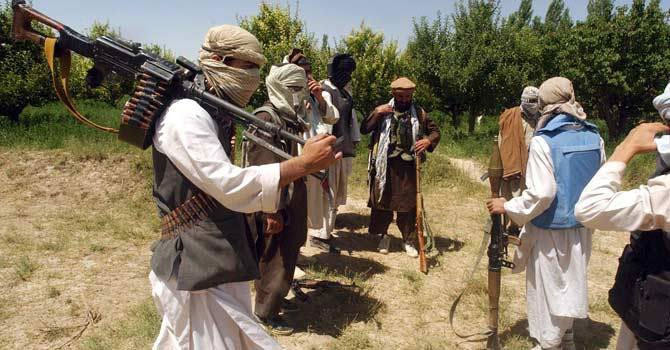
KABUL:The Afghan Taliban launched their “spring offensive” Friday, heralding fresh fighting in the drawn-out conflict as embattled security forces struggle to recover from a devastating attack on a military base one week ago.
Operation Mansouri — named after the group’s former leader, killed in a US drone strike in 2016 — will target foreign forces with “conventional attacks, guerrilla warfare, complex martyrdom attacks, insider attacks,” an insurgent statement said.
“The enemy will be targeted, harassed, killed or captured until they abandon their last posts,” it continued.
The annual spring offensive normally marks the start of the “fighting season,” though this winter the Taliban continued to battle government forces, most successfully in last week’s attack on the military base outside the northern city of Mazar-i-Sharif.
The massacre last Friday saw insurgents armed with guns and suicide bombs slaughter at least 135 young recruits, according to the official toll, though multiple sources have claimed it is much higher.
The assault is believed to be the deadliest by the Taliban on an Afghan military target since they were driven from power in 2001, and fueled fears of insider attacks — when Afghan soldiers and police turn their guns on colleagues or on international troops.
The attackers carried valid passes to the base, security sources said, and were dressed in Afghan army uniforms. The defense minister and army chief have resigned, and at least 35 soldiers have been arrested over the incident.
Already beset by killings, desertions, and struggles over leadership and morale, Afghan forces have been straining to beat back insurgents since US-led NATO troops ended their combat mission in December 2014.
They faced soaring casualties in 2016, up by 35 percent with 6,800 soldiers and police killed, according to a US watchdog.
With more than one third of Afghanistan outside of government control, civilians also continue to bear a heavy brunt, with thousands killed and wounded each year with children paying an increasingly disproportionate price, according to UN figures.
Afghanistan’s Interior Ministry shrugged off the Taliban threats Friday, saying the offensive was “not something new.”
“We will target, kill, defeat and suppress the Taliban... all across the country,” acting ministry spokesman Najib Danish told AFP.
The Taliban statement said they would focus on state-building and “establishing mechanisms for social justice and development” in the areas under their control.
Afghan and international officials have repeatedly called on the Taliban to disarm and join the political process, a call they have so far refused.
Kabul-based analyst Ahmad Saeedi said the insurgents — “emboldened” by government failures — would instead seek more territory this year.
“I believe this will be a difficult year for Afghan security forces, as they will be facing the resilient Taliban’s complex and sophisticated attacks countrywide,” he told AFP.

The Taliban announcement comes days after Pentagon chief Jim Mattis visited Kabul as the Trump administration seeks to craft a new strategy in Afghanistan.
Mattis also warned that 2017 would be “another tough year” for Afghan security forces, but would not be drawn on recent calls by NATO commander in Afghanistan General John Nicholson for “a few thousand” more troops.
The Afghan conflict is the longest in US history — US-led NATO troops have been at war there since 2001, after the ousting of the Taliban regime for refusing to hand over Osama Bin Laden following the 9/11 attacks in the United States.
The US has around 8,400 troops in the country with about another 5,000 from NATO allies.
Earlier this month, the American military dropped its largest non-nuclear bomb on Daesh group hideouts in eastern Afghanistan, killing nearly a hundred militants, according to unverified figures from Afghan officials.
The bombing triggered global shockwaves, but was criticized by observers who questioned its use against a group that is not considered as big a threat as the Taliban.
Some analysts even argued the strike could boost the Taliban, who had been fighting a turf war with IS in Nangarhar province near the border with Pakistan, where the bomb was dropped.
Two US troops were killed Wednesday while fighting IS militants near the blast-site, the Pentagon has said, highlighting the price of its continuing role in the conflict.
Saad Hariri pledges to contest May election

Updated 14 February 2026
Follow

Saad Hariri pledges to contest May election

  • Beirut rally draws large crowds on anniversary of his father’s assassination

BEIRUT: Lebanon’s former Prime Minister Saad Hariri announced on Saturday that his movement, which represents the majority of Lebanon’s Sunni community, would take part in upcoming parliamentary elections scheduled for May.

The Future Movement had suspended its political activities in 2022.

Hariri was addressing a large gathering of Future Movement supporters as Lebanon marked the 21st anniversary of the assassination of his father and former Prime Minister Rafik Hariri, at Martyrs’ Square in front of his tomb.

He said his movement remained committed to the approach of “moderation.”

A minute’s silence was observed by the crowd in Martyrs’ Square at the exact time when, in 2005, a suicide truck carrying about 1,000 kg of explosives detonated along Beirut’s seaside road as Rafik Hariri’s motorcade passed, killing him along with 21 others, including members of his security guards and civilians, and injuring 200 people.

Four members of Hezbollah were accused of carrying out the assassination and were tried in absentia by the Special Tribunal for Lebanon.

The crowd waved Lebanese flags and banners of the Future Movement as they awaited Saad Hariri, who had returned to Beirut from the UAE, where he resides, specifically to commemorate the anniversary, as has been an annual tradition.

Hariri said that “after 21 years, the supporters of Hariri’s approach are still many,” denouncing the “rumors and intimidation” directed at him.

He added: “Moderation is not hesitation … and patience is not weakness. Rafik Hariri’s project is not a dream that will fade. He was the model of a statesman who believed, until martyrdom, that ‘no one is greater than their country.’ The proof is his enduring place in the minds, hearts and consciences of the Lebanese people.”

Hariri said he chose to withdraw from political life after “it became required that we cover up failure and compromise the state, so we said no and chose to step aside — because politics at the expense of the country’s dignity and the project of the state has no meaning.”

He said: “The Lebanese are weary, and after years of wars, divisions, alignments and armed bastions, they deserve a normal country with one constitution, one army, and one legitimate authority over weapons — because Lebanon is one and will remain one. Notions of division have collapsed in the face of reality, history and geography, and the illusions of annexation and hegemony have fallen with those who pursued them, who ultimately fled.”

Hariri said the Future Movement’s project is “One Lebanon, Lebanon first — a Lebanon that will neither slide back into sectarian strife or internal fighting, nor be allowed to do so.”

He added that the Taif Agreement is “the solution and must be implemented in full,” arguing that “political factions have treated it selectively by demanding only what suits them — leaving the agreement unfulfilled and the country’s crises unresolved.”

He said: “When we call for the full implementation of the Taif Agreement, we mean: weapons exclusively in the hands of the state, administrative decentralization, the abolition of political sectarianism, the establishment of a senate and full implementation of the truce agreement. All of this must be implemented — fully and immediately — so we can overcome our chronic problems and crises together.

“Harirism will continue to support any Arab rapprochement, and reject any Arab discord. Those who seek to sow discord between the Gulf and Arab countries will harm only themselves and their reputation.

“We want to maintain the best possible relations with all Arab countries, starting with our closest neighbor, Syria — the new Syria, the free Syria that has rid itself of the criminal and tyrannical regime that devastated it and Lebanon, and spread its poison in the Arab world.”

Hariri said he saluted “the efforts of unification, stabilization and reconstruction led by Syrian President Ahmad Al-Sharaa.”

When asked about the Future Movement’s participation in parliamentary elections following his withdrawal from politics, he said: “Tell me when parliamentary elections will be held, and I will tell you what the Future Movement will do. I promise you that, when the elections take place, they will hear our voices, and they will count our votes.”

The US Embassy in Lebanon shared a post announcing that Ambassador Michel Issa laid a wreath at the grave of Rafik Hariri.

Hariri’s legacy “to forge peace and prosperity continues to resonate years later with renewed significance,” the embassy said.