MOSCOW: Saudi Arabia reiterated Wednesday its stand on the Syrian president, saying that there is no place for Bashar Assad in the country’s future.
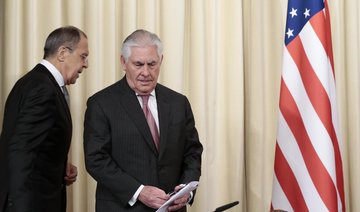
“We do not believe there is a future for Bashar in Syria,” said Saudi Foreign Minister Adel Al-Jubeir during a press conference with his Russian counterpart Sergei Lavrov.
“Assad is responsible for the killing of 300,000 Syrian citizens. He is also to blame for the involvement of the Iranian Revolutionary Guard and Hezbollah in carrying out genocide crimes in Syria,” said the minister.
Al-Jubeir highlighted Riyadh-Moscow coordination regarding the Syrian crisis, confirming that the leaders of both countries are eager to enhance historical ties.
He said there are many obstacles that must be overcome via dialogue and mutual coordination. “I am convinced that there are many opportunities to achieve success,” Al-Jubeir added.
Lavrov said Russia and Saudi Arabia are part of the group of countries supporting Syria. He added that the Syrian crisis was a main point of discussion during his talks with Al-Jubeir.
Al-Jubeir also supported the idea of an international probe into a suspected chemical weapons attack in the town of Khan Sheikhun, but said the Kingdom still believes the Assad regime was behind the strike.
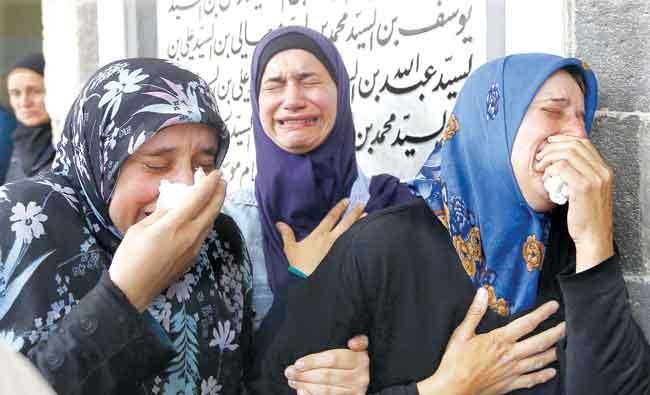
Meanwhile, hundreds of tearful mourners attended a mass funeral Wednesday for loved ones killed in a suicide bombing on a convoy of evacuees, in one of the Syrian war’s most gruesome attacks.
At least 150 people, including 72 children, were killed on April 15 in an explosion targeting evacuees from Foua and Kfraya, two Shiite-majority villages under siege in northwestern Syria.
Women, children and men — some of them in military uniform — began gathering at a mosque from the morning to take part in the funeral procession.
“There’s no worse feeling than this, than burying your sister without being able to see her,” said 19-year-old Abdelsalam Remman, his voice breaking.
He was carrying a poster of his 6-year-old sister Tuqa, who was killed in the attack after being evacuated with their mother, who was wounded.
“Our heart melted until we identified her” among those of the dead several days later, said Remman.
The suicide car bombing in Rashidin, west of Syria’s second city Aleppo, was one of the most devastating attacks of the six-year war that has killed at least 320,000.
It hit a convoy of evacuees from Foua and Kfraya, who had been bussed out of their besieged regime-held villages as part of an evacuation deal that also included two opposition-controlled towns surrounded by the regime.
The attacker appeared to lure children to his vehicle with bags of crisps, according to witnesses. Dozens of unidentified bodies remain at Aleppo’s government hospital, and many survivors said they had relatives who were still missing.
A pained expression on her face, Wafaa Homsi looked at the rows of coffins, one of which held her 13-year-old daughter Raghd.
“My daughter is being buried here. My husband and two of my sons are still missing. We’re waiting to hear something, anything, about them,” Homsi said.
— With input from AFP


![]()
No future for Assad in Syria, reiterates Saudi Arabia
No future for Assad in Syria, reiterates Saudi Arabia


Latest updates




© 2026 SAUDI RESEARCH & PUBLISHING COMPANY, All Rights Reserved And subject to Terms of Use Agreement.