

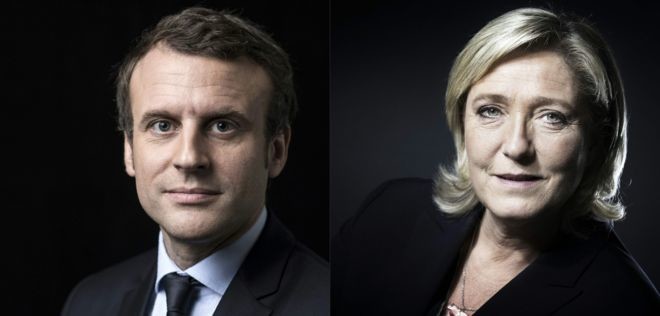
Macron, Le Pen set for French election run-off

Final French vote count puts Macron, Le Pen through to 2nd round. (AFP)
Updated 24 April 2017
Follow

Macron, Le Pen set for French election run-off

PARIS: Pro-European Emmanuel Macron is set to face far-right candidate Marine Le Pen in France’s presidential run-off, results showed Sunday, making him clear favorite to emerge as the country’s youngest leader in its history.
Macron topped Sunday’s first round with 23.7 percent of votes, slightly ahead of National Front (FN) leader Le Pen with 21.9 percent, according to near-final results from the interior ministry.
They will contest the run-off on May 7.
“For months and again today I’ve heard the doubts, the anger and the fears of the French people. Their desire for change too,” 39-year-old Macron told thousands of cheering supporters in Paris.
He pledged to unite “patriots” behind his agenda to renew French politics and modernize the country against Le Pen and “the threat of nationalists.”
The euro rose sharply against the dollar as fears of France pulling out of the single currency and European Union receded following the breakthrough of Macron, former economy minister under outgoing Socialist President Francois Hollande.
An ex-investment banker whose marriage to his former school teacher has fascinated France, Macron said the results were a clear rejection of traditional parties.
Neither candidate from the mainstream Republicans and Socialists made it through to the second round for the first time in six decades in a stunning shakeup of national politics.
“The challenge is to break completely with the system which has been unable to find solutions to the problems of our country for more than 30 years,” Macron said, already eyeing crucial parliamentary elections in June.
The outcome capped an extraordinary campaign in a deeply divided and demoralized France, which has been hit by a series of terror attacks since 2015 and remains stuck with low economic growth.
Le Pen hailed a “historic vote” in front of her supporters, adding: “The first stage has been passed.”
Macron, who had never before stood for election and only started his grassroots centrist movement 12 months ago, will go into the run-off as the clear frontrunner.
New polls released Sunday evening showed pro-business Macron easily beating Le Pen, who has hardened her anti-immigration and anti-Europe rhetoric over the last week.
The French vote was being closely watched as a bellwether for populist sentiment following the election of Donald Trump as US President and Britain’s vote to leave the EU.
Throughout the campaign, Macron insisted France was “contrarian” — ready to elect a pro-globalization liberal at a time when rightwing nationalists are making gains around the world.
“It’s a victory for openness, social-mindedness,” Macron supporter Marie-Helene Visconti, a 60-year-old artist, told AFP at his election party where the EU flag was waved alongside the French tricolore.

Le Pen follows in the footsteps of her father Jean-Marie, who made it through to the 2002 presidential run-off in what came as a political earthquake for France.
Le Pen Senior went on to suffer a stinging defeat when mainstream parties closed ranks to keep him out.
Though Le Pen came in behind Macron, there was joy at the FN’s election party in Henin-Beaumont, a former coal mining town in northern France, with outbursts of the Marseillaise national anthem.
Le Pen said the second round would be a battle over France’s future, with her vision of a France out of the EU and behind reinforced borders radically different from her opponent’s.
“The major issue of this election is runaway globalization, which is putting our civilization in danger,” she told supporters.
“Either we continue on the path of complete deregulation, with no borders and no protection... mass immigration and free movement of terrorists... or you choose France,” she added.
Far-right expert Nonna Mayer at Sciences Po university said a Le Pen victory was not impossible, “but it seems unlikely that she will carry the second round.”
“If she wins, it will obviously be an anti-Europe, protectionist, exclusionist line that wins and which could have troubling consequences for Europe and France,” she added.
Despite Macron’s plans to “relaunch the building of Europe,” the combined scores of staunch euroskeptics Le Pen, far-left Jean-Luc Melenchon and nationalist Nicolas Dupont-Aignan add up to nearly 50 percent.
European Commission chief Jean-Claude Juncker on Sunday congratulated Macron and wished him “good luck.”

Macron also drew immediate support from his defeated rivals from the Socialists and Republicans.
Socialist Benoit Hamon, projected to win a humiliating six percent, said the left had suffered a “historic drubbing” but urged voters to keep out Le Pen who he said was “an enemy of the republic.”
Scandal-hit Republicans candidate Francois Fillon followed suit, saying: “There is no other choice than voting against the far-right.”
Fillon was seen as a favorite until January when his campaign was torpedoed by allegations that he gave his British-born wife a fictitious job as his parliamentary assistant.
He was on course Sunday to score 20 percent.
The former prime minister has accused Hollande of being behind a campaign to destabilize him and said in a concession speech the obstacles he had faced were “too numerous, too cruel.”
Support for Communist-backed Melenchon, meanwhile, had surged in recent weeks on the back of assured performances in two televised debates.
He was on course for around 19.2 percent of the vote, underlining the strength of anti-establishment sentiment.

The vote took place under heavy security after Thursday’s killing of a policeman on Paris’s Champs-Elysees avenue claimed by the Daesh group.
With France still under the state of emergency imposed after the Paris attacks of November 2015, around 50,000 police and 7,000 soldiers were deployed to guard voters.
Thursday’s shooting was the latest in a bloody series of attacks that have cost more than 230 lives since 2015.
Nearly 47 million people were eligible to vote in the eurozone’s second biggest economy and turnout was forecast to be high at around 80 percent. The results will be seen as a credit to French pollsters, who successfully forecast the results.

Stranded travelers scramble to make new connections as war shuts much of Middle East to air travel

Updated 6 sec ago
Follow

Stranded travelers scramble to make new connections as war shuts much of Middle East to air travel

  • Airspace or airports in Israel, Qatar, Syria, Iran, Iraq, Kuwait, Bahrain, Oman and the United Arab Emirates were closed, according to flight tracking sites and government agencies there

DUBAI: Hundreds of thousands of stranded travelers scrambled to make new connections and get through to airlines on jammed phone lines Sunday after the attack on Iran by the United States and Israel shut down much of the Middle East to air travel.
Tourists and business travelers crowded hotels and airports, with no word on when many airports would reopen or when flights to and through the Middle East would resume. Some governments advised their stranded citizens to shelter in place.
Shutdown airports in Dubai, Abu Dhabi and Doha — including Dubai International Airport, one of the busiest in the world — are important hubs for travel between Europe, Africa and the West to Asia. All three were directly hit by strikes.
Mohammad Abdul Mannan, in the crowd at Hazrat Shahjalal International Airport in Dhaka, Bangladesh, said he wasn’t concerned about the war, but that he needs to get his flight to the Middle East to make a living.
“We have set out to go for work, and we must go,” he said. “My only concern is how to go abroad and how to earn an income.”
Confusion reigned for many travelers as they tried to get answers on online portals or through busy phone lines.
In Dubai, stranded travelers could hear fighter jets overhead and an explosion when the Fairmont Palm Hotel was hit by a missile strike.
Many were unable to get updated flight information from tour operators or Dubai-based Emirates, which suspended all flights to and from Dubai until at least Monday afternoon.
Louise Herrle and her husband had their flight to Washington canceled on their way back to their Pittsburgh home after a tour of Dubai and Abu Dhabi, with no word when they could reschedule.
“We’re in the hotel room, we are not leaving it, so you’re not going to give it up until we know we have a flight out of here,” Herrle said. “I’m sure everyone else is in the same situation.”
Flights canceled, airports and airspaces still closed
Cirium, an aviation analytics firm, said it is hard to calculate the number of travelers stranded worldwide.
However, it estimated that at least 90,000 people alone change flights daily in the airports in Dubai, Doha or Abu Dhabi on just three airlines, Emirates, Qatar Airways and Etihad Airways.
Airspace or airports in Israel, Qatar, Syria, Iran, Iraq, Kuwait, Bahrain, Oman and the United Arab Emirates were closed, according to flight tracking sites and government agencies there.
More than 2,800 flights were canceled Sunday to and from airports across the Middle East, including those that remained open in Saudi Arabia, Jordan and Egypt, according figures on flight tracking site FlightAware. International airports in London, Mumbai, Delhi, Bangkok, Istanbul, Sri Lanka and Paris each reported dozens of flights canceled, as well.
Cancellations will extend beyond Sunday, at least.
Emirates suspended all flights to and from Dubai until at least Monday afternoon. Air India suspended all flights to and from the United Arab Emirates, Saudi Arabia, Israel and Qatar until Tuesday. Israeli airline EL AL said it was preparing to fly home Israelis stranded abroad once the airspace reopened and closed ticket sales for flights through March 21 to ensure stranded customers get priority.
Two airports in the United Arab Emirates reported strikes as the government there condemned what it called a “blatant attack involving Iranian ballistic missiles” on Saturday.
Officials at Dubai International Airport said four people were injured, while Zayed International Airport in Abu Dhabi said one person was killed and seven others were injured in a drone strike. Strikes were also reported at Kuwait International Airport.
Iran did not publicly claim responsibility.
Flight disruptions are likely to continue
Airlines urged passengers to check their flight status online before heading to the airport. Some airlines issued waivers to affected travelers that will allow them to rebook their flight plans without paying extra fees or higher fares. Others offered full refunds.
“For travelers, there’s no way to sugarcoat this,” said Henry Harteveldt, an airline industry analyst and president of Atmosphere Research Group. “You should prepare for delays or cancelations for the next few days as these attacks evolve and hopefully end.”
Mike McCormick, who used to oversee air traffic control for the Federal Aviation Administration, said countries might reopen their airspace once American and Israeli officials tell airlines where military flights are operating and how capable Iran remains at firing missiles.
‘No one really knows what’s going on’
The reverberations echoed far outside the Middle East — for example, airport authorities in the resort island of Bali in Indonesia said more than 1,600 tourists were stranded at I Gusti Ngurah Rai International Airport on Sunday after five flights to the Middle East were canceled or postponed.
Airlines that are crossing the Middle East will have to reroute flights around the conflict with many flights headed south over Saudi Arabia. That will cause delays and higher costs.
Kristy Ellmer, an American who had been on business meetings in Dubai, said she was staying in a hotel and keeping multiple flights booked in case airports reopen.
She said she was gaining confidence in the government’s ability to protect the city from missiles, but also keeping away from windows when she hears explosions.
“You hear a lot of explosions at times, there’s hundreds of them,” Ellmer said. “And so when we hear them we sort of just don’t stay near the windows just in case the glass was to break or there was some impact.”