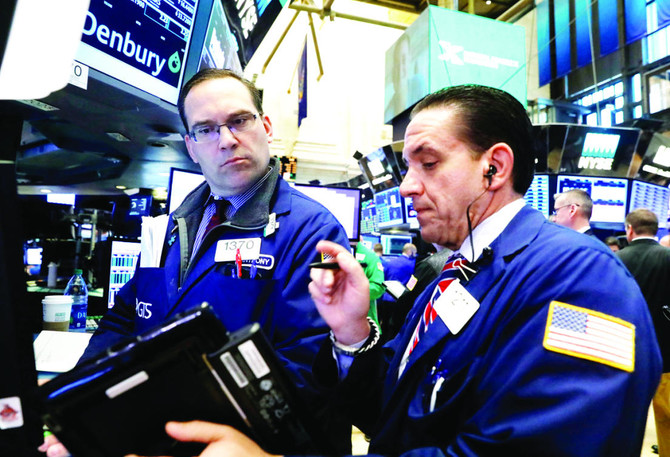
LONDON: Euro zone stock markets mostly trod water Thursday as investors turned their attention to the upcoming French presidential election, while Wall Street opened on a firmer footing on the back of a raft of corporate earnings reports, traders said.
Around 1350 GMT, London’s benchmark FTSE 100 index was barely changed, recovering slightly from a weaker start to the session induced by the strong pound.
Frankfurt’s DAX 30 index was also steady, while the Paris CAC 40 added more than 1.2 percent.
“Equity markets are mixed” with the FTSE “underperforming” as a result of the falling oil price and the unwelcome strength of the poud, said Mike van Dulken, analyst at Accendo Markets.
“Germany’s DAX is also down, but to a lesser extent, due to the euro’s strength,” while Wall Street was staging a small rebound following the previous day’s weakness, van Dulken said.
The FTSE remained vulnerable to the rise in the pound in the wake of British Prime Minister Theresa May’s decision to call a snap election, said Joshua Mahony, market analyst at IG trading group.
Eyes were also on the first round vote in the French presidential elections this weekend, with a four-way race making it tough to call on who will go into the run-off.
There are fears a win for far-right leader Marine Le Pen, riding a wave of populism, could see the collapse of the euro zone after she said she would withdraw France from the currency bloc.
“World stock markets may be rangebound ahead of the first round of the French presidential election on Sunday, but the euro has hit a three-week high against the US dollar,” said Mahony.
Markets have been rattled in recent weeks by a series of events that upended the optimism that welcomed in the year.
Trump’s failure to push through key health care reforms last month dealt a huge blow to his chances of passing the tax-cutting, big-spending plan that had helped fan a global rally since his election win in November.
That was followed by a US missile strike on Syria — which hit US-Russian relations — and the ongoing sabre-rattling by North Korea that has fueled worries about nuclear conflict.
An uninspiring Federal Reserve report Wednesday on the US economy also failed to provide any lift.
“Geopolitical angst, a faltering US economy and the UK snap election are consuming investors mindsets,” said Stephen Innes, senior trader at Oanda trading group.
In view of the many uncertainties, investors were reluctant to take any risks, he said.
Crude prices meanwhile rebounded Thursday, boosted by the oil minister of Saudi Arabia saying an output cut among major producers might need to be extended past its June-end cut-off in order to properly deal with a global glut.
But investors kept away from big-name companies after the US government on Wednesday announced a increase in petroleum stockpiles, which fueled worries about demand as the country heads into the crucial holiday season when Americans take to the roads.

World markets tread water as French election looms
Saudi ports brace for cargo surge as shipping lines reroute
RIYADH: Preliminary estimates suggest that several global shipping lines could reroute part of their operations to Saudi Arabia’s Red Sea ports, potentially adding 250,000 containers and 70,000 vehicles per month, according to Rayan Qutub, head of the Logistics Council at the Jeddah Chamber of Commerce, in an interview with Al-Eqtisadiah.
“Any disruption in the Strait of Hormuz not only affects maritime traffic in the Arabian Gulf but could also reshape global trade routes,” Qutub said, highlighting the strait’s status as one of the world’s most critical maritime chokepoints for energy and goods transport.
With rising regional tensions, international shipping companies are reassessing their routes, adjusting shipping lines, or exploring alternative sea lanes. This signals that the current challenges extend beyond the Arabian Gulf, impacting the global supply chain as a whole.
Limited impact on US, European shipments
The effects of these developments will not be uniform across trade routes. Qutub noted that goods from China and India, which rely heavily on routes through the Arabian Gulf, are most vulnerable to disruption. In contrast, shipments from Europe and the US typically traverse western maritime routes via the Suez Canal and the Red Sea, making them less susceptible to regional disturbances.
Saudi Arabia’s strategic location, he emphasized, strengthens the resilience of regional trade. The Kingdom operates an integrated network of Red Sea ports — including Jeddah, Rabigh, Yanbu, and Neom — that have benefited from substantial infrastructure upgrades and technological enhancements in recent years, boosting their capacity to absorb increased cargo volumes.
Red Sea bookings
Several major carriers, including MSC, CMA CGM, and Maersk, have already opened bookings to Saudi Red Sea ports, signaling a shift in operational focus to these strategically positioned hubs.
However, Qutub warned that rerouted shipments could increase sailing times. Cargo from Asia, which normally takes 30-45 days, might now require longer voyages via the Cape of Good Hope and the Mediterranean, potentially extending transit to 60-75 days in some cases.
These changes are also reflected in rising shipping costs, driven by longer routes, higher fuel consumption, and increased insurance premiums — a typical response when global trade patterns shift due to geopolitical pressures.
Qutub emphasized that Saudi Arabia’s transport and logistics sector is managing these developments through coordinated government oversight. The Ministry of Transport and Logistics, the Logistics National Committee, and the Logistics Partnership Council recently convened to evaluate the impact on trade and supply chains. Regular weekly meetings have been established to monitor developments and implement solutions to safeguard the stability of supplies and continuity of trade.
He noted that the Kingdom’s logistical readiness is the result of long-term strategic investments, encompassing ports, airports, road networks, rail systems, and logistics zones. Today, Saudi logistics integrates maritime, land, rail, and air transport, enabling a resilient response to global disruptions.
Qutub also highlighted the need for the private sector to continuously review logistics and crisis management strategies, develop alternative plans, and manage strategic stockpiles. Such measures are essential to mitigate temporary fluctuations in global trade and ensure smooth supply chain operations.