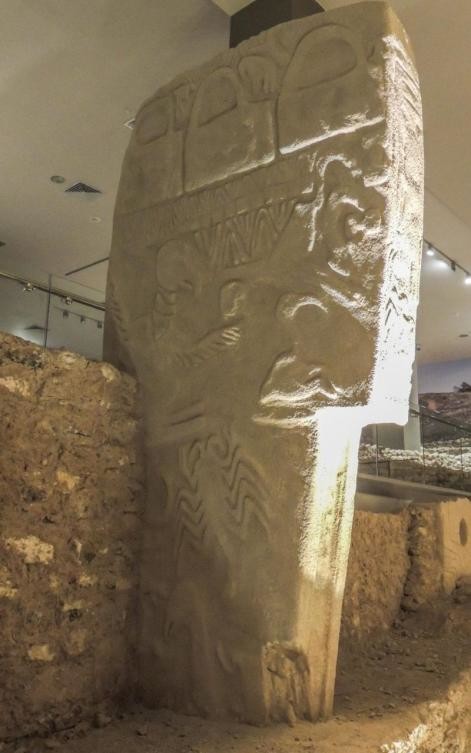
DUBAI: Ancient images carved into stone at an archaeological site in Turkey tell the story of the comet that triggered a small-scale ice age more than 13,000 years ago, scientists at the University of Edinburgh revealed this week in the Mediterranean Archaeology and Archaeometry publication.
The researchers said that carvings on a rock called the Vulture Stone suggest that a collection of comet fragments hit the Earth leading to human disaster around 11000 BC.
The carving of a headless man is believed to symbolize the extensive loss of life and it is reported that the event, which wiped out woolly mammoths, helped to spark the rise of human civilization on Earth.
For decades, scientists speculated that a comet could have caused the drop in temperature that occurred during a period known as the Younger Dryas.
This period is crucial in the history of humanity as it is pinpointed as the era during which agricultural practices began and the first Neolithic civilizations made their mark.
Before the comet strike, vast swathes of wild wheat and barley had allowed nomadic hunters in the Middle East to set up base camps. However, the icy conditions that followed caused communities to work together in the fight to maintain crops which led to the rise of communal farming and the first towns.
The Telegraph reports that experts analyzed symbols carved onto stone at Gobekli Tepe in southern Turkey in a bid to find out if they could be linked to constellations.
The scientists interpreted the animals in the carvings as astronomical symbols and matched their positions to patterns of stars using computer software, leading researchers to date the event to 10,950BC.

Ancient Turkey carvings show how comet struck Earth, sparking rise of civilization
Arts festival’s decision to exclude Palestinian author spurs boycott
- A Macquarie University academic who researches Islamophobia and Palestine, Abdel-Fattah responded saying it was “a blatant and shameless act of anti-Palestinian racism and censorship,” with her lawyers issuing a letter to the festival
SYDENY: A top Australian arts festival has seen the withdrawal of dozens of writers in a backlash against its decision to bar an Australian Palestinian author after the Bondi Beach mass shooting, as moves to curb antisemitism spur free speech concerns.
The shooting which killed 15 people at a Jewish Hanukkah celebration at Sydney’s Bondi Beach on Dec. 14 sparked nationwide calls to tackle antisemitism. Police say the alleged gunmen were inspired by Daesh.
The Adelaide Festival board said last Thursday it would disinvite Randa Abdel-Fattah from February’s Writers Week in the state of South Australia because “it would not be culturally sensitive to continue to program her at this unprecedented time so soon after Bondi.”
FASTFACTS
• Abdel-Fattah responded, saying it was ‘a blatant and shameless act of anti-Palestinian racism and censorship.’
• Around 50 authors have since withdrawn from the festival in protest, leaving it in doubt, local media reported.
A Macquarie University academic who researches Islamophobia and Palestine, Abdel-Fattah responded saying it was “a blatant and shameless act of anti-Palestinian racism and censorship,” with her lawyers issuing a letter to the festival.
Around 50 authors have since withdrawn from the festival in protest, leaving it in doubt, local media reported.
Among the boycotting authors, Kathy Lette wrote on social media the decision to bar Abdel-Fattah “sends a divisive and plainly discriminatory message that platforming Australian Palestinians is ‘culturally insensitive.'”
The Adelaide Festival said in a statement on Monday that three board members and the chairperson had resigned. The festival’s executive director, Julian Hobba, said the arts body was “navigating a complex moment.”
a complex and unprecedented moment” after the “significant community response” to the board decision.
In the days after the Bondi Beach attack, Jewish community groups and the Israeli government criticized Prime Minister Anthony Albanese for failing to act on a rise in antisemitic attacks and criticized protest marches against Israel’s war in Gaza held since 2023.
Albanese said last week a Royal Commission will consider the events of the shooting as well as antisemitism and social cohesion in Australia. Albanese said on Monday he would recall parliament next week to pass tougher hate speech laws.
On Monday, New South Wales state premier Chris Minns announced new rules that would allow local councils to cut off power and water to illegally operating prayer halls.
Minns said the new rules were prompted by the difficulty in closing a prayer hall in Sydney linked to a cleric found by a court to have made statements intimidating Jewish Australians.
The mayor of the western Sydney suburb of Fairfield said the rules were ill-considered and councils should not be responsible for determining hate speech.
“Freedom of speech is something that should always be allowed, as long as it is done in a peaceful way,” Mayor Frank Carbone told Reuters.