TEHRAN: Campaigning began on Friday for Iran’s presidential election with incumbent Hassan Rouhani facing a tough battle against hard-liners, though not from former President Mahmoud Ahmadinejad who was barred from standing.
Ahmadinejad’s disqualification by the conservative-run Guardian Council was no surprise — he had been advised not to run by Supreme Leader Ayatollah Ali Khamenei who said it would “polarize” the nation.
His populist economics and defiant attitude to the establishment had alienated even Ahmadinejad’s hard-line backers during his 2005-2013 tenure.
“Once the supreme leader had told him not to stand, it became impossible for him to be cleared by the Guardian Council,” said Clement Therme, research fellow for Iran at the International Institute for Strategic Studies.
“By his second term, (Ahmadinejad) was even challenging the clerics. He was not useful anymore for the system.”
The mood in Tehran has been subdued — many are disillusioned with Rouhani’s failure to kick-start the economy despite broad support for his efforts to rebuild ties with the West, notably through a nuclear deal with world powers that eased sanctions.
There has been uproar over a decision by the election commission to ban live TV debates, seen by some as an attempt to prevent embarrassment to some of the candidates or the regime as a whole.
Campaigning, which the Guardian Council announced could begin immediately, had not been supposed to start for another week, so there was little activity on Friday.
But experts say the authorities are keen to excite interest in the vote.
“They need that for legitimacy — the turnout is even more important than the result,” said Therme.
Iran’s elections are tightly controlled, with the Guardian Council allowing just six people — and no women — to stand for the May 19 vote out of 1,636 hopefuls that registered last week.
If no candidate wins more than 50 percent, a run-off between the top two is held a week later.
Rouhani, a politically moderate cleric, squeaked to victory last time with 51 percent in the first round, helped by a divided conservative camp.
The Guardian Council has resisted efforts by Iran’s Parliament, the Majles, to clarify the criteria by which they choose candidates.
The constitution adopted after the 1979 revolution offers only vague guidelines that candidates should possess “administrative capacity and resourcefulness... trustworthiness and piety.”
The build-up to the vote has injected more interest than many predicted just a couple of months ago, when Rouhani was seen as a shoo-in for a second term if only because the conservative opposition seemed unable to offer a strong candidate.
Since then, the 56-year-old former judge and cleric Ebrahim Raisi has emerged as a front-runner for the conservatives.
Little-known on the political scene, Raisi runs a powerful religious foundation and business empire in Mashhad and is seen as a close ally of — and possible successor to — supreme leader Ayatollah Ali Khamenei.
But despite emphasizing his care for the poor, many say Raisi’s hard-line judicial background and entourage will turn off voters.
“He seems like a good and calm person himself, but the people around him are scary,” said a tour operator in Yazd, echoing a widely heard sentiment.
Some think he may drop out at the last minute in favor of Tehran mayor Mohammad Bagher Ghalibaf, who came second to Rouhani in 2013.
Ghalibaf — a war veteran, former Revolutionary Guards commander and police chief — has support from powerful backroom hard-liners and presents himself as a pragmatic problem-solver.


![]()
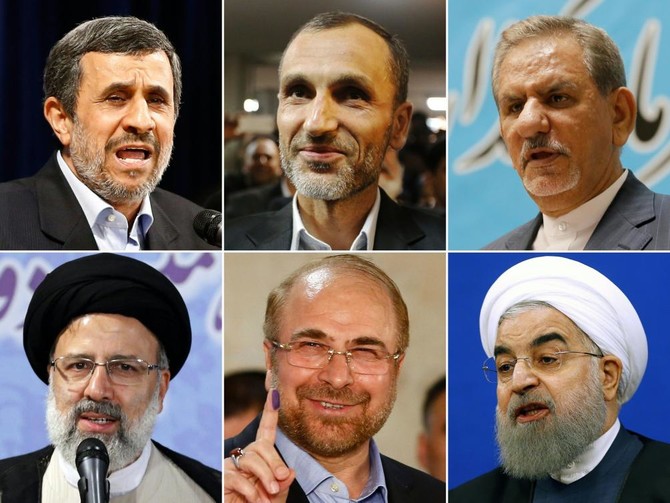
Iran election campaign kicks off without Ahmadinejad
Iran election campaign kicks off without Ahmadinejad
Latest updates


© 2026 SAUDI RESEARCH & PUBLISHING COMPANY, All Rights Reserved And subject to Terms of Use Agreement.