MIAMI: The last orca has been born in captivity at a SeaWorld park in San Antonio just over a year after the theme park decided to stop breeding orcas following animal rights protests and declining ticket sales.
The Orlando-based company said the orca — the last in a generation of whales bred in confinement — was born Wednesday afternoon. SeaWorld did not immediately name the calf because the park’s veterinarians had not yet determined whether it was male or female.
The mother, 25-year-old Takara, was already pregnant when SeaWorld announced in March 2016 that it had stopped breeding its orcas. The gestation period for orcas is about 18 months.
Preparing late last month for the moment, SeaWorld’s chief zoological officer, Chris Dold, said he expected the birth to be bittersweet, because it would be the last such event at any of the parks. But just hours after the calf was born about 3:30 p.m. EDT Wednesday, Dold said, SeaWorld staff only felt like celebrating. SeaWorld said mother and calf both appear healthy.
“These are extraordinary moments,” he said by phone while traveling to the US from Abu Dhabi, where SeaWorld is developing its first new park without orcas. “It’s a tempered celebration only because we’re focused on the health of these guys.”
SeaWorld decided to stop breeding orcas, and phase out its world-famous killer whale performances by 2019, after public opinion turned against keeping orcas, dolphins and other animals in captivity for entertainment. The backlash intensified after the 2013 release of “Blackfish,” a documentary critical of SeaWorld’s orca care. It focused on the orca Tilikum, which killed trainer Dawn Brancheau in Orlando in 2010, dragging her into the pool before shocked visitors after a “Dine with Shamu” show.
Tilikum, which sired 14 calves over nearly 25 years in Orlando, died of bacterial pneumonia in January.
The newborn calf was sired by Kyuquot at the San Antonio park by natural means. It brings SeaWorld’s orca population in the US to 23. All the orcas are expected to remain on display and available for researchers for years to come in Orlando, San Diego and San Antonio.
SeaWorld has said it plans to introduce new “natural orca encounters” in place of theatrical shows. This summer, the San Diego park will unveil a new, educational attraction in a revamped pool, and new orca attractions eventually will follow in San Antonio and Orlando.
The calf will be visible to visitors either in the orca stadium pool at the San Antonio park or in two adjacent pools. Observations about the calf and Takara by SeaWorld trainers will be provided from the moment of birth to researchers trying to fill gaps in their data about wild killer whales.
Dold said veterinarians at the San Antonio park told him the calf was born normally — tail first — after about an hour and a half of smooth labor. Both orcas were swimming calmly, including taking breaths at the water’s surface, and trainers would be watching for the calf to begin nursing.
“Mom generally will rest but she can’t rest too much .... mom’s not holding onto the calf, but it’s riding in her slipstream, and that’s how it gets around,” Dold said. “Our expectation is that all of this will go smoothly, but we take none of that for granted.”
Birth control and “social management” will prevent future orca pregnancies, said spokeswoman Suzanne Pelisson Beasley. SeaWorld has not collected a wild orca in nearly 40 years, and most of its orcas were born in captivity.
Researchers have said they worry that SeaWorld’s decision to stop breeding orcas will slowly reduce their ability to study orca health, growth and behavior, limiting them in coming years to collecting data from a small pod of aging whales.
Heather Hill, a St. Mary’s University comparative psychologist who plans to monitor the sleeping habits of Takara and the calf over the coming year, said it was frustrating to see research opportunities at SeaWorld undermined by public opinion amid federal cuts to science funding.
“This will be one of the first times we’ll be able to see not just a mother with a newborn calf but also a newborn calf with siblings,” Hill said.
In a statement, Tracy Reiman, executive vice president of the Ethical Treatment of Animals (PETA), said the mother and her calf should be retired to a seaside sanctuary.
“Throughout her life, Takara the orca has been artificially inseminated many times, separated from her mother and two of her children, and shuffled from theme park to theme park at SeaWorld’s whim,” PETA’s statement said.
This is Takara’s fifth calf. Two of her other offspring remain at the San Antonio park, while one lives at SeaWorld Orlando and another has been loaned to a park in Tenerife, Spain. SeaWorld has no current plans to separate Takara and the newborn in the future, or to move any of its other orcas, Dold said.
In March, Dold said SeaWorld remains committed to orca research and conservation, calling the last orca birth in captivity “a solemn reminder of how things can change and how things can be lost.”


![]()
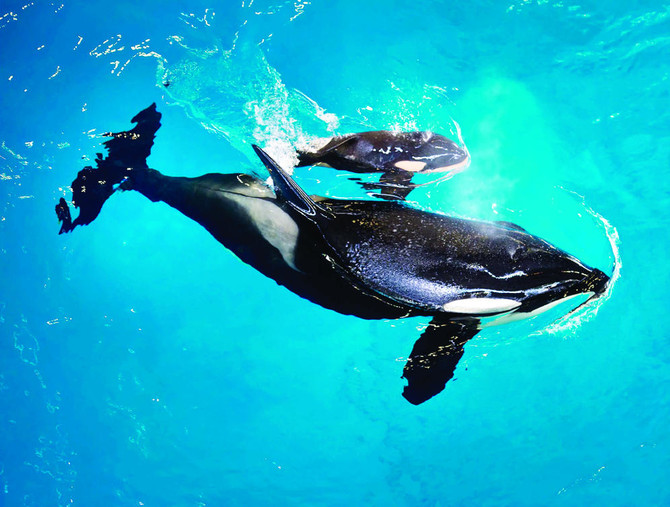
Baby orca! Last killer whale is born at a SeaWorld park
Baby orca! Last killer whale is born at a SeaWorld park
Latest updates


© 2026 SAUDI RESEARCH & PUBLISHING COMPANY, All Rights Reserved And subject to Terms of Use Agreement.