JEDDAH: Houthi militias and fighters of ousted President Ali Abdullah Saleh continue to plant land and sea mines amid international silence. This is despite the fact that the use of such explosives is considered a crime against humanity, according to Yemeni government and military officials.
As a result, Yemen needs years to eliminate the mines because there are no maps to locate where they were planted. The Houthi militias planted mines in sensitive areas to stop the advance of government forces, especially after the southern governorates have been liberated.
Statistics show that hundreds of civilian victims fell victim to the explosives, killed or maimed, and the figure is increasing due to the spread of the war in urban areas.
Col. Haytham Haloub, chief of the Military Engineering Division in the Fourth Military Region and director of the National Mine Action Center in Aden, said that coup militias planted many mines in a haphazard manner, including the prohibited anti-personnel mines as well as homemade bombs and anti-tank mines.
He added that until last May, engineering teams defused more than 31,000 mines in Aden, Lahj, Abyan and some parts of the Taiz Governorate.
The Arab Federation for Human Rights, in its last report, said the Houthis planted mines at more than 500,000 locations in Yemen, which were responsible for 700 deaths. Engineers of the Arab coalition have dismantled 40,000 mines so far.
The Yemeni government has sought the international community’s help to defuse the mines planted in densely populated areas in the liberated areas.
The government said the mines are banned internationally; pose a threat to life and lead to losses of civilian lives, especially women and children. They are difficult to find because there are no maps with their position, it said.
The government has sought help from the international community because Yemen lacks the required equipment. Yemeni engineering teams, with the support of the Arab Coalition, extracted and dismantle several Iranian-made naval minefields of various sizes.
They were planted by the coup militias on the coasts of the Midi region, in the northwest of Yemen.
One such naval mine hit a boat on the Midi coast, leading to the deaths of eight fishermen. Col. Mohammed Salam Al-Asbahi, commander of the Naval Arrow operation, said the Yemeni Army began the process of combing and clearing the coasts and islands from mines planted by rebel militias.
Al-Asbahi said the locations of the mines were identified and marked to help fishermen avoid dangerous areas. He added that the engineering teams started the disposal process, dragging the mines to one of the unpopulated islands where they are detonated.
Omar Jawhar, brigadier general of the Fifth Military Region War in Midi, said the aim is to clear the Red Sea islands and coasts of Iranian mines.
In statements to the media, he said the process is not limited to sea mines only, but covers the wild coasts of Midi.
He added the mines lifted from the Red Sea came from Iran. The discovery corroborates testimony by Gen. Joseph Foteil, US commander of the American forces in the Middle East, to the US Congress Armed Forces Committee that Houthi rebels are strongly supported by Iran and threaten shipping in the Hormouz and strategic Bab Al-Mandab straits. He said: “Houthis, with Iran’s support, spread along the Hormouz rockets and radar systems, in addition to mines and explosive boats.”
He added that the Arab coalition forces thwarted an attempt to smuggle mines over sea routes to the western beaches of Yemen.


![]()
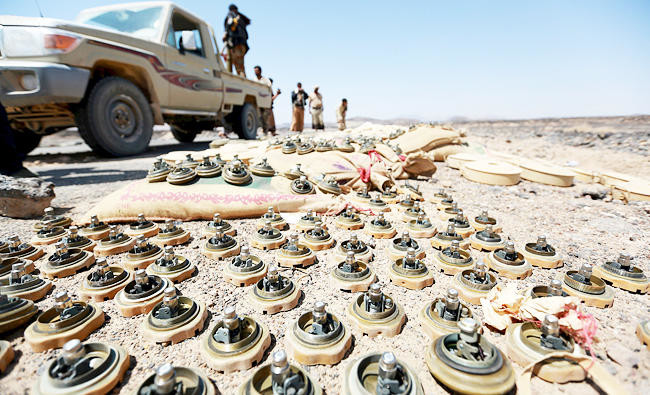
Houthi mines at 500,000 spots killed 700 in Yemen
Houthi mines at 500,000 spots killed 700 in Yemen



Latest updates


© 2026 SAUDI RESEARCH & PUBLISHING COMPANY, All Rights Reserved And subject to Terms of Use Agreement.