WASHINGTON: Secretary of State Rex Tillerson declared the Iran nuclear deal a failure on Wednesday but left open the possibility the Trump administration will uphold it nonetheless.
The top American diplomat sought to reinforce the notion that the US is aggressively countering Iran’s destabilizing behavior throughout the Middle East, even though President Donald Trump so far has not pulled out of the deal. Tillerson spoke a day after certifying to Congress that Iran is complying with its obligations under the 2015 deal, a requirement for Tehran to continue receiving relief from nuclear sanctions.
“The JCPOA fails to achieve the objective of a non-nuclear Iran,” Tillerson said, using an acronym for the 2015 nuclear deal. “It only delays their goal of becoming a nuclear state.”
He said the deal, brokered by former President Barack Obama’s administration along with other world powers, represented the “same failed approach” the US has taken to North Korea. Like with the North, Tillerson said, the Trump administration was unwilling to be patient with Iran, ticking through a list of countries where he said Iran was supporting terrorism and violence.
Tillerson’s hastily arranged statement before cameras at the State Department reflected the competing forces pulling at the Trump administration as it develops its policy toward Iran. On the one hand, Trump wants to show he’s being tougher than Obama toward Iran, but on the other hand, he’s not yet ready to rip up the deal.
Trump as a candidate vowed to discard or renegotiate the pact, and shortly after taking office his administration put Tehran “on notice” that its troublesome behavior would no longer be tolerated. But neither Iran nor the other world powers that negotiated the agreement have any interest in re-opening the deal, and US companies stand to lose billions if the deal is scuttled.
Proponents of the deal have long acknowledged it doesn’t address concerns about Iran’s non-nuclear behavior, such as its ballistic missile program or support for Houthi rebels in Yemen. Obama and others argued it was narrowly tailored to take the most dangerous prospect — a nuclear-armed Iran — off the table.
The deal’s critics, though, say it fails to achieve even that goal because key restrictions on Iran’s nuclear development sunset after a decade or more. With some of those critics now in office, Tillerson’s comments Wednesday marked the first time that position has been echoed by the US government.
Still, since taking office, Trump has stopped promising he’ll gut the deal. Tillerson said that decision will be made as part of a governmentwide review of Iran policy currently under way.
“The Trump administration has no intention of passing the buck to a future administration on Iran,” Tillerson said.
In an ominous warning, Tillerson linked Iran’s behavior to that of North Korea and said that with both countries, the US would no longer engage in “strategic patience.” The US has been exploring ways to address the threat of North Korea’s nuclear program, which is significantly farther along than Iran’s.
“An unchecked Iran has the potential to travel the same path as North Korea — and to take the world along with it,” Tillerson said.


![]()
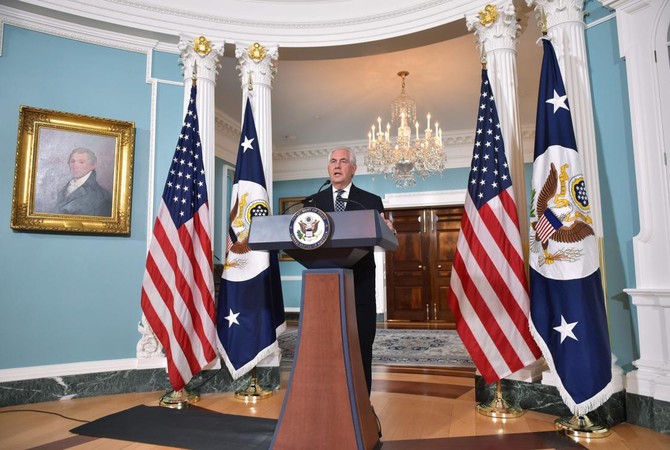
Tillerson declares the Iran nuclear deal a failure
Tillerson declares the Iran nuclear deal a failure


Latest updates


© 2026 SAUDI RESEARCH & PUBLISHING COMPANY, All Rights Reserved And subject to Terms of Use Agreement.