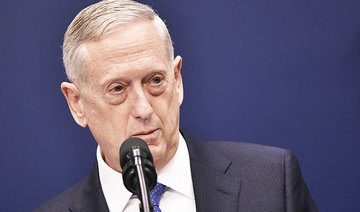
WASHINGTON: Defense Secretary Jim Mattis is looking to the Middle East and North Africa for broader contributions and new ideas to fight Islamic extremism as the Trump administration fleshes out its counterterrorism strategy.
His trip to the region, which began with his departure Monday night, includes stops with longstanding allies Saudi Arabia and Israel, and new partners like Djibouti.
As the administration enhances its efforts, Mattis has made a point of consulting counterparts around the world. His goals include expanding the American-led coalition against the Daesh group in Iraq and Syria, but also combatting Al-Qaeda, whose Yemen branch is posing particular worry as it uses ungoverned spaces in the Arab world’s poorest country to plan attacks on the United States.
In announcing Mattis’s trip, the Pentagon said last week he would be discussing ways to “defeat extremist terror organizations.”
Mattis is starting his travels Tuesday in Riyadh, where he is expected to meet senior Saudi leaders. Saudi Arabia is leading a coalition that is fighting Iran-backed Houthis in Yemen. The coalition’s airstrikes began two years ago but haven’t driven the Houthis from the capital and large parts of Yemen they still control.
The Trump administration is considering providing intelligence, aerial refueling and other military assistance to the United Arab Emirates, which is helping the Saudis. The UN says some 50,000 civilians have been killed or wounded in the three-year stalemate.
Worries about Daesh aren’t limited to Syria and Iraq. Its influence has spread to Libya and elsewhere in North Africa. Mattis told a Pentagon news conference last week that he hoped to bring as many other nations as possible into the administration’s new strategy, which involves diplomatic and other non-military features. He said that plan was still in “skeleton form,” though it was being “fleshed out.”
The Middle East’s landscape is getting more complicated.
Syria’s alleged chemical weapons attack on April 4 prompted a US cruise missile strike, temporarily slowing the pace of Washington’s air campaign against Daesh in northern Syria.
And a US airstrike April 11 killed 18 fighters associated with a US-supported Syrian rebel group. Central Command said the US strike was misdirected.
Also last week, US forces in Afghanistan struck a Daesh stronghold near the Pakistani border with the 11-ton “mother of all bombs,” the largest US non-nuclear bomb ever used in combat.
The Middle East is familiar turf for Mattis, a Marine veteran of the Iraq war who rose to four-star rank. He finished his military career as head of Central Command, which directs US military operations across the Middle East and Central Asia.
On his weeklong trip, Mattis also is scheduled to visit Egypt and Qatar, the small Arab country that hosts the US military’s main Mideast air operations center. It will be his first trip to these countries since taking office in January. He also will make a brief stop at Camp Lemonnier in Djibouti in the Horn of Africa, which the US uses to fly sensitive drone missions over Somalia and Yemen. Mattis visited Iraq in February on his first trip to the Middle East as Pentagon chief.


![]()

Pentagon’s Mattis discussing war aims in Mideast this week
Pentagon’s Mattis discussing war aims in Mideast this week


Latest updates


© 2026 SAUDI RESEARCH & PUBLISHING COMPANY, All Rights Reserved And subject to Terms of Use Agreement.