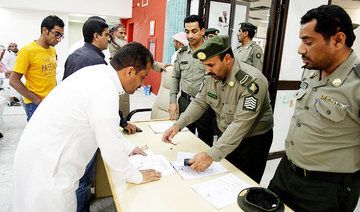
Illegal expats urged to take advantage of amnesty period

Updated 17 April 2017
Follow

Illegal expats urged to take advantage of amnesty period

JEDDAH: Undocumented expats have ten weeks left to rectify their legal status in Saudi Arabia in a campaign which allows them to leave the country without incurring any penalties.
Those in the Kingdom illegally who wish to correct their status will be allowed to do so within a grace period announced in March.
The campaign, “A Nation Without Violations,” was launched by the Interior Ministry days before the amnesty period began on March 29 and seeks to allow illegal expats to leave the country without incurring the penalties associated with breaking the Kingdom’s residency and labor laws.
One of the key aspects of the process is that those who are undocumented will not have their fingerprints taken, allowing them to return to the Kingdom in the future.
Illegal expats “will be exempt from the consequences associated with the deportee fingerprint system,” the Passport Department confirmed in a post on its Twitter account.
The amnesty period allows various types of violators, many of whom are in legal limbo, to travel back to their home countries without hefty fines or prison sentences.
The campaign will benefit pilgrims who have stayed on in Saudi Arabia after completing their religious rites, expats whose residency permits (Iqama) have expired and employees with valid work permits but no Iqama.
Workers who have been designated as “Huroob” — absent without leave from their employer — will also be allowed to exit without fines. As will those who have entered the Kingdom’s territory illegally.
Violating the Saudi residency system begets deportation, a prison sentence and fines. The fine can range from SR15,000 ($4,000) to SR100,000 ($26,663), General Sulaiman Al-Yahya, director general of the Passport Department, told the Saudi state-run news channel Al-Ekhbariya.
In announcing the campaign, Crown Prince and Interior Minister Mohammed bin Naif urged violators to take advantage of the amnesty period and make use of the assistance provided by 19 governmental authorities.
The Interior Ministry said the amnesty offer is an extension of a similar grace period in 2013 granted by Saudi Arabia’s previous monarch King Abdullah. In 2013, 2.5 million people were able to correct their illegal status in the country.
The 2013 amnesty period was announced in April and then extended for three extra months to allow more people to take advantage of the window of opportunity.


Rebuilding lives: Saudi initiative gives fresh hope to amputees

Updated 08 December 2025
Follow

Rebuilding lives: Saudi initiative gives fresh hope to amputees

  • Baitureh Health Association has provided life-changing support to more than 1,000 people
  • Prosthetic limbs can cost up to $76,000

MAKKAH: The Baitureh Health Association for the Care of Amputees has quickly become one of Saudi Arabia’s most impactful humanitarian initiatives, transforming support for people with lost limbs.

Established in 2020, the association deals with people’s physical, psychological and social needs and fills a long-standing gap in the national health system.

CEO Badr bin Alyan told Arab News that the initiative was created in response to a growing need, driven by amputations linked to accidents, blood disorders, occupational injuries and other causes.

Its operations were “based on service integration rather than fragmentation, enabling beneficiaries to return to their lives with confidence, ability and independence,” he said.

This holistic process covers everything from initial evaluations to psychological and physical rehabilitation, family support, prosthetic fitting and ongoing maintenance.

Its psychological support programs include group sessions led by certified mentors who have undergone similar experiences, as well as field visits to support patients before and after amputation.

More than 1,000 people across the Kingdom have so far benefitted from the association’s work, about 10 percent of them children, whom Alyan said were “the most sensitive and the most in need of intensive psychological and family support.”

Its specialist programs for children — My First Step and Therapeutic Entertainment — help young people adapt to prosthetics, overcome trauma and build confidence in a safe and supportive setting.

The association has completed more than 300 prosthetic fittings, including silicone cosmetic limbs, mechanical, hydraulic, electronic and 3D-printed models. 

Alyan said the type of prosthetic selected depended on a number of factors, such as age, lifestyle, type of amputation, activity level and psychological readiness.

Children also have to undergo frequent adjustments to their new limbs to account for their growth.

Each prosthetic cost between SR20,000 ($5,300) and SR285,000, Alyan said.

The association funds its work through sponsorships, community contributions and strategic partnerships.

Despite its success, Alyan said there were still challenges to be faced, including the lack of a consolidated base for the provision of psychological support and therapy services and prosthetics development and maintenance.

There was also a shortage of local experts, he said.

In response, the association set up a rehabilitation center, which Alyan said would help to localize prosthetics manufacturing, reduce costs and accelerate fitting processes and create opportunities for local experts to develop their knowledge and experience.

But providing prosthetics was only part of the association’s work, he said.

“Rebuilding a human life is the deeper goal.”