Daesh militant linked to Charlie Hebdo attack could still be alive — Iraq

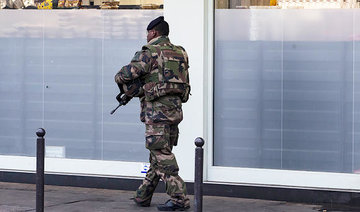
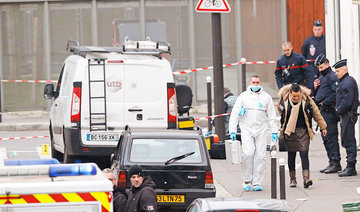
A man pauses outside the old offices of the satirical Charlie Hebdo magazine where two brothers armed with assault rifles shot and killed 11 people, including most of the publication’s cartoonists and writers, on January 7, 2015, as France pays tribute two years later in Paris, France, January 5, 2017. (REUTERS)
Updated 15 April 2017
Follow

Daesh militant linked to Charlie Hebdo attack could still be alive — Iraq

BAGHDAD: A Daesh militant linked to the deadly 2015 attack on French weekly Charlie Hebdo could be still be alive, the Iraqi military said on Saturday.
Boubaker el-Hakim was reported by American defense officials to have been killed in November, in a US drone strike in Raqqa, Daesh’s de facto capital in Syria.
Iraqi intelligence supplied information to the Syrian airforce to carry out a series of strikes on Daesh headquarters and hideouts in Syria, including one believed to belong to el-Hakim, an Iraqi military statement said.
Aircraft from Syrian President Bashar Assad’s airforce targeted several locations in Raqqa and Albu Kamal, near the Iraqi border, said the statement, without indicating the location of el-Hakim’s headquarters or the date of the raids.
An Iraqi military spokesman told Reuters el-Hakim’s headquarters were destroyed but it wasn’t clear if he was killed.
In 2015 Iraq and Syria established a joint committee with Russia and Iran, Assad’s main foreign backers, to share intelligence about Daesh.
El-Hakim was believed to have been involved in planning the January 2015 attack on Charlie Hebdo, a weekly known for its satirical covers ridiculing political and religious leaders.
Two Islamist militants broke into an editorial meeting of the weekly, raking it with bullets, killing 17 people. Another militant later killed a policewoman and took hostages at a supermarket, killing four before police shot him dead.
Daesh declared a “caliphate” spanning parts of Iraq and Syria after it captured the Iraqi city of Mosul in mid-2014.
The hard-line Sunni group has since lost most cities it captured in Iraq and its fighters are now surrounded in parts of Mosul by US-backed Iraqi government forces.
A US-backed offensive is also under way to capture Raqqa, involving a Syrian Kurdish-Arab militia alliance.


Putin says Russia will achieve its Ukraine aims by force if Kyiv doesn’t want peace

Updated 3 sec ago
Follow

Putin says Russia will achieve its Ukraine aims by force if Kyiv doesn’t want peace

MOSCOW: Russian President Vladimir Putin said Ukraine was in no ​hurry for peace and if it did not want to resolve their conflict peacefully, Moscow would accomplish all its goals by force.
Putin’s remarks on Saturday, carried by state news agency TASS, followed a vast Russian drone and missile attack that prompted Ukrainian President Volodymyr Zelensky to say Russia was demonstrating its ‌wish to ‌continue the war while Kyiv ‌wanted peace.
Zelensky ⁠is ​to ‌meet US President Donald Trump in Florida on Sunday to seek a resolution to the war Putin launched nearly four years ago with a full-scale invasion of Russia’s smaller neighbor.
The White House did not immediately respond to a request for comment on Putin’s remarks.
Russian commanders told ⁠Putin during an inspection visit that Moscow’s forces had captured the ‌towns of Myrnohrad, Rodynske and Artemivka in ‍Ukraine’s eastern region of ‍Donetsk, as well as Huliaipole and Stepnohirsk in ‍the Zaporizhzhia region, the Kremlin said on the Telegram messaging app.
Ukraine’s military rejected Russia’s assertions about Huliaipole and Myrnohrad as false statements. The situation in both places remains “difficult” but “defensive operations” ​by Ukrainian troops are ongoing, the General Staff of Ukraine’s Armed Forces said in a statement ⁠on social media.
The Southern Command of Ukraine’s Armed Forces said on Telegram “fierce fighting” continued in Huliaipole. “However, a substantial part of Huliaipole continues to be held by the Defense Forces of Ukraine.”
Verifying battlefield claims is difficult as access on both sides is restricted, information is tightly controlled and front lines shift quickly, with media relying on satellite and geolocated footage that can be partial or delayed.