Eight charged over Pakistani liberal student’s murder

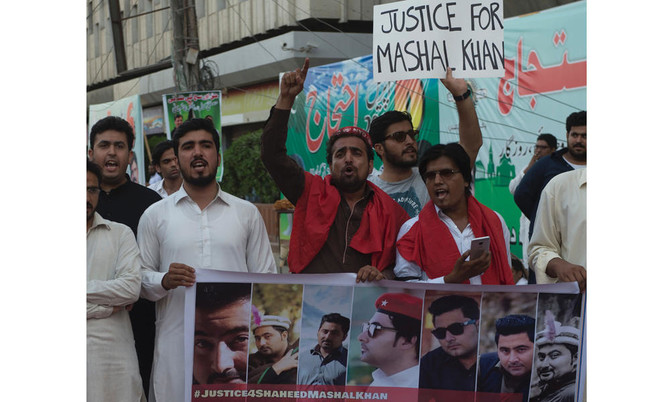
Pakistani activists shout slogans during a protest in Karachi on April 14, 2017, against the killing of student Mashal Khan by his classmates. (AFP / ASIF HASSAN)
Updated 15 April 2017
Follow

Eight charged over Pakistani liberal student’s murder

PESHAWAR, Pakistan: Eight Pakistanis who brutally murdered a fellow university student over his liberal views were charged with murder and terrorism on Saturday, court officials said.
Mashal Khan, a journalism student, was stripped, beaten, shot, and thrown from the second floor of his hostel at the Abdul Wali Khan university in the conservative northwestern town of Mardan on Thursday by a large mob.
So far a total of 12 people have been arrested over the incident and police are hunting for more suspects.
“Eight students were presented before an anti-terrorism court in Mardan over murder and challenging the writ of the state,” public prosecutor Rafiullah Khan told AFP.
Four others were arrested Saturday, Khan said.
Graphic video footage from the crime scene showed dozens of men outside the hostel kicking and hurling projectiles at a body sprawled on the ground.
Mushtaq Ghani, Information Minister of northwestern Khyber Pakhtunkhwa province, said the government had also requested Peshawar High Court to conduct a judicial probe into the incident.
Students had previously complained to university authorities about Khan’s alleged secular and liberal views and Khan had been in a heated debate during a class the day he was killed.
Blasphemy is a hugely sensitive charge in conservative Muslim Pakistan, and can carry the death penalty. Even unproven allegations can cause mob lynchings and violence.
At least 65 people have been murdered by vigilantes over blasphemy allegations since 1990.
The independent Human Rights Commission of Pakistan (HRCP) has urged that all those involved in the lynching be brought to justice.
“The state’s abject failure to protect Mashal Khan’s right to life has created great panic and horror among students and academia. Unless all those who played any part in Mashal’s brutal murder are brought to justice, such barbarity will only spread,” it said.
At his funeral on Friday, Khan’s father said he hoped his son’s murder would “evoke realization among people that killing an innocent is a sin.”


Geoeconomic confrontation tops global risks in 2026: WEF report

Updated 14 January 2026
Follow

Geoeconomic confrontation tops global risks in 2026: WEF report

  • Also armed conflict, extreme climate, public polarization, AI
  • None ‘a foregone conclusion,’ says WEF’s MD Saadia Zahidi

DUBAI: Geoeconomic confrontation has emerged as the top global risk this year, followed by state-based armed conflict, according to a new World Economic Forum report.

The Global Risks Report 2026, released on Wednesday, found that both risks climbed eight places year-on-year, underscoring a sharp deterioration in the global outlook amid increased international competition.

The top five risks are geoeconomic confrontation (18 percent of respondents), state-based armed conflict (14 percent), extreme weather events (8 percent), societal polarization (7 percent) and misinformation and disinformation (7 percent).

The WEF’s Managing Director Saadia Zahidi said the report “offers an early warning system as the age of competition compounds global risks — from geoeconomic confrontation to unchecked technology to rising debt — and changes our collective capacity to address them.

“But none of these risks are a foregone conclusion.”

The report assesses risks across three timeframes: immediate (2026); short-to-medium term (next two years); and long term (next 10 years).

Economic risks show the largest overall increase in the two-year outlook, with both economic downturn and inflation jumping eight positions.

Misinformation and disinformation rank fifth this year but rise to second place in the two-year outlook and fourth over the 10-year horizon.

The report suggests this reflects growing anxiety around the rapid adoption of artificial intelligence, with adverse outcomes linked to AI surging from 30th place in the two-year timeframe to fifth in the 10-year outlook.

Uncertainty dominates the global risk outlook, according to the report.

Surveyed leaders and experts view both the short- and long-term outlook negatively, with 50 percent expecting a turbulent or stormy global environment over the next two years, rising to 57 percent over the next decade.

A further 40 percent and 32 percent, respectively, describe the outlook as unsettled across the two- and 10-year timeframes, while just 1 percent anticipate a calm global outlook in either period.

Environmental risks ease slightly in the short-term rankings. Extreme weather fell from second to fourth place and pollution from sixth to ninth. Meanwhile, critical changes to Earth systems and biodiversity loss dropped seven and five positions, respectively.

However, over the next decade, environmental threats re-emerge as the most severe, with extreme weather, biodiversity loss, and critical changes to Earth systems topping the global risk rankings.

Looking ahead over the next decade, around 75 percent of respondents anticipate a turbulent or stormy environmental outlook, making it the most pessimistic assessment across all risk categories.

Zahidi said that “the challenges highlighted in the report underscore both the scale of the potential perils we face and our shared responsibility to shape what comes next.”

Despite the gloomy outlook, Zahidi signaled a positive shift in global cooperation.

 “It is also clear that new forms of global cooperation are already unfolding even amid competition, and the global economy is demonstrating resilience in the face of uncertainty.”

Now in its 21st year, the Global Risks Report highlights a core message: global risks cannot be managed without cooperation.

As competition intensifies, rebuilding trust and new forms of collaboration will be critical, with the report stressing that today’s decisions will shape future outcomes.

The report was released ahead of WEF’s annual meeting, which will be held in Davos from Jan. 19 to 23.