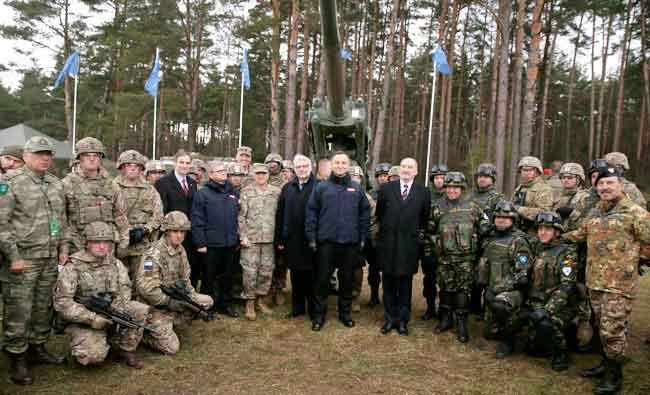
ORZYSZ, Poland: Poland’s President Andrzej Duda has hailed the launch of a US-led North Atlantic Treaty Organization’s (NATO) multinational battalion in an area of his country bordering Russia’s heavily militarized Kaliningrad exclave as an “historic moment.”
The battalion is one of four NATO is deploying for the first time to Poland and the Baltic states as tripwires against Russian adventurism on its eastern flank, a region formerly under Moscow’s control and spooked by its actions in Ukraine.
“Generations of Poles have waited for this moment since the end of World War II, generations that dreamt of being part of the just, united, democratic and truly free West,” President Duda said at ceremonies in the northeastern Polish town of Orzysz.
Poland joined NATO in 1999, a decade after it peacefully shed communism as the Iron Curtain fell in 1989.
Speaking along side Duda, NATO Supreme Allied Commander US Gen. Curtis Scaparrotti called the deployment “a clear demonstration of NATO’s unity and resolve, and sends a clear message to any potential aggressor.”
Three similar NATO units, led by the Germany, Canada and Britain, are being deployed this year in Lithuania, Latvia and Estonia. Each unit includes around 800 troops.
The countries requested them after Russia’s 2014 annexation of Crimea from Ukraine.
The Kremlin has denied any territorial ambitions and claims that NATO is trying to encircle Russia.
But Moscow’s deployment last year of nuclear-capable Iskander missiles into its Kaliningrad exclave, which borders Lithuania and Poland, and frequent Russian military drills in the region have rattled nearby NATO members.
The Orzysz NATO base lies around 100 kilometers (60 miles) from the Kaliningrad exclave and a stone’s throw from the strategically sensitive “Suwalki Gap,” a land corridor critical to the security of the Baltic states.
The 65-kilometer stretch of border with Lithuania is sandwiched between Kaliningrad and Belarus.
Military strategists warn it is the Achilles’ heel of NATO’s eastern flank: its capture would amputate the alliance’s three Baltic members and so shatter its credibility.
The freshly deployed NATO troops are expected to hold maneuvers around the Suwalki Gap in June.

Poland’s president hails ‘historic’ NATO battalion launch
Immigration agents draw guns, arrest activists following them in Minneapolis
MINNEAPOLIS: Immigration officers with guns drawn arrested some activists who were trailing their vehicles on Tuesday in Minneapolis, a sign that tensions have not eased since the departure last week of a high-profile commander.
At least one person who had an anti-ICE message on clothing was handcuffed while face-down on the ground. An Associated Press photographer witnessed the arrests.
Meanwhile, Tuesday was the deadline for the Minnesota governor, state attorney general and the mayors of Minneapolis and St. Paul to produce documents to a federal grand jury in response to a Justice Department request for records of any effort to stifle the Trump administration’s immigration crackdown. Officials have denounced it as a bullying tactic.
Federal agents in the Twin Cities lately have been conducting more targeted immigration arrests at homes and neighborhoods, rather than staging in parking lots. The convoys have been harder to find and less aggressive. Alerts in activist group chats have been more about sightings than immigration-related detainments.
Several cars followed officers through south Minneapolis after there were reports of them knocking at homes. Officers stopped their vehicles and ordered activists to come out of a car at gunpoint. Agents told reporters at the scene to stay back and threatened to use pepper spray.
There was no immediate response to a request for comment from the Department of Homeland Security and Immigration and Customs Enforcement.
A federal judge last month put limits on how officers treat motorists who are following them but not obstructing their operations. Safely following agents “at an appropriate distance does not, by itself, create reasonable suspicion to justify a vehicle stop,” the judge said. An appeals court, however, set the order aside.
Border Patrol commander Greg Bovino, who was leading an immigration crackdown in Minneapolis and other big US cities, left town last week, shortly after the fatal shooting of Alex Pretti, the second local killing of a US citizen in January.
Trump administration border czar Tom Homan was dispatched to Minnesota instead. He warned that protesters could face consequences if they interfere with officers.
Grand jury seeks communications, records
Minneapolis Mayor Jacob Frey’s office said it was complying with a grand jury subpoena requesting documents about the city’s response to Operation Metro Surge, but it released no other details.
“We have done nothing wrong and have nothing to hide, but when the federal government weaponizes the criminal justice system against political opponents, it’s important to stand up and fight back,” spokesperson Ally Peters said.
Other state and local offices run by Democrats were given similar requests. People familiar with the matter have told the AP that the subpoenas are related to an investigation into whether Minnesota officials obstructed enforcement through public statements.
No bond for man in Omar incident
Elsewhere, a man charged with squirting apple cider vinegar on Democratic US Rep. Ilhan Omar will remain in jail. US Magistrate Judge David Schultz granted a federal prosecutor’s request to deny bond to Anthony Kazmierczak.
“We simply cannot have protesters and people — whatever side of the aisle they’re on — running up to representatives who are conducting official business, and holding town halls, and assaulting them,” Assistant US Attorney Benjamin Bejar said Tuesday.
Defense attorney John Fossum said the vinegar posed a low risk to Omar. He said Kazmierczak’s health problems weren’t being properly addressed in jail and that his release would be appropriate.
___
Raza reported from Sioux Falls, South Dakota. AP reporters Ed White in Detroit and Hannah Fingerhut in Des Moines, Iowa, contributed.