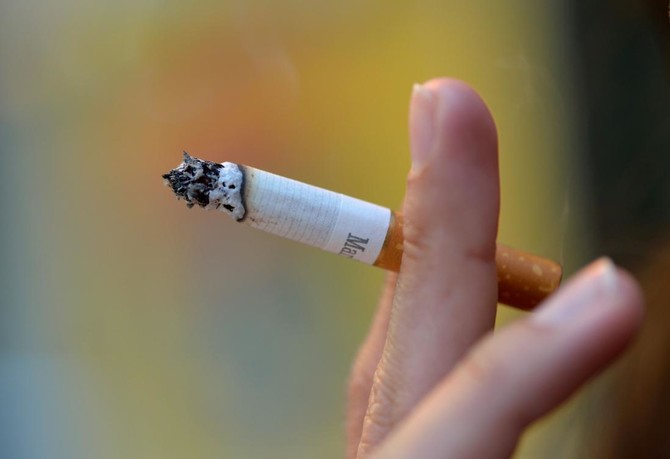
Smoking to kill 200 million in China this century: WHO

smoking cigarettes(AFP)
Updated 14 April 2017
Follow

Smoking to kill 200 million in China this century: WHO

BEIJING: Smoking-related diseases will claim 200 million lives in China this century and plunge tens of millions into poverty, a report said Friday.
China is the world’s largest consumer and producer of tobacco, and the industry provides the government with colossal sums.
In 2015, it recorded 1.1 trillion yuan ($160 billion) in profits, up 20 percent year-on-year.
But a report by the World Health Organization (WHO) and United Nations Development Programme (UNDP) said Friday that the Asian giant will suffer an economic toll if it does not urgently reduce its smoking population.
The paper — called “The Bill China Cannot Afford” — estimated that the total annual economic cost of tobacco use in the country in 2014 was 350 billion yuan, up tenfold from 2000.
“If nothing is done to reduce [the death rate] and introduce more progressive policies, the consequences could be devastating not just for the health of people across the country, but also for China’s economy as a whole,” WHO China representative Bernhard Schwartlander said in a statement.
The calculation includes both the direct costs of treating tobacco-related illness and the indirect costs such as lost work productivity.
“The rapid increase in costs associated with tobacco use in China is unsustainable,” Schwartlander added.
Twenty-eight percent of all adults and 50 percent of men in China are estimated to smoke regularly.
Rural-to-urban migrants are more likely to be smokers, the report said, adding that they risk descending into poverty when smoking-related medical costs become too great — a reality at odds with the government goal of eradicating poverty nationwide by 2020.
The organizations recommended a smoke-free policy across the country akin to laws in Beijing and Shanghai, where smoking is banned in most public places.
However, enforcing anti-smoking measures can be difficult in China as the state-owned China National Tobacco Corp, which enjoys a near-monopoly, shares offices and senior officials with the national tobacco regulator.
The report also urged further raising tobacco taxes to make smoking less affordable. While retail tobacco prices increased following a taxation hike in 2015, the average price of a cigarette pack remains just ten yuan.
A 50 percent increase in the retail price of cigarettes would prevent 20 million premature deaths over 50 years, the report said.


Book Review: ‘Padma’s All American’ Cookbook

Updated 19 December 2025
Follow

Book Review: ‘Padma’s All American’ Cookbook

  • For her, the true story of American food proves that immigration is not an outside influence but the foundation of the country’s culinary identity

Closing out 2025 is “Padma’s All American: Tales, Travels, and Recipes from Taste the Nation and Beyond: A Cookbook,” a reminder that in these polarizing times within a seemingly un-united US, breaking bread really might be our only human connection left. Each page serves as a heaping — and healing — helping of hope.

“The book you have before you is a personal one, a record of my last seven years of eating, traveling and exploring. Much of this time was spent in cities and towns all over America, eating my way through our country as I filmed the shows ‘Top Chef’ and ‘Taste the Nation’,” the introduction states.

“Top Chef,” the Emmy, James Beard and Critics Choice Award-winning series, which began in 2006, is what really got Padma Lakshmi on the food map.

“Taste the Nation,” of course, is “a show for immigrants to tell their own stories, as they saw fit, and its success owes everything to the people who invited us into their communities, their homes, and their lives,” she writes.

Working with producer David Shadrack Smith, she began developing a television series that explored American immigration through cuisine, revealing how deeply immigrant food traditions shaped what people considered American today.

She was the consistent face and voice of reason — curious and encouraging to those she encountered.

Lakshmi notes that Americans now buy more salsa and sriracha than ketchup, and dishes like pad Thai, sushi, bubble tea, burritos and bagels are as American as apple pie — which, ironically, contains no ingredients indigenous to North America. Even the apples in the apple pie came from immigrants.

For her, the true story of American food proves that immigration is not an outside influence but the foundation of the country’s culinary identity.

“If I think about what’s really American … it’s the Appalachian ramp salt that I now sprinkle on top of my Indian plum chaat,” she writes.

In this book Lakshmi tells the tale of how her mother arrived in the US as an immigrant from India in 1972 to seek “a better life.”

Her mother, a nurse in New York, worked for two years before Lakshmi was brought to the US from India. At 4 years old, Lakshmi journeyed alone on the 19-hour flight.

America became home.

Now, with visibility as a model and with a noticeable scar on her arm (following a horrific car accident), she is using her platform for good once again.

Lakshmi is merging her immigrant advocacy with her long career in food media.

The photo of her on the cover, joined by a large American flag, is loud, proud and intentional.

The book contains pages dedicated to ingredients and their uses, actual recipes and, most deliciously, the stories of how those cooks came to be.