Packed Iraq morgue reveals toll of Mosul conflict

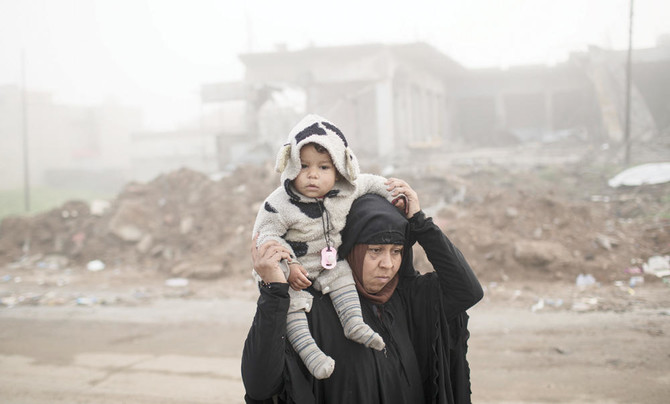
A woman carries her daughter as they flee fighting between Iraqi security forces and Daesh militants, on the western side of Mosul, Iraq, on April 2. (AP)
Updated 13 April 2017
Follow

Packed Iraq morgue reveals toll of Mosul conflict

QAYYARA, Iraq: The stench hits you long before you reach the morgue where the latest casualties of war between Daesh militants and Iraqi forces are kept.
Dr. Mansour Maarouf dons a surgical mask as he approaches the morgue refrigerator and pauses before pulling open the door to an icy blast. “In the name of God,” he says out of respect for the dead.
Inside, around two dozen corpses lie on the floor: Some in body bags, several wrapped in blankets and a few so torn to pieces they come in sacks.
Nearly all of them are victims of the ongoing battle to dislodge Daesh militants from Mosul, around 60 km further north. On the deadliest day so far, 21 bodies arrived at the hospital in the town of Qayyara.
The morgue gives a sense of the heavy toll the conflict is taking on civilians, but also highlights the practical challenges of dealing with the dead when infrastructure is ruined and administration has collapsed.
Staff at the hospital, which is run by aid group Women’s Alliance Health International (WAHA), purchased the cable connecting the morgue fridge to the power supply themselves, and space is limited.
“They (the Iraqi Health Ministry) have promised to provide us with shelves to increase the capacity,” said the doctor.
Until recently, the only place in the province authorized to issue death certificates was the department of forensic medicine in west Mosul, which remains under Daesh control.
That meant the dead had to be driven hundreds of kilometers to the cities of Tikrit or Erbil and often got held up at checkpoints on the way, if not turned back.
To resolve the issue, the Iraqi government has now authorized the hospital in Qayyara to issue death certificates, except when the victim’s identity or cause of death are unclear.
In those cases, the body is transferred to a new mortuary on the eastern side of Mosul, which is under the control of Iraqi security forces.
There, an autopsy is conducted if necessary, and the body is buried in a numbered grave so it can be found in future should someone come searching.
“We wait for a period (before burying the body), depending how full the fridges are,” said Dr. Modhar Alomary, who is in charge of the morgue, the sound of outgoing artillery in the background.
Alomary declined to say how many bodies he had received.
Bringing up the bodies
It might seem that Alomary’s workload would decrease once the battle for Mosul is over, but he expects the opposite.
That is when the task will begin of uncovering the mass graves where Daesh threw its opponents after executing them.
A sinkhole south of Mosul believed to be the largest site may contain as many as 4,000 bodies, according to Human Rights Watch.
One worker at the morgue knows the scale of Daesh’s two and half year killing spree better than most. He was an employee at the morgue in Mosul when Daesh overran the city in the summer of 2014 and kept working there until just over one month ago.
In that time, “huge numbers” of bodies passed through the morgue, he said, many of them civilians, former policeman and ex-soldiers killed by the militants. “Sometimes we got 20-25, 50 (bodies in a day).”
The militants, who assumed control of hospitals across Mosul and appointed an “Emir of Health,” did not allow the morgue workers to conduct autopsies on their victims.
As for Daesh’s own dead, the morgue worker said he was forced to fabricate the cause of death on the certificates of Iraqi fighters slain in battle, such as “car accident.”
That, to him, was an indication the militants anticipated defeat and wanted to make life easier for the families of its Iraqi members after Daesh.
Death certificates were not issued for foreign fighters because their only identity was a nom de guerre, he said.
During the battle for Mosul’s eastern half, the morgue worker said he had received the corpses of 72 militants in a single day, estimating a total of 2,000 had passed through in the three months it took Iraqi forces to rout them.
Iraqi forces are now struggling to dislodge Daesh from a few remaining districts in the west of the city, and the morgue worker said comparatively few dead militants had been brought in up until the point he left: “The number of civilian casualties is greater,” he said.
Many civilians killed in Mosul have been buried in gardens by relatives who were not able to reach a graveyard during the fighting and now want to dig up their loved ones and give them a proper burial.
Two men came to ask Dr. Alomary what they should do with the remains of several relatives who were among dozens of civilians killed in an air strike by the US-led coalition on the western Mosul Jadida district last month.
“We buried them by the side of the road and want to bring them here,” one of the men said to the doctor, who advised him to wait for Iraqi forces to finish clearing the rest of the city.
The bodies must also be dug up to get an official death certificate, which will enable victims’ relatives to claim compensation from the government.
But unless the authorities keep watch, people could take advantage of the chaos to fake deaths — whether to escape justice, or simply start a new life.


Gaza teen’s chances of walking again depends on Rafah reopening

Updated 3 sec ago
Follow

Gaza teen’s chances of walking again depends on Rafah reopening

  • Rimas Abu Lehia was wounded five months ago when Israeli troops opened fired toward a crowd mobbing an aid truck
  • Israel’s campaign in Gaza after the Hamas October 2023 attack has decimated the territory’s health sector
DEIR AL-BALAH, Gaza Strip: Rimas Abu Lehia was wounded five months ago when Israeli troops opened fired toward a crowd of hungry people mobbing an aid truck for food in Gaza and a bullet shattered the 15-year-old Palestinian girl’s left knee.
Now her best chance of walking again is surgery abroad. She is on a long list of more than 20,000 Palestinians, including 4,500 children, who have been waiting — some more than a year — for evacuation to get treatment for war wounds or chronic medical conditions, according to the Gaza Health Ministry.
Their hopes hinge on the reopening of the crucial Rafah border crossing between Gaza and Egypt, a key point under the nearly 4-month-old ceasefire between Israel and Hamas. Israel has announced the crossing would open in both directions on Sunday.
The Israeli military body in charge of coordinating aid to Gaza said Friday that “limited movement of people only” would be allowed. Earlier, Prime Minister Benjamin Netanyahu had said Israel will allow 50 patients a day to leave; others have spoken of up to 150 a day.
That’s a large jump from about 25 patients a week allowed to leave since the ceasefire began, according to UN figures. But it would still take anywhere from 130 to 400 days of crossings to get everyone in need out.
Abu Lehia said her life depends on the crossing opening.
“I wish I didn’t have to sit in this chair,” she said, crying as she pointed at the wheelchair she relies on to move. “I need help to stand, to dress, to go to the bathroom.”
Evacuations are critical as Gaza hospitals are decimated
Israel’s campaign in Gaza after the Hamas October 2023 attack on southern Israel that triggered the war has decimated the territory’s health sector — the few hospitals still working were overwhelmed by casualties. There are shortages of medical supplies and Israel has restricted aid entry.
Hospitals are unable to perform complicated surgeries for many of the wounded, including thousands of amputees, or treat many chronic conditions. Gaza’s single specialized cancer hospital shut down early in the war, and Israeli troops blew it up in early 2025. Without giving evidence, the military said Hamas militants were using it, though it was located in an area under Israeli control for most of the war.
More than 10,000 patients have left Gaza for treatment abroad since the war began, according to the World Health Organization.
After Israeli troops seized and closed the Rafah crossing in May 2024 and until the ceasefire, only around 17 patients a week were evacuated from Gaza, except for a brief surge of more than 200 patients a week during a two-month ceasefire in early 2025, according to WHO figures.
About 440 of those seeking evacuation have life-threatening injuries or diseases, according to the Health Ministry. More than 1,200 patients have died while waiting for evacuation, the ministry said Tuesday.
A UN official said one reason for the slow pace of evacuations has been that many countries are reluctant to accept the patients because Israel would not guarantee they would be allowed to return to the Gaza Strip. The official spoke on condition of anonymity because he was not authorized to discuss the issue. The majority of evacuees have gone to Egypt, the United Arab Emirates, Qatar and Turkiye.
He said it wasn’t clear if that would change with Rafah’s opening. Even with “daily or almost daily evacuations,” he said, the number is not very high. Also, Israel has said it will only allow around 50 Palestinians a day to enter Gaza while tens of thousands of Palestinians hope to go back.
Israel has also banned sending patients to hospitals in the Israeli-occupied West Bank and east Jerusalem since the war began, the official said — a move that cut off what was previously the main outlet for Palestinians needing treatment unavailable in Gaza.
Five human rights groups have petitioned Israel’s High Court of Justice to remove the ban. The court has not ruled. Still, one cancer patient in Gaza was allowed to travel to the West Bank for treatment on Jan. 11, after the Jerusalem District Court accepted a petition in his case by the Israeli rights group Gisha.
Thousands of cancer patients need evacuation
Gaza has more than 11,000 cancer patients and some 75 percent of the necessary chemotherapy drugs are not available, the Health Ministry said. At least 4,000 cancer patients need urgent treatment abroad, it added.
Ahmed Barham, a 22-year-old university student, has been battling leukemia. He underwent two lymph node removal surgeries in June but the disease is continuing to spread “at an alarming rate,” his father, Mohamed Barham, said.
“There is no treatment available here,” the elder Barham said.
His son, who has lost 35 kilograms (77 pounds), got on the urgent list for referral abroad this past week but still doesn’t have a confirmation of travel.
“My son is dying before my eyes,” the father said.
Desperate for Rafah to open
Mahmoud Abu Ishaq, a 14-year-old, has been waiting for more than a year on the referral list for treatment abroad.
The roof of his family home collapsed when an Israeli strike hit nearby in the southern town of Beni Suhaila. The boy was injured and suffered a retinal detachment.
“Now he is completely blind,” his father, Fawaz Abu Ishaq said. “We are waiting for the crossing to open.”
Abu Lehia was wounded in August, when she went out from her family tent in the southern city of Khan Younis, looking for her younger brother, Muhannad, she said. The boy had gone out earlier that morning, hoping to get some food off entering aid trucks.
At the time, when Gaza was near famine, large crowds regularly waited for trucks and pulled food boxes off them, and Israeli troops often opened fire on the crowds. The Israeli military said its forces were firing warning shots, but hundreds were killed over the course of several months, according to Gaza health officials.
When Abu Lehia arrived at the edge of a military-held zone from which the trucks were passing, dozens of people were fleeing as Israeli troops fired. A bullet hit Abu Lehia in the knee, and she fell to the ground screaming, she said.
At the nearby Nasser Hospital, she underwent multiple surgeries, but they were unable to repair her knee. Doctors told her she needs knee replacement surgery outside Gaza.
Officials told the family last month that she would be evacuated in January. But so far nothing has happened, said her father, Sarhan Abu Lehia.
“Her condition is getting worse day by day,” he said. “She sits alone and cries.”