AMSTERDAM: Global chemical weapons investigators have gone to Turkey to collect samples as part of an inquiry into an alleged chemical weapons attack in neighboring Syria last week that killed 87 people.
The fact-finding mission was sent by the Organization for the Prohibition of Chemical Weapons (OPCW) in The Hague to gather bio-metric samples and interview survivors, sources told Reuters on Thursday.
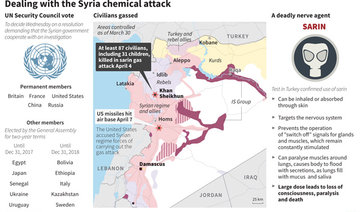
The toxic gas attack on April 4, which killed scores of people including children, prompted a US cruise missile strike on a Syrian air base and widened a rift between the United States and Russia, a close ally of Syrian President Bashar Assad in his conflict with rebels and militants fighting to oust him.
Syrian authorities have repeatedly denied using any chemical weapons. Russian officials said the gas had been released by an air strike on a poison gas storage depot controlled by rebels. Washington said that account was not credible, and rebels have denied it.
Samples taken from the poison gas site in Syria’s Idlib governorate tested positive for the nerve agent sarin, the British delegation at the OPCW said on Thursday.
“UK scientists have analyzed samples taken from Khan Sheikhoun. These have tested positive for the nerve agent sarin, or a sarin-like substance,” the delegation said during a special session on Syria at the OPCW in The Hague.
The UK result confirmed earlier testing by Turkish authorities that concluded that sarin had been used for the first time on a large scale in Syria’s civil war since 2013.
The OPCW mission will determine whether chemical weapons were used, but is not mandated to assign blame. Its findings, expected in 3-4 weeks, will be passed to a joint United Nations-OPCW investigation tasked with identifying individuals or institutions responsible for using chemical weapons.
International investigators have concluded that sarin, chlorine and sulfur mustard gas have been used in Syria’s six-year-old conflict, with government forces using chlorine and Daesh militants using sulfur mustard.
Last week’s poison gas attack in the town of Khan Sheikhoun in the rebel-held province of Idlib near the Turkish border was the most lethal since a sarin attack on Aug. 21, 2013 killed hundreds in a rebel-controlled suburb of the capital Damascus.


![]()

Chemical weapons experts in Turkey to investigate; UK confirms sarin use
Chemical weapons experts in Turkey to investigate; UK confirms sarin use


Latest updates


© 2026 SAUDI RESEARCH & PUBLISHING COMPANY, All Rights Reserved And subject to Terms of Use Agreement.