


Abu Sayyaf leader behind execution of foreigners is killed, Philippines says

Armed Forces of the Philippines (AFP) Chief of Staff Gen. Eduardo Ano (C) gestures during a news conference inside the military headquarters in Manila on Wednesday. With him are Vice Admiral Narciso Vingson and national police chief Ramon Apolinariio. (REUTERS/Romeo Ranoco)
Updated 12 April 2017
Follow

Abu Sayyaf leader behind execution of foreigners is killed, Philippines says

MANILA, Philippines: Philippines troops battling militants on a central resort island killed a young Abu Sayyaf commander who was involved in the beheadings of two Canadians and a German and who had sailed far from the extremists’ southern jungle hideouts to capture more hostages, the military chief said Wednesday.
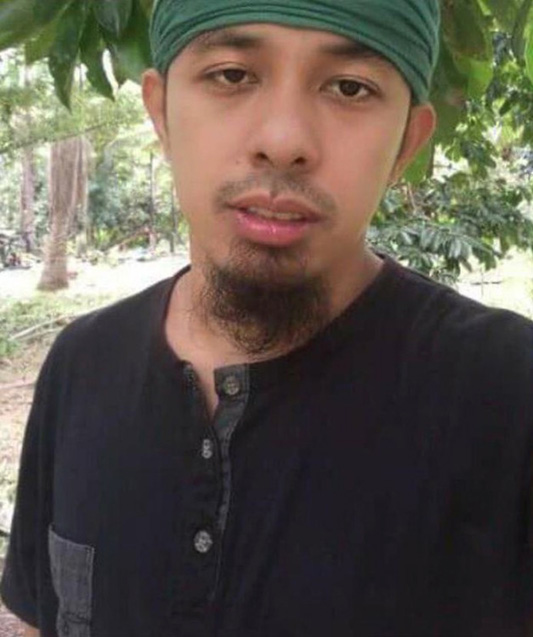
Military chief of staff Gen. Eduardo Ano told The Associated Press that troops recovered and identified the remains of Moammar Askali at the scene of the battle in a coastal village on Bohol island. Five other Abu Sayyaf gunmen, three soldiers and a policeman also were killed in Tuesday’s clashes.
Ano said captured Abu Sayyaf militants identified Askali from a photo troops took of the young militant leader after death, which confirmed that the gunmen who quietly cruised into Bohol on three motorboats Monday night then clashed with troops belonged to the Islamic extremist group. Askali, who used the nom de guerre Abu Rami, had partly served as an Abu Sayyaf spokesman in recent years.
“This is a major blow to the Abu Sayyaf,” Ano told The AP. “If they have further plans to kidnap innocent people somewhere, they will now have to think twice.”
Askali was an emerging hard-line leader of Abu Sayyaf and had pledged allegiance to the Daesh group. He had received bomb-making training from Malaysian Zulkifli bin Hir, or Marwan, a top Southeast Asia militant leader who was killed in 2015, according to a police profile.
It was Abu Sayyaf’s first known attempt to carry out ransom kidnappings deep in the central Philippines heartland, far from the group’s jungle lairs in the southern provinces of Sulu and Basilan. Ano said the troops were still hunting at least five Abu Sayyaf gunmen, though fighting had eased Wednesday.
While the bold kidnapping attempt appears to have been foiled, the militants’ success in penetrating the bustling region of beach resorts and other popular attractions could raise concern among tourists and businessmen.
Bohol island lies about 640 kilometers (397 miles) southeast of Manila and is about an hour by boat from Cebu province, a trade and tourism center which has hosted some of the meetings of the Association of Southeast Asian Nations, the regional bloc the Philippines is leading this year.
Ano said military intelligence operatives had been trying to track the movements of Askali’s group for several days after learning of their planned abductions.
The gunmen traveled on motorboats along a river to Inabanga’s Napo village, where government forces assaulted them, military spokesman Col. Edgard Arevalo said, adding that troops recovered four rifles and a homemade bomb from the dead gunmen.

                                                                                                            Moammar Askali

The US Embassy in Manila had earlier advised Americans to take precautions amid “unsubstantiated yet credible information” of possible kidnappings by terrorists in Bohol and other central areas.
The United States and the Philippines both list Abu Sayyaf as a terrorist organization for bombings, kidnappings for ransom and beheadings.
Abu Sayyaf militants have crossed the sea border with Malaysia on powerful speedboats and kidnapped scores of foreign tourists in past years, reflecting their growing capability and desperation for money. In 2001, they sailed as far as western Palawan province, where they seized 20 people, including three Americans, from a resort.
Philippine President Rodrigo Duterte has ordered troops to destroy the extremists and has threatened to declare martial law in the country’s south if the threat posed by the Abu Sayyaf and other extremist groups aligned with the Daesh group gets out of control.
Although Abu Sayyaf have been weakened by years of battle setbacks, they beheaded two Canadians last year and a German hostage earlier this year after ransom deadlines lapsed. Askali was involved in those kidnappings and the captives’ gruesome murders, Ano said.
The militants are still holding at least 29 captives in Sulu’s jungles, many of them foreign tugboat and cargo ship crewmen seized in the seas surrounded by southern Philippines, Malaysia and Indonesia.
___
Associated Press writer Teresa Cerojano contributed to this report.



Judge bars federal prosecutors from seeking the death penalty against Luigi Mangione

Updated 02 February 2026
Follow

Judge bars federal prosecutors from seeking the death penalty against Luigi Mangione

  • Judge Margaret Garnett’s Friday ruling foiled the Trump administration’s bid to see Mangione executed
  • Garnett dismissed a federal murder charge against Mangione, finding it technically flawed. She left in place stalking charges that could carry a life sentence

NEW YORK: Federal prosecutors can’t seek the death penalty against Luigi Mangione in the killing of UnitedHealthcare CEO Brian Thompson, a federal judge ruled Friday, foiling the Trump administration’s bid to see him executed for what it called a “premeditated, cold-blooded assassination that shocked America.”
Judge Margaret Garnett dismissed a federal murder charge that had enabled prosecutors to seek capital punishment, finding it technically flawed. She wrote that she did so to “foreclose the death penalty as an available punishment to be considered by the jury” as it weighs whether to convict Mangione.
Garnett also dismissed a gun charge but left in place stalking charges that carry a maximum punishment of life in prison. To seek the death penalty, prosecutors needed to show that Mangione killed Thompson while committing another “crime of violence.” Stalking doesn’t fit that definition, Garnett wrote in her opinion, citing case law and legal precedents.
In a win for prosecutors, Garnett ruled they can use evidence collected from his backpack during his arrest, including a 9mm handgun and a notebook in which authorities say Mangione described his intent to “wack” an insurance executive. Mangione’s lawyers had sought to exclude those items, arguing the search was illegal because police hadn’t yet obtained a warrant.
During a hearing Friday, Garnett gave prosecutors 30 days to update her on whether they’ll appeal her death penalty decision. A spokesperson for the US attorney’s office in Manhattan, which is prosecuting the federal case, declined to comment.
Garnett acknowledged that the decision “may strike the average person — and indeed many lawyers and judges — as tortured and strange, and the result may seem contrary to our intuitions about the criminal law.” But, she said, it reflected her “committed effort to faithfully apply the dictates of the Supreme Court to the charges in this case. The law must be the Court’s only concern.”
Mangione, 27, appeared relaxed as he sat with his lawyers during the scheduled hearing, which took place about an hour after Garnett issued her written ruling. Prosecutors retained their right to appeal but said they were ready to proceed to trial.
Outside court afterward, Mangione attorney Karen Friedman Agnifilo said her client and his defense team were relieved by the “incredible decision.”
Jury selection in the federal case is set for Sept. 8, followed by opening statements and testimony on Oct. 13. The state trial’s date hasn’t been set. On Wednesday, the Manhattan district attorney’s office urged the judge in that case to schedule a July 1 trial date.
“That case is none of my concern,” Garnett said, adding that she would proceed as if the federal case is the only case unless she hears formally from parties involved in the state case. She also said the federal case will be paused if the government appeals her death penalty ruling.
Thompson, 50, was killed on Dec. 4, 2024, as he walked to a midtown Manhattan hotel for UnitedHealth Group’s annual investor conference. Surveillance video showed a masked gunman shooting him from behind. Police say “delay,” “deny” and “depose” were written on the ammunition, mimicking a phrase used by critics to describe how insurers avoid paying claims.
Mangione, an Ivy League graduate from a wealthy Maryland family, was arrested five days later at a McDonald’s in Altoona, Pennsylvania, about 230 miles (about 370 kilometers) west of Manhattan.
Following through on Trump’s campaign promise to vigorously pursue capital punishment, Attorney General Pam Bondi ordered Manhattan federal prosecutors last April to seek the death penalty against Mangione.
It was the first time the Justice Department sought the death penalty in President Donald Trump’s second term. He returned to office a year ago with a vow to resume federal executions after they were halted under his predecessor, President Joe Biden.
Garnett, a Biden appointee and former Manhattan federal prosecutor, ruled after hearing oral arguments earlier this month.
Besides seeking to have the death penalty rejected on the grounds Garnett cited, Mangione’s lawyers argued that Bondi’s announcement flouted long-established Justice Department protocols and was “based on politics, not merit.”
They said her remarks, followed by posts to her Instagram account and a TV appearance, “indelibly prejudiced” the grand jury process resulting in his indictment weeks later.
Prosecutors urged Garnett to keep the death penalty on the table, arguing that the charges were legally sound and Bondi’s remarks weren’t prejudicial, as “pretrial publicity, even when intense, is not itself a constitutional defect.”
Prosecutors argued that careful questioning of prospective jurors would alleviate the defense’s concerns about their knowledge of the case and ensure Mangione’s rights are respected at trial.
“What the defendant recasts as a constitutional crisis is merely a repackaging of arguments” rejected in previous cases, prosecutors said. “None warrants dismissal of the indictment or categorical preclusion of a congressionally authorized punishment.”