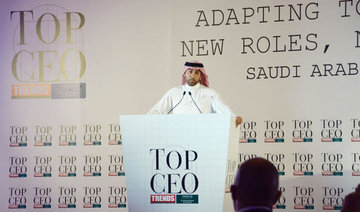
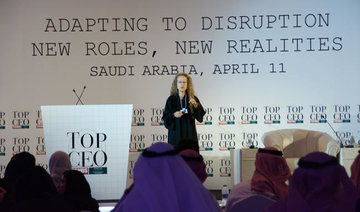
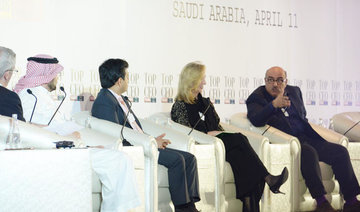
KING ABDULLAH ECONOMIC CITY: The growth of entrepreneurship in the Gulf region is held back by the fear of taking risks and possible failure, said panelists at the Top CEO Conference.
Encouraging small and medium-sized enterprises (SMEs), entrepreneurship and startups entails “a cultural shift” in a society that is not as accepting of failure compared to some other markets, said Iyad Malas, founding partner of the private equity firm Gateway Partners.
“That’s something (seen) culturally in our part of the world… we have an issue around saying ‘I’ve done something and failed’,” he said, adding that the greatest lessons are learned after failures.
This obstacle extends to the wider Asian region, according to Lawrence Morgan, CEO of Nest Global. He is based in Hong Kong, where he said many parents do not permit their children to engage in entrepreneurial activities and would rather they hold more stable jobs.
“The biggest impediment for people starting their business in Asia is parents’ permission. What parents would say is that ‘I spend all this money on your education for you to then go and be a failure… you’re going to become a lawyer or a banker (which is) what I envisioned for you’,” Morgan said at a panel discussion on the so-called “broken job machine.”
Boosting SMEs falls under the goals of the Saudi Vision 2030 as it is considered a major agent of economic growth that creates jobs and supports innovation.
SMEs comprise nearly 25 percent of the Saudi labor force, according to a report published by Jeddah Chamber of Commerce and Industry (JCCI) in April 2016. Out of the 25 percent, only 10 percent are Saudi nationals.
The wider range of SMEs is represented by the middle class, which Amr Khashoggi, vice president of human resources and group affairs at Zahid Group, described as “the backbone” of the economy. “Without the middle class you lose the backbone of any economy. SMEs are provider of jobs,” he said.
Introducing business education at a younger age in schools was addressed as one of the main drivers of SMEs and start-ups. On-the-job training and collaboration between businesses is also required to sharpen entrepreneurship skills.
Khashoggi said there was a lack of collaboration in the entrepreneurship space in Saudi Arabia. “I don’t think SME incubators that exist today are doing a very good job,” he said.
On the same note, business people that have been successful should reinvest locally in new entrepreneurs, Morgan suggested. “That will create a great cycle of investment that then can really try and foster a new economy,” he said.
According to the JCCI report, Saudi Arabia, which is the largest economy in the Gulf region, is home to almost 20 percent of the total SMES in the Middle East North Africa region.

How ‘fear of failure’ is holding back Gulf entrepreneurs
Saudi Maaden reports 156% profit surge to $2bn on strong commodity prices, record production
RIYADH: Saudi mining and metals company Maaden has reported a 156 percent jump in its net profit attributable to shareholders for 2025, driven by higher commodity prices, record production volumes, and a one-off bargain purchase gain.
The state-backed giant posted a net profit of SR7.35 billion ($1.95 billion) for the full year 2025, an increase from SR2.87 billion in the previous year. The firm’s revenue surged by 19 percent to SR38.58 billion, up from SR32.55 billion in 2024.
This comes as Saudi Arabia steps up efforts to expand its mining sector as a pillar of economic diversification, encouraging international participation and private investment to unlock the Kingdom’s estimated $2.5 trillion in untapped mineral resources under Vision 2030.
In a statement on Tadawul, the company said: “Performance was led by record phosphate production, near record aluminum production, an increase in all three of Maaden’s main output commodity prices.”
The performance was also fueled by a 60 percent increase in gross profit, which reached SR14.79 billion. In its annual results announcement, Maaden attributed the top-line growth to “higher commodity market prices for phosphate, aluminum and gold business units,” as well as increased sales volumes in its phosphate and aluminum segments. This was partially offset by slightly lower sales volume in the gold unit.
Maaden’s CEO, Bob Wilt, hailed 2025 as a transformative year for the company, marked by strategic growth and operational excellence. “This was a great year for Maaden’s strategic growth. We delivered strong financial results and sustained operational excellence across the business,” he said in a statement.
“This was driven by growth in production across all businesses, including record-breaking DAP (di-ammonium phosphatevolumes), disciplined cost control across and a clear commitment to our role as a cornerstone of the Saudi economy,” Wilt added.
Profitability was further bolstered by an increased share of net profit from joint ventures and an associate. This included a one-off bargain purchase gain of SR768 million related to Maaden’s investment in Aluminium Bahrain B.S.C. The company also benefited from lower finance costs.
The fourth quarter of 2025 was strong, with Maaden swinging to a net profit of SR1.67 billion, compared to a loss of SR106 million in the same period of the prior year. Quarterly revenue rose 7 percent to SR10.64 billion.
The firm achieved record production of di-ammonium phosphate, reaching 6.72 million tonnes for the year, a 9 percent increase. Aluminum production remained near-record levels, while the company added a net 7.8 million ounces to its reportable gold mineral resources through discovery and resource development.
The phosphate division saw sales jump 17 percent to SR20.77 billion, with the earnings before interest, taxes, depreciation, and amortization margin expanding to 47 percent. The aluminum business reported a 9 percent increase in sales to SR10.99 billion, with EBITDA more than doubling in the fourth quarter.
Looking ahead, Wilt emphasized that the pace of growth will accelerate as the company advances key initiatives, including the Phosphate 3 Phase 1 and Ar Rjum projects, which remain on budget and schedule. Maaden has also secured a gas supply for its future Phosphate 4 project.
“This pace of growth will only accelerate. Not only as we advance projects and increase the scale of our exploration program, but as we continue to grow production and implement technology that will further modernize, streamline and unlock value,” Wilt added.
Earnings per share for the year rose sharply to SR1.91, up from SR0.78 in 2024. Total shareholders’ equity increased by 18.7 percent to SR61.59 billion.