MANILA: The Philippine Court of Appeals has upheld a guilty verdict on a US Marine for killing a transgender woman nearly three years ago, a case that stirred debate over the US military presence in its former colony.
A lower court had found Lance Corporal Joseph Scott Pemberton guilty of killing Jennifer Laude in a hotel in Olongapo, outside a former US navy base northwest of the capital, in 2014.
He was jailed for between six and 10 years on a Philippine military base.
Pemberton had admitted choking but not killing Laude after, he said, he discovered that the person he was with was not a woman. He had been charged with murder but was convicted of the lesser offense of homicide, which does not require malicious intent.
In a ruling dated April 3, but only made public on Monday, the Court of Appeals denied Pemberton’s appeal due to “lack of merit.”
It also raised the compensation he must pay Laude’s family to 150,000 pesos ($3,000) from 80,000 pesos.
The killing stoked anger over the presence of US soldiers on Philippine soil after senators voted two decades ago shut US bases because of social issues, including crimes committed by servicemen.
The two countries are close military allies and the United States has for years led dozens of joint training exercises in the Philippines.
But the relationship has soured under Philippine President Rodrigo Duterte who says the US military presence makes his country a target for conflict, especially if tensions escalate between the United States and China in the South China Sea.
Duterte announced a “separation” from the United States in October, declaring he had realigned with China as the two agreed to resolve their South China Sea dispute through talks.
He has threatened repeatedly to scrap a series of defense pacts with the United States, but taken no concrete steps to do so, and Philippine defense officials frequently reaffirm the strength of the relationship. (Reporting by Neil Jerome Morales)


Philippine court upholds guilty verdict on US soldier in transgender’s killing

Philippine court upholds guilty verdict on US soldier in transgender’s killing
Bangladesh halts controversial relocation of Rohingya refugees to remote island
- Administration of ousted PM Sheikh Hasina spent about $350m on the project
- Rohingya refuse to move to island and 10,000 have fled, top refugee official says
DHAKA: When Bangladesh launched a multi-million-dollar project to relocate Rohingya refugees to a remote island, it promised a better life. Five years on, the controversial plan has stalled, as authorities find it is unsustainable and refugees flee back to overcrowded mainland camps.
The Bhasan Char island emerged naturally from river sediments some 20 years ago. It lies in the Bay of Bengal, over 60 km from Bangladesh’s mainland.
Never inhabited, the 40 sq. km area was developed to accommodate 100,000 Rohingya refugees from the cramped camps of the coastal Cox’s Bazar district.
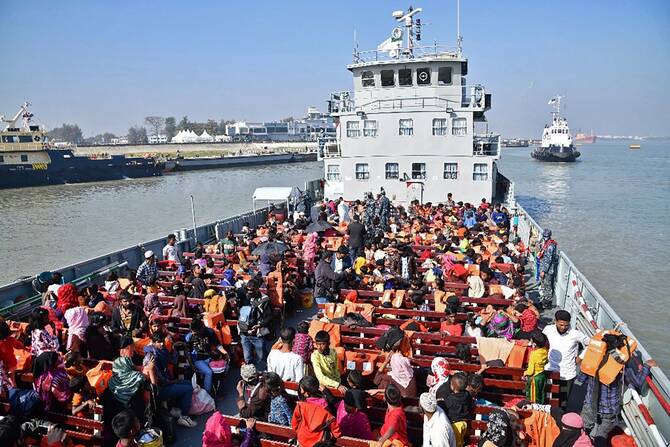
Relocation to the island started in early December 2020, despite protests from the UN and humanitarian organizations, which warned that it was vulnerable to cyclones and flooding, and that its isolation restricted access to emergency services.
Over 1,600 people were then moved to Bhasan Char by the Bangladesh Navy, followed by another 1,800 the same month. During 25 such transfers, more than 38,000 refugees were resettled on the island by October 2024.
The relocation project was spearheaded by the government of former Prime Minister Sheikh Hasina, who was ousted last year. The new administration has since suspended it indefinitely.
“The Bangladesh government will not conduct any further relocation of the Rohingya to Bhasan Char island. The main reason is that the country’s present government considers the project not viable,” Mizanur Rahman, refugee relief and repatriation commissioner in Cox’s Bazar, told Arab News on Sunday.
The government’s decision was prompted by data from UN agencies, which showed that operations on Bhasan Char involved 30 percent higher costs compared with the mainland camps in Cox’s Bazar, Rahman said.
“On the other hand, the Rohingya are not voluntarily coming forward for relocation to the island. Many of those previously relocated have fled ... Around 29,000 are currently living on the island, while about 10,000 have returned to Cox’s Bazar on their own.”
A mostly Muslim ethnic minority, the Rohingya have lived for centuries in Myanmar’s western Rakhine state but were stripped of their citizenship in the 1980s and have faced systemic persecution ever since.
In 2017 alone, some 750,000 of them crossed to neighboring Bangladesh, fleeing a deadly crackdown by Myanmar’s military. Today, about 1.3 million of them shelter in 33 camps in the coastal Cox’s Bazar district, making it the world’s largest refugee settlement.
Bhasan Char, where the Bangladeshi government spent an estimated $350 million to construct concrete residential buildings, cyclone shelters, roads, freshwater systems, and other infrastructure, offered better living conditions than the squalid camps.
But there was no regular transport service to the island, its inhabitants were not allowed to travel freely, and livelihood opportunities were few and dependent on aid coming from the mainland.
Rahman said: “Considering all aspects, we can say that Rohingya relocation to Bhasan Char is currently halted. Following the fall of Sheikh Hasina’s regime, only one batch of Rohingya was relocated to the island.
“The relocation was conducted with government funding, but the government is no longer allowing any funds for this purpose.”
“The Bangladeshi government has spent around $350 million on it from its own funds ... It seems the project has not turned out to be successful.”


