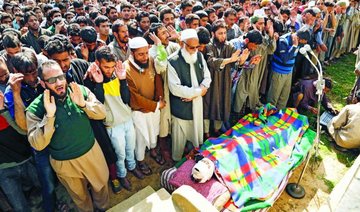
SRINAGAR, Indian-administered Kashmir: Six civilians were killed in Indian-administered Kashmir Sunday when police opened fire at protesters who stormed polling stations during a by-election for a parliamentary seat, a top officer said.
State and paramilitary police fired bullets and shotgun pellets as thousands of protesters shouting slogans against Indian rule charged into voting booths in Budgam district near the main city of Srinagar.
“Violent protests happened at many places in Budgam. Protesters damaged and snatched electronic voting machines (EVMs) at some places,” Shantmanu, the state’s chief electoral officer, told AFP.
“Six persons have died so far in the violence,” said Shantmanu, who uses only one name.
In the Charare-e-Sharif area of Budgam two people were killed when the paramilitary Border Security Force fired at protesters, he said.
In the Beerwah area of the same district the paramilitary police opened fire at a stone-throwing crowd, killing another person.
Two more were killed in the continuing clashes, with one of them succumbing to multiple pellet injuries from the shotguns which Indian paramilitary forces use in Kashmir for crowd control.
Polling had to be halted in at least 10 places amid a call by top Kashmiri separatist leaders opposed to Indian rule to boycott the by-election.
Former state Chief Minister Farooq Abdullah, who is contesting the Srinagar seat, slammed the government for its failure to maintain law and order.
“Elections should have been peaceful. This government has failed in giving a peaceful atmosphere for people to come and vote,” he told reporters.
Ahead of the polling, authorities suspended Internet services across the Kashmir Valley for fear of widespread protests.
Police had also detained hundreds of young people and separatist activists in the run-up to the poll, sources told AFP.
Kashmir has been divided between India and Pakistan since the end of British rule in 1947. Both claim the disputed territory in its entirety.
Rebel groups in Indian Kashmir have for decades battled troops and police, demanding independence or a merger of the territory with Pakistan. Around 500,000 Indian soldiers are deployed in the region.
Ahead of Sunday’s polling, the Indian government had sent in 20,000 additional paramilitaries.
Armed encounters between rebels and government forces have become more frequent since the killing of a popular rebel leader by security forces last July sparked widespread unrest.
Police and army officials say dozens of local youths have joined the rebel ranks since then.

Six dead after Indian police open fire at Kashmir protesters
Uganda army denies seizing opposition leader as vote result looms
- Election day was marred by significant technical problems after biometric machines
- There were also reports of violence against the opposition in other parts of the country
KAMPALA: Uganda’s army denied claims on Saturday that opposition leader Bobi Wine had been abducted from his home, as counting continued in an election marred by reports of at least 10 deaths amid an Internet blackout.
President Yoweri Museveni, 81, looked set to be declared winner and extend his 40-year rule later on Saturday, with a commanding lead against Wine, a former singer turned politician.
Wine said Friday that he was under house arrest, and his party later wrote on X that he had been “forcibly taken” by an army helicopter from his compound.
The army denied that claim.
“The rumors of his so-called arrest are baseless and unfounded,” army spokesman Chris Magezi told AFP.
“They are designed to incite his supporters into acts of violence,” he added.
AFP journalists said the situation was calm outside Wine’s residence early Saturday, but they were unable to contact members of the party due to continued communications interruptions.
A nearby stall-owner, 29-year-old Prince Jerard, said he heard a drone and helicopter at the home the previous night, with a heavy security presence.
“Many people have left (the area),” he said. “We have a lot of fear.”
With more than 80 percent of votes counted on Friday, Museveni was leading on 73.7 percent to Wine’s 22.7, the Electoral Commission said.
Final results were due around 1300 GMT on Saturday.
Wine, 43, whose real name is Robert Kyagulanyi, has emerged as the main challenger to Museveni in recent years, styling himself the “ghetto president” after the slum areas where he grew up in the capital, Kampala.
He has accused the government of “massive ballot stuffing” and attacking several of his party officials under cover of the Internet blackout, which was imposed ahead of Thursday’s polls and remained in place on Saturday.
His claims could not be independently verified, but the United Nations rights office said last week that the elections were taking place in an environment marked by “widespread repression and intimidation” against the opposition.
- Reports of violence -
Analysts have long viewed the election as a formality.
Museveni, a former guerrilla fighter who seized power in 1986, has total control over the state and security apparatus, and has ruthlessly crushed any challenger during his rule.
Election day was marred by significant technical problems after biometric machines — used to confirm voters’ identities — malfunctioned and ballot papers were undelivered for several hours in many areas.
There were reports of violence against the opposition in other parts of the country.
Muwanga Kivumbi, member of parliament for Wine’s party in the Butambala area of central Uganda, told AFP’s Nairobi office by phone that security forces had killed 10 of his campaign agents after storming his home.