DIYARBAKIR, TURKEY: In rallies from the Kurdish southeast to the northern Black Sea coast, Turkish President Tayyip Erdogan has seemed to attempt the impossible: win over both nationalists and Kurds with threats to make spring a “black winter” for Kurdish militants.
In campaign speeches ahead of an April 16 referendum on increasing his powers, Erdogan has signalled that army operations to crush Kurdistan Workers Party (PKK) militants could intensify and spread into Syria and Iraq in the months ahead.
“With God’s permission, it will be spring for Turkey and the Turkish people and a black winter for terrorists,” Erdogan told supporters on Monday in Trabzon, a heavily nationalist town on the Black Sea coast.
Such fighting talk plays well with nationalists who abhor the idea of renewed peace talks with the PKK, which first took up arms more than three decades ago and is considered a terrorist group by Turkey, the United States and European Union.
But it is a message he has also taken to the largely Kurdish southeast, courting those conservative Kurds who blame the militants for an upsurge in violence that the United Nations says has killed 2,000 people and displaced half a million since a cease-fire collapsed in July 2015.
“Could there be peace with those who walk around with weapons in their hands?” Erdogan said, addressing a crowd of several thousand waving Turkish flags amid tight security in the region’s largest city Diyarbakir last Saturday.
“Nobody can divide our land. Those who try will find our armed forces, our police, our village guards up against them.”
On the surface, life appears to have returned to normal in parts of Diyarbakir. But heavily armed security forces man checkpoints in some areas, and disillusionment and anger at both the state and the PKK run deep.
Bombed-out buildings and heaps of rubble are contained within the Roman-era walls of its ancient Sur district, devastated last year by tanks and artillery when security forces fought PKK militants who dug trenches and laid explosives.
“There is great pessimism across the region,” said Yavuz Celik, 32, a local shopkeeper.
“There’s always pressure. We’re even scared of gathering in small groups ... During the peace process it was very different. We were even able to dance together in the street here.”
POLITICIANS JAILED
Opinion polls suggest a tight race in the referendum, although the latest research this week suggests momentum is swinging in Erdogan’s favor, putting support for the constitutional changes at around 53 percent.
Erdogan risked a nationalist backlash when he launched peace talks with the PKK in 2012, a move praised by European allies and seen as a step toward unlocking the economic potential of Turkey’s southeast bordering Syria, Iran and Iraq.
There has been heavy fighting since the cease-fire broke down almost two years ago and Erdogan’s pitch for support in the referendum has run into opposition from the pro-Kurdish opposition.
The pro-Kurdish HDP, the second largest opposition group in parliament, played a key role as a mediator in the peace process. But its leaders and thousands of its members, who oppose any greater powers for Erdogan in the referendum, have been jailed over the past year for alleged militant links.
HDP co-leader Selahattin Demirtas, who has called for a “no” vote in the referendum, issued a defiant statement from jail this week, calling on people to resist what he called the “tyranny” of a government creating “an atmosphere of fear.”
“The closure of political channels unfortunately empowers those in the Kurdish movement who believe armed means are legitimate,” said Diba Nigar Goksel, Turkey director for the International Crisis Group think tank.
“There is no durable military solution to Turkey’s PKK conflict,” she said. “Peace talks between Ankara and the PKK are the only way forward for a durable solution.”
SYRIA AND IRAQ
Nationalists in Turkey have been incensed by the growing sway of Kurdish militia fighters in Syria and the presence of PKK leaders in northern Iraq, an issue which Erdogan suggested he would address in future military operations.
Turkey’s conflict with the PKK has been fueled in recent years by events across the border in Syria, where the Kurdish YPG militia has enjoyed US support in the fight against Islamic State, and in Iraq, where Ankara fears the militants are exploiting a security vacuum.
Erdogan described Turkey’s “Euphrates Shield” operation, an incursion into northern Syrian to push back Islamic State and try to prevent YPG gains, as just a first phase and spoke of a “roadmap” for more operations both there and in Iraq.
“It is not an operation which only has a Syrian dimension. This matter has an Iraqi dimension too,” he said in a television interview on Tuesday evening.


![]()
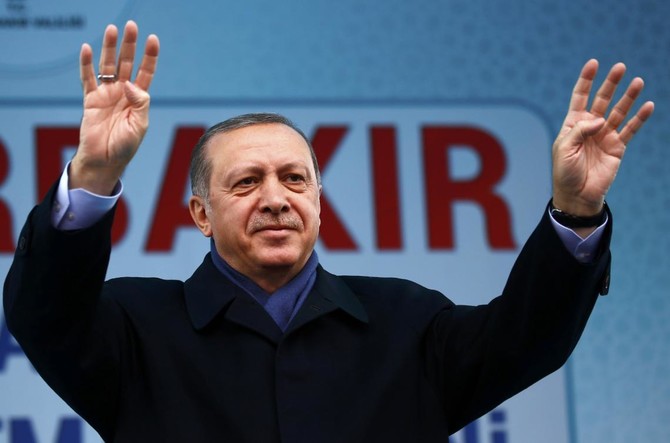
Turkey’s Erdogan courts nationalists, Kurds alike with hard line on PKK
Turkey’s Erdogan courts nationalists, Kurds alike with hard line on PKK
Latest updates



© 2026 SAUDI RESEARCH & PUBLISHING COMPANY, All Rights Reserved And subject to Terms of Use Agreement.