India, Britain talk up post-Brexit trade prospects

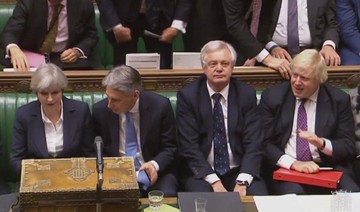
Philip Hammond, right, talks to Arun Jaitley during a joint press conference in New Delhi on Tuesday. (AP)
Updated 05 April 2017
Follow

India, Britain talk up post-Brexit trade prospects

NEW DELHI: India and Britain on Tuesday talked up their prospects of developing a new trading relationship, as their finance ministers met in New Delhi to prepare for the UK’s exit from the EU.

British Finance Minister Philip Hammond flew in to New Delhi for talks with Indian counterpart Arun Jaitley, days after Prime Minister Theresa May triggered the start of the Brexit process after last June’s referendum vote to quit the EU.
Hammond played down the risks of a so-called “hard Brexit,” in which Britain would lose access to the markets of the bloc’s other 27 nations if the two sides cannot reach a consensus deal within a two-year deadline.
“We have made the decision that we will not be part of the structure of the EU, but we have also made very clear that we want to negotiate the maximum possible open trade relationship with the EU,” Hammond told a news conference after a joint economic and financial dialogue.
“We hope to be able to negotiate a deep and special relationship with the EU that will allow us to go on trading and investing in each other’s economy, but at the same time allow us to rebuild our relationships with our partners and allies around the world.”
In India, the world’s fastest-growing large economy with a population of 1.3 billion, Britain has a massive market opportunity — but also a counterpart not known for favoring free trade.
May met a cool reception on her first visit to India last November, with Prime Minister Narendra Modi stressing the importance not only of trade but also of freedom of movement for his country’s skilled workers.
Still, Jaitley struck a positive note by saying, “The UK, post-Brexit, is looking at a different level of relationship with India. And there’s a huge aspiration in India itself also, to add to, and improve on, this relationship.”
No formal negotiations on a bilateral free trade agreement would be possible until Britain has formally left the EU, but Hammond said the two sides would have a “deep discussion” in the meantime.
In a joint statement, the ministers highlighted a pact for each country to invest 120 million pounds ($149 million) in a joint fund under India’s National Investment and Infrastructure Fund to invest in energy and renewables.
They also discussed efforts to make India’s rupee currency more freely tradable on international markets, and promote ‘masala’ bonds for Indian companies to borrow in their own currency from investors in the City of London.
The National Highways Authority of India, the Indian Renewable Energy Development Agency and the Indian Railway Finance Corporation all plan to issue masala bonds in the coming months, they added.

Lawsuit challenges Trump administration’s ending of protections for Somalis

Updated 10 March 2026
Follow

Lawsuit challenges Trump administration’s ending of protections for Somalis

  • The lawsuit cites a series of statements Trump has made describing Somalis as “garbage” and “low IQ people” who “contribute nothing.”

BOSTON: Immigrant rights advocates filed a lawsuit on Monday seeking to stop US President Donald Trump’s administration from next ​week ending legal protections that allow nearly 1,100 Somalis to live and work in the United States. The lawsuit, brought by four Somalis and two advocacy groups, challenges the US Department of Homeland Security’s decision to end Temporary Protected Status for Somali immigrants, whom Trump has derided in public remarks. Outgoing Homeland Security Secretary Kristi Noem in January announced that TPS for Somalis would end on March 17, arguing that Somalia’s conditions had improved, despite fighting continuing between Somali forces and Al-Shabab militants. The plaintiffs, who ‌include the groups ‌African Communities Together and Partnership for the Advancement ​of ‌New ⁠Americans, in the ​lawsuit filed ⁠in Boston federal court argue the move was procedurally flawed and driven by a discriminatory, predetermined agenda.
The lawsuit cites a series of statements Trump has made describing Somalis as “garbage” and “low IQ people” who “contribute nothing.”
The plaintiffs said the administration is ending TPS for Somalia and other countries due to unconstitutional bias against non-white immigrants, not based on objective assessments of country conditions.
“The termination of TPS for Somalia is racism masking as immigration policy,” ⁠Omar Farah, executive director at the legal group Muslim Advocates, said ‌in a statement.
DHS did not respond to ‌a request for comment. It has previously said TPS ​was “never intended to be a de ‌facto amnesty program.”
TPS is a form of humanitarian immigration protection that shields eligible migrants ‌from deportation and allows them to work. Under Noem, DHS has moved to end TPS for a dozen countries, sparking legal challenges. The administration on Saturday announced plans to pursue an appeal at the US Supreme Court in order to end TPS for over 350,000 Haitians. It ‌also wants the high court to allow it to end TPS for about 6,000 Syrians.

SOMALI COMMUNITY TARGETED
Somalia was first designated ⁠for TPS in ⁠1991, with its latest extension in 2024. About 1,082 Somalis currently hold TPS, and 1,383 more have pending applications, according to DHS. Somalis in Minnesota in recent months had become a target of Trump’s immigration crackdown, with officials pointing to a fraud scandal in which many people charged come from the state’s large Somali community. The Trump administration cited those fraud allegations as a basis for a months-long immigration enforcement surge in Democratic-led Minnesota, during which about 3,000 immigration agents were deployed, spurring protests and leading to the killing of two US citizens by federal agents.
In November, Trump announced he would end TPS for Somalis in Minnesota, and a month later said ​he wanted them sent “back to where they ​came from.”
The US Department of State advises against traveling to Somalia, citing crime and civil unrest among numerous factors.