GENEVA: The UN on Friday said “incremental” progress was made during a fifth round of talks between Syria’s warring parties, but warned the “real peace negotiations” had yet to begin.
Syrian government and opposition representatives had been “serious and engaged” during the latest nine days of talks in Geneva, UN mediator Staffan de Mistura told reporters.
He said all sides were “keen and ready to return to Geneva for a sixth round of talks,” adding that he would announce the date after discussions next week with UN chief Antonio Guterres and the UN Security Council.
The two sides, who met with de Mistura separately, did finally delve into some substance, after spending four previous rounds squabbling over the agenda.
They began discussing four separate “baskets” of issues, on governance, drafting a new constitution, elections and combating terrorism in the war-ravaged country.
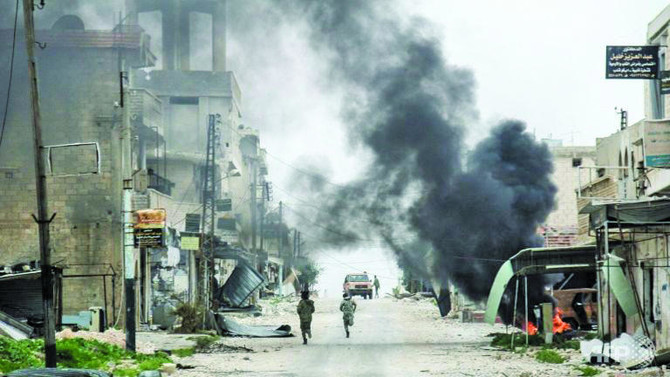
There was never much hope of a breakthrough, with the sides hopelessly deadlocked over the fate of President Bashar Assad and violence persisting in a six-year conflict that has already claimed more than 320,000 lives.
De Mistura previously warned not to expect “miracles” and on Friday hailed the fact that no one had walked out. He acknowledged though that the talks still remained in the preparation stage.
“In every negotiation there are certain issues that need to be prepared... before the real, real peace negotiations start... and it is clear, we are not quite there,” he said.
“I cannot deny that there are serious challenges, and I am not seeing immediately this developing into a peace agreement,” he added.
He insisted that “we must maintain this incremental momentum on the political process, even if it is only incremental.”
The negotiating sides hailed that negotiations on substance had finally begun, but appeared less optimistic than their mediator that progress was being made.
Nasr Al-Hariri, the chief negotiator for the opposition High Negotiations Committee (HNC), lamented to reporters that the opposition was dealing with “a side that does not want to reach a political solution.”
The chief negotiator on the government side, Syria’s Ambassador to the UN Bashar Al-Jaafari, was even more pessimistic. “We were looking forward to achieving... at least some progress in this round, but this did not happen,” he told reporters.
He maintained that his opponents “do not want a political solution, unless (it) is in accordance with their illusions... that we would hand over the keys of Syria to them.”
The Syrian government appears to have little reason to make concessions.
The rebels increasingly find themselves on the back foot, both on the ground, where they have been haemorrhaging territory, and when it comes to international support.
The US, long the opposition’s most powerful backer, acknowledged Thursday that it is no longer focused on ousting Assad as it seeks a new strategy to end Syria’s civil war.
Other opposition backers have been indicating the same, even as government supporters Russia and Iran wield increasing influence.
De Mistura on Friday meanwhile dismissed a barrage of rumors he was preparing to step down.
Only “if and when you will hear it directly either from the secretary-general or from myself, then you have to take it very seriously,” he told reporters.

‘Real’ Syria peace negotiations yet to start, says UN
Lebanon calls for pressure to be put on Israel to prevent violations of international law
- Israeli forces conduct operation in Lebanon, abduct official, kill 4 Lebanese people including child
BEIRUT: Lebanese Prime Minister Nawaf Salam has instructed the Ministry of Foreign Affairs to act with the UN to put pressure on Israel to disclose the fate of a Lebanese citizen abducted by the Israeli army early on Monday.
Israelis reportedly crossed into Lebanese territory, entering the town of Habbariyeh in the Hasbaya District, and abducted the citizen from his home.
This incursion and abduction is the first of its kind since the cessation of hostilities between the countries.
Meanwhile, Israel continued its airstrikes on Monday, killing three people, including a 4-year-old child, when a civilian vehicle was targeted.
A sniper also shot another person in the border town of Ayta ash Shab, who reportedly later died.
Atwi Atwi was the man added to the list of Lebanese prisoners in Israel, bringing the total to 24. Three of the prisoners were captured before the last Israeli war on Lebanon.
An Israeli force from the 210th Brigade in the Mount Dov area reportedly infiltrated from the Ruwaisat Al-Alam outpost toward Sadanah Hill, traveling on foot for about an hour before reaching a house on the outskirts of Habbariyeh.
The soldiers stormed the house and handcuffed Atwi’s wife. Atwi, 65, attempted to resist but was captured and taken toward Israeli border positions.
The abducted official was the former mayor of Habbariyeh and the head of the Islamic Group in Hasbaya and Marjeyoun, an ally of Iran-backed Hezbollah in its recent war. He works in social and humanitarian affairs in the area, according to several residents.
An Israeli army statement confirmed Atwi’s abduction in a “nighttime operation” which had been formulated on intelligence information gathered in recent weeks. The statement added that he was transferred to Israel for interrogation and that weapons were found inside the building.
The statement also affirmed that the Israeli army would continue its operations to eliminate “threats on the northern front.”
The Israeli escalation came a day after Salam’s visit to the border region, which left residents in the south with the impression that “the state stands with them.”
In a statement issued on Monday, Salam said that “the incident constitutes a blatant assault on Lebanon’s sovereignty, a violation of the declaration of cessation of hostilities, and a flagrant breach of international law.”
He stressed that “it will remain a national priority, and the state will follow up on it through all diplomatic and legal channels in place.”
The local municipality convened a meeting with a delegation from the UN Interim Force in Lebanon to brief it on the incident, and residents of the area of the abduction organized a protest expressing their fear that “Israeli practices prevalent in the 1970s could return, when Israeli soldiers used to infiltrate deep into populated areas.”
Bassam Hammoud, deputy head of the political bureau of the Islamic Group in Lebanon, said that the group was “committed to the decisions of the Lebanese state and to what has been approved under the cessation of hostilities agreement.”
Hammoud added: “We have taken no actions outside the framework of this agreement, whether military, field-based, or otherwise. And even if they found a rifle inside the house (belonging to Atwi), so what? Is there any Lebanese home that does not have a rifle inside?”
The Islamic Group issued a statement which held “the Israeli occupation fully responsible for any harm that may befall the abducted individual.”
Meanwhile, the Israeli army said that it had targeted a civilian vehicle near the town of Yanouh, describing the attack as “an airstrike to assassinate Hezbollah’s Head of Artillery Ahmad Ali Salami, in (the) Yanouh area.”
The Israeli army said in a statement: “Ahmad carried out numerous terror attacks throughout the war against IDF troops and Israel, and recently operated to rehabilitate Hezbollah’s artillery capabilities from within the civilian population in Lebanon, in violation of the ceasefire understandings.”
The airstrike killed Salami, 4-year-old Ali Hassan Jaber and his father Hassan.
Lebanese Interior Minister Ahmad Al-Hajjar condemned the attack, noting that Hassan Jaber was “a member of the Internal Security Forces who was killed while passing by with his son near the site targeted by the Israeli airstrike in the town of Yanouh.”
Al-Hajjar also condemned the abduction of Atwi from his home, describing the act as “an unacceptable transgression and a flagrant violation of Lebanese sovereignty and security.”
The Israeli army claimed that it was “aware of allegations indicating that uninvolved civilians had fallen as a result of the strike,” explaining that, prior to carrying it out, “measures were taken aimed at limiting subsequent harm to civilians, including the use of precision munitions and the conduct of aerial surveillance, and it regrets any harm that befell uninvolved civilians.”
It added: “The Israeli army is working to reduce damage as much as possible, and the incident is under review.”