African woman targeted in fresh mob violence in India

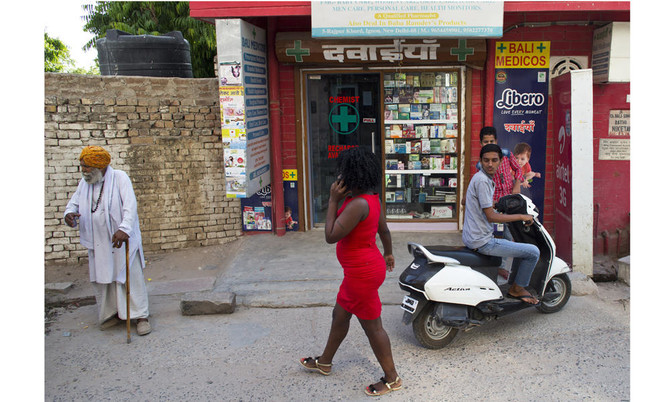
In this June 8, 2016 file photo, an African woman walks through one of the few neighborhoods that rents apartments to people of African origin in New Delhi, India. Mobs of Indians have repeatedly attacked African students in a New Delhi suburb in recent days after rumors that a local boy had been kidnapped by Nigerians. (AP Photo/Saurabh Das, File)
Updated 29 March 2017
Follow

African woman targeted in fresh mob violence in India

NEW DELHI: A Kenyan woman was attacked Wednesday, Indian police said, in the same northern city where a mob had assaulted African students following the death of a local teenager from a suspected drug overdose.
The woman was allegedly dragged out of a taxi and repeatedly slapped and kicked by unknown assailants as she returned to her home in Greater Noida, a satellite city outside India’s capital New Delhi.
“She has lodged a formal complaint and alleged that four to five men attacked her. We have launched an investigation,” senior police officer Sujata Singh told AFP.
The 25-year-old student suffered bruising from the attack and was taken to hospital for treatment, Singh said.
The incident came as police stepped up security in the city’s sprawling suburbs where mobs on Monday attacked a group of Africans with sticks and metal chairs.
Police have arrested five people over the assault but are still looking for at least four others and have set up security checkpoints and increased patrols as part of the manhunt.
Video footage showed an angry mob hitting a car with sticks and kicking it, while another clip showed dozens of attackers hitting shoppers in a mall with metal chairs and garbage cans.
Hundreds of African students live in Greater Noida, where there are several popular universities, engineering colleges and other educational institutions.
The attack followed the death of a local 16-year-old from an apparent drug overdose on Sunday.
Police detained five Nigerian students in connection with the case after a group of local people went to their home and accused them of murder.
The students were later released after police failed to find any evidence against them.
But a crowd that had assembled for a candlelit vigil to demand justice for the teenager turned violent after spotting a group of Nigerians.
India’s foreign ministry condemned the incident as “deplorable” and assured the Nigerian high commissioner (ambassador) that all steps were being taken to protect their citizens in India.


Geoeconomic confrontation tops global risks in 2026: WEF report

Updated 20 min 53 sec ago
Follow

Geoeconomic confrontation tops global risks in 2026: WEF report

  • Also armed conflict, extreme climate, public polarization, AI
  • None ‘a foregone conclusion,’ says WEF’s MD Saadia Zahidi

DUBAI: Geoeconomic confrontation has emerged as the top global risk this year, followed by state-based armed conflict, according to a new World Economic Forum report.

The Global Risks Report 2026, released on Wednesday, found that both risks climbed eight places year-on-year, underscoring a sharp deterioration in the global outlook amid increased international competition.

The top five risks are geoeconomic confrontation (18 percent of respondents), state-based armed conflict (14 percent), extreme weather events (8 percent), societal polarization (7 percent) and misinformation and disinformation (7 percent).

The WEF’s Managing Director Saadia Zahidi said the report “offers an early warning system as the age of competition compounds global risks — from geoeconomic confrontation to unchecked technology to rising debt — and changes our collective capacity to address them.

“But none of these risks are a foregone conclusion.”

The report assesses risks across three timeframes: immediate (2026); short-to-medium term (next two years); and long term (next 10 years).

Economic risks show the largest overall increase in the two-year outlook, with both economic downturn and inflation jumping eight positions.

Misinformation and disinformation rank fifth this year but rise to second place in the two-year outlook and fourth over the 10-year horizon.

The report suggests this reflects growing anxiety around the rapid adoption of artificial intelligence, with adverse outcomes linked to AI surging from 30th place in the two-year timeframe to fifth in the 10-year outlook.

Uncertainty dominates the global risk outlook, according to the report.

Surveyed leaders and experts view both the short- and long-term outlook negatively, with 50 percent expecting a turbulent or stormy global environment over the next two years, rising to 57 percent over the next decade.

A further 40 percent and 32 percent, respectively, describe the outlook as unsettled across the two- and 10-year timeframes, while just 1 percent anticipate a calm global outlook in either period.

Environmental risks ease slightly in the short-term rankings. Extreme weather fell from second to fourth place and pollution from sixth to ninth. Meanwhile, critical changes to Earth systems and biodiversity loss dropped seven and five positions, respectively.

However, over the next decade, environmental threats re-emerge as the most severe, with extreme weather, biodiversity loss, and critical changes to Earth systems topping the global risk rankings.

Looking ahead over the next decade, around 75 percent of respondents anticipate a turbulent or stormy environmental outlook, making it the most pessimistic assessment across all risk categories.

Zahidi said that “the challenges highlighted in the report underscore both the scale of the potential perils we face and our shared responsibility to shape what comes next.”

Despite the gloomy outlook, Zahidi signaled a positive shift in global cooperation.

 “It is also clear that new forms of global cooperation are already unfolding even amid competition, and the global economy is demonstrating resilience in the face of uncertainty.”

Now in its 21st year, the Global Risks Report highlights a core message: global risks cannot be managed without cooperation.

As competition intensifies, rebuilding trust and new forms of collaboration will be critical, with the report stressing that today’s decisions will shape future outcomes.

The report was released ahead of WEF’s annual meeting, which will be held in Davos from Jan. 19 to 23.