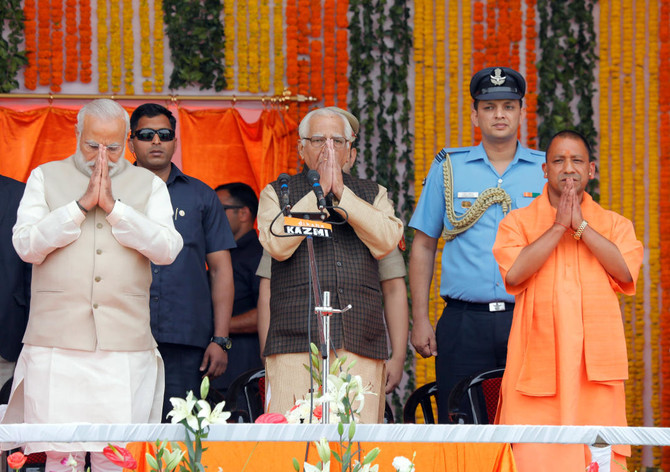
GORAKHPUR, India/NEW DELHI: Since Indian Prime Minister Narendra Modi stunned the political establishment by promoting a hard-line Hindu priest to one of the country’s most powerful positions, Yogi Adityanath has sounded more statesman than rabble-rouser.
Gone is the fiery anti-Muslim rhetoric and promotion of Hindu supremacy for which the saffron-robed 44-year-old is known, and in its place is a message of social inclusion more akin to Modi’s language since sweeping to power in 2014.
“My government will be for everyone, not specifically for any caste or community ... We will work for development of all sections and castes,” Adityanath said shortly after being made chief minister of Uttar Pradesh, India’s most populous state.
The words jar with what the shaven-headed leader of the Gorakhnath sect has been saying from public platforms throughout a political career spanning nearly 20 years.
In his northern power base — the down-at-heel town of Gorakhpur near the Nepalese border — Adityanath’s more conciliatory comments have done little to dispel unease among members of the Muslim community, who make up nearly a fifth of Uttar Pradesh’s 200 million or so people.
“We should just go about doing our job and pray the Hindu Yuva Vahini doesn’t take over mosques to build new temples,” said local driver Aijaz Sheikh, referring to the Hindu Youth Force set up by Adityanath in 2002 to carry out his agenda.
“If we react then we will pay the price. The loss will be ours and no Hindu will come to stand with us in Gorakhpur.”
Adityanath’s ascent has prompted widespread questions about India’s secular status, and whether Modi, himself a product of a nationalist Hindu upbringing, intends to pursue more aggressive pro-Hindu policies as he pursues economic reforms.
Adityanath was a key campaigner for Modi’s Bharatiya Janata Party (BJP) in Uttar Pradesh elections, and the thumping victory he helped deliver underlined how a divisive candidate could eclipse rivals who tried to reach out across communities.
“With Yogi Adityanath’s appointment, vigilantism has been upgraded into state policy,” said Gilles Verniers, assistant professor of political sciences at Ashoka University outside Delhi.
Abattoirs and “Romeo Squads”
In a gleaming white temple compound in Gorakhpur, people crowd Adityanath’s offices to petition his band of fanatical followers in the Hindu Youth Force to settle their personal grievances.
Clerks hammer out their requests on old mechanical typewriters, handing them to members of the force to deal with.
Not all disputes concern religion, but Adityanath’s devotees say their main mission is to fight against creeping encroachment by Uttar Pradesh’s Muslim community.
“It was a very difficult period for Hindus and for Yogi ji,” Mahesh Poddar, a textile merchant who was one of the first people to join the youth force, told Reuters in the temple compound.
“We felt like we were living in a country that doesn’t belong to us.”
Adityanath declined requests for an interview on past actions and his plans as chief minister.
Since his March 19 swearing-in, he has pushed policies that are an extension of Modi’s nationwide agenda, notably demanding state ministers declare their incomes and assets as part of a crackdown on corruption.
At the same time, he has instructed officials to prepare to shut down all mechanized abattoirs, part of a campaign pledge that appealed to Hindus because they view cows as sacred and because slaughterhouses are run mainly by Muslims.
The slaughter of cows is, in fact, prohibited in Uttar Pradesh, although not always enforced, but a blanket ban would also hurt buffalo meat exports.
Meat traders in the state said on Monday they had launched a strike to protest against the closure of butcher’s shops and slaughterhouses considered illegal.
“We are not selling drugs or indulging in criminal activities. We sell meat to feed our families but the government is targeting us because we are Muslims,” Raza Quereshi, a member of the Meat Producers’ Association, told Reuters.
Police have also deployed “anti-Romeo squads” to keep men and women apart in public to protect women from harassment.
But they are also seen by some as an extension of Adityanath’s battle against what he calls “love jihad,” or entrapment of Hindu women to convert them to Islam.
Religious tensions sporadically flare into violence in India, including in 1992 when more than 2,000 people were killed in clashes between Muslims and Hindus sparked by the demolition of a mosque on a contested site in Ayodhya, Uttar Pradesh.
Provocation, criminal charges
Adityanath, born in the northern state of Uttarakhand, left his family to join the Gorakhnath sect and was quickly chosen to succeed its chief priest. He was elected to parliament in 1998 in his mid-20s and has won re-election four times.
During his career, he has earned a reputation as a fringe firebrand.
News channels have aired footage of some of his public comments, including in 2007 when he said: “If they (Muslims) convert one Hindu girl, we will convert 100 Muslim girls ... if they kill one Hindu, we will also kill 100 Muslims.”
Like many Indian politicians, Adityanath also faces a string of criminal cases, disclosed in the affidavit he filed as a candidate in the 2014 general election.
These include attempted murder, criminal intimidation, promoting religious enmity and defiling a place of worship.
No charges have been framed and Adityanath has said the cases against him were baseless and politically motivated.
In one seen by Reuters at a local police station, a local Muslim politician called Talat Aziz accused Adityanath of deliberately provoking a clash between Muslims and Hindus in 1999 that led to the death of a 26-year-old police constable.
She is still fighting the case, which is pending before a local court.
Close aide Balu Rai said Adityanath had provided ample evidence to prove he was not involved in the death.
Officials in Modi’s office expressed confidence in Adityanath and said they expected him to change his image and policies for the good of the state.
And although he has clashed with the BJP before and his sect has maintained independence from the ruling party, some expect Adityanath to conform to Modi’s wishes now he is chief minister.
“He is a rabble-rouser whom the party has been using to communalize the agenda, the elections and the discourse,” said journalist and historian Akshaya Mukul. “But I don’t see him slipping beyond the control of the high command.”