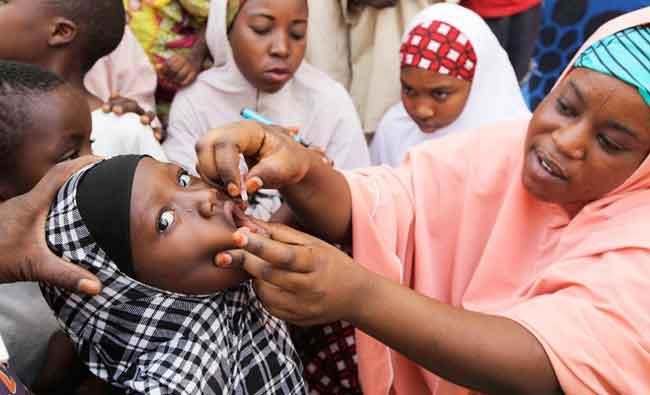
LAGOS: The World Health Organization said Friday 116 million children are to receive polio vaccines in 13 countries in west and central Africa as part of efforts to eradicate the disease on the continent.
“The synchronized vaccination campaign, one of the largest of its kind ever implemented in Africa, is part of urgent measures to permanently stop polio on the continent,” the WHO said.
The program will see all children under the age of five in 13 countries immunized from Saturday “in a coordinated effort to raise childhood immunity to polio,” it added.
The countries are Benin, Cameroon, Central African Republic, Chad, Ivory Coast, Democratic Republic of Congo (DRC), Guinea, Liberia, Mali, Mauritania, Niger, Nigeria and Sierra Leone.
Once a worldwide scourge, polio is still endemic in three countries — Nigeria, Afghanistan and Pakistan.
This year, the WHO has recorded four cases of polio — two each in Pakistan and Afghanistan. Last year, there were 37 cases globally.
The four-day campaign in Africa by 190,000 vaccinators is part of the response to the discovery of three cases of polio in the insurgency-wracked state of Borno in northeast Nigeria last year.
Before then, the west African country had not reported a case of polio in two years and was on track to be certified free of the virus this year.
Rod Curtis, from the UN children’s fund UNICEF in Borno, told AFP another campaign would take place at the end of April in the countries around Lake Chad.
Lake Chad forms the border between Nigeria, Niger, Chad and Cameroon, which have all been affected by Boko Haram’s insurgency.
“It’s funded by international donors, local governments and the government of Japan who spent $33 million specifically to support this campaign,” he said.
Polio is a highly infectious viral disease which mainly affects young children and can result in permanent paralysis. There is no cure and it can only be prevented through immunization.
Matshidiso Moeti, WHO regional director for Africa, said South Africa’s former President Nelson Mandela launched a campaign 20 years ago to “Kick Polio Out of Africa.”
“At that time, every single country on the continent was endemic to polio, and every year, more than 75,000 children were paralyzed for life by this terrible disease,” said Moeti.
“Thanks to the dedication of governments, communities, parents and health workers, this disease is now beaten back to this final reservoir.”
UNICEF’s regional director for west and central Africa, Marie-Pierre Poirier, said she was hopeful polio could be wiped out with the help of African leaders.
“Polio eradication will be an unparalleled victory, which will not only save all future generations of children from the grip of a disease that is entirely preventable, but will show the world what Africa can do when it unites behind a common goal,” she said.

116 million African children to get polio vaccines
Philippines eyes closer cooperation on advanced defense tech with UAE
- Philippine-UAE defense agreement is Manila’s first with a Gulf country
- Philippines says new deal will also help modernize the Philippine military
MANILA: The Philippines is seeking stronger cooperation with the UAE on advanced defense technologies under their new defense pact — its first such deal with a Gulf country — the Department of National Defense said on Friday.
The Memorandum of Understanding on Defense Cooperation was signed during President Ferdinand Marcos Jr.’s visit to Abu Dhabi earlier this week, which also saw the Philippines and the UAE signing a comprehensive economic partnership agreement, marking Manila’s first free trade pact with a Middle Eastern nation.
The Philippines-UAE defense agreement “seeks to deepen cooperation on advanced defense technologies and strengthen the security relations” between the two countries, DND spokesperson Assistant Secretary Arsenio Andolong said in a statement.
The MoU “will serve as a platform for collaboration on unmanned aerial systems, electronic warfare, and naval systems, in line with the ongoing capability development and modernization of the Armed Forces of the Philippines,” he added.
It is also expected to further military relations through education and training, intelligence and security sharing, and cooperation in the fields of anti-terrorism, maritime security, and peacekeeping operations.
The UAE’s Ministry of Foreign Affairs has described security and defense as “very promising fields” in Philippine-UAE ties, pointing to Abu Dhabi being the location of Manila’s first defense attache office in the Middle East.
The UAE is the latest in a growing list of countries with defense and security deals with the Philippines, which also signed a new defense pact with Japan this week.
“I would argue that this is more significant than it looks on first read, precisely because it’s the Philippines’ first formal defense cooperation agreement with a Gulf state. It signals diversification,” Rikard Jalkebro, associate professor at the Anwar Gargash Diplomatic Academy in Abu Dhabi, told Arab News.
“Manila is widening its security partnerships beyond its traditional circles at a time when strategic pressure is rising in the South China Sea, and the global security environment is (volatile) across regions.”
Though the MoU is not an alliance and does not create mutual defense obligations, it provides a “framework for the practical stuff that matters,” including access, training pathways, procurement discussions and structured channels” for security cooperation, he added.
“For the UAE, the timing also makes sense, seeing that Abu Dhabi is no longer only a defense buyer; it’s increasingly a producer and exporter, particularly in areas like UAS (unmanned aerial systems) and enabling technologies. That opens a new lane for Manila to explore capability-building, technology transfer, and industry-to-industry links,” Jalkebro said.
The defense deal also matters geopolitically, as events in the Middle East and the Indo-Pacific region have ripple effects on global stability and commerce.
“So, a Philippines–UAE defense framework can be read as a pragmatic hedge, strengthening resilience and options without formally taking sides,” Jalkebro said.