GAZA: A senior Hamas militant was shot dead near his home in the Gaza Strip on Friday, the group said, blaming Israel for the killing.
An Israeli military spokeswoman refused to comment on the incident in the Hamas-run Palestinian coastal enclave.
Mazen Fuqaha, a fighter from the occupied West Bank whom Israel released in a prisoner swap in 2011 and exiled to the Gaza Strip, was shot several times, said Hamas police.
Another senior Hamas official, Izzat El-Reshiq, said the killers used silencers.
“Hamas and its (military wing) hold (Israel) and its collaborators responsible for this despicable crime... (Israel) knows that the blood of fighters is not spilled in vain and Hamas will know how to act,” the group said in a statement.
Khalil Al-Haya, Hamas’s deputy chief in the Gaza Strip, said only Israel would have had something to gain from the death.
“If the enemy thinks that this assassination will change the power balance, then it should know the minds of Qassam will be able to retaliate in kind,” he said.
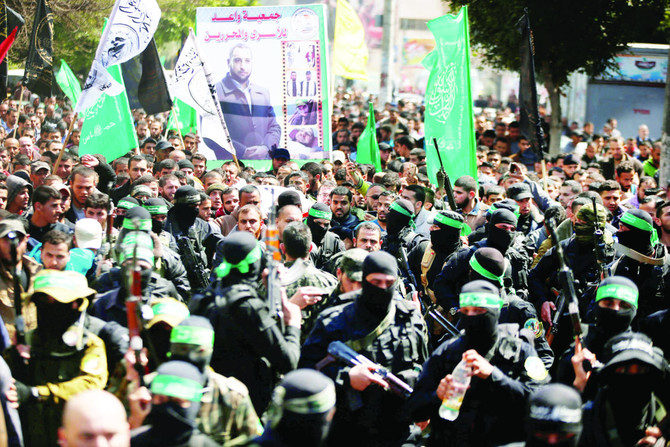
Thousands of Hamas supporters called for “revenge” during the funeral of Fuqaha.
“Revenge, revenge!” called participants at the procession.
Ismail Jaber, Hamas-nominated attorney general, said: “This assassination has the clear marks of Mossad,” he said, referring to the Jewish state’s spy agency.
Prime Minister Ismail Haniyeh and Yahya Sinwar, the new leader of Hamas in the Gaza Strip, headed the procession from the Shifa morgue to the Omari mosque.
Fuqaha, 38, was one of more than 1,000 Palestinian prisoners that Israel released in exchange for soldier Gilad Shalit whom Gaza militants had held captive in the coastal enclave after abducting him in a cross-border raid in 2006.
Israel jailed Fuqaha in 2003 for planning attacks against Israelis and sentenced him to nine life terms. Israeli media said that after his release while in exile in Gaza, he continued to plan attacks by West Bank militants.
Hamas has ruled the Gaza Strip for 10 years.
Cross-border violence between Gaza militants and Israel has largely died down since a 2014 war in which militants launched thousands of rockets into Israel.
According to Gaza health officials, more than 2,100 Palestinians, mostly civilians, were killed in 50 days of fighting. Israel put its dead at 67 soldiers and six civilians.
Militants from small radical groups have continued to fire an occasional rocket into Israel from Gaza despite Hamas’ efforts to rein them in but Israel says it holds Hamas responsible and responds with airstrikes and tank fire.
Hamas has recently said it is becoming impatient with Israel’s bombing of its facilities and has hinted that it may end the current state of relative calm.
Meanwhile, surrounded by militant training sites on uprooted Jewish settlement lands, the first movie set in the Gaza Strip is growing, depicting the history-rich, volatile alleyways of Jerusalem’s Old City.
The set is the latest effort by Al-Aqsa channel, run by Hamas, to kick-start its drama production in the territory and release another series slated to air in the month of Ramadan.
In Gaza, filming footage of Jerusalem and other central locations from the conflict is a challenge.
Gaza’s population of about 2 million live in mostly cramped conditions in the coastal sandy territory compared to the rugged mountain terrain of the West Bank, so crews have struggled to film the twisting ancient alleyways of Jerusalem’s Old City. And that is how the idea to create a set depicting Jerusalem was born.
The fate of Jerusalem is an emotional issue at the heart of the conflict between Israel and the Palestinians. Israel captured east Jerusalem, home to the Old City with its holy sites sacred to Jews, Christians and Muslims, in the 1967 war. Palestinians want the territory for their future state.

Hamas blames Israeli spy agency for assassination of senior member
Syrian church marks Christmas and reaffirms faith months after deadly attack
- The June attack was blamed on a Daesh cell, which authorities said had also planned to target a Shiite shrine
DWEIL’A: At a church in Syria where a suicide attack killed 25 people in June, hundreds of worshippers gathered before Christmas to remember those they lost and reaffirm their faith.
With a small detail of security forces standing guard outside, members of Mar Elias Church held Mass on Tuesday evening and lit an image of Christmas tree made of neon lights on the wall of the courtyard outside. The tree was hung with pictures of those who were killed in the attack.
They include three men the congregation hails as heroes for tackling the bomber, potentially averting a much higher death toll in the June 22 attack.
A man opened fire then detonated an explosive vest inside the Greek Orthodox church in Dweil’a on the outskirts of Damascus as it was filled with people praying on a Sunday.
Before he detonated the vest, brothers Boutros and Gergis Bechara and another congregant, Milad Haddad, tackled the shooter and pushed him out of the center of the church, congregants said.
“If it weren’t for the three of them, maybe not one person would remain out of 400 people,” said Imad Haddad, the brother of Milad Haddad, who attended Tuesday’s Christmas tree lighting.
He hasn’t decorated for Christmas or put up a tree at home, but gathering at the church was “is a message of peace and love” and a message that “we are believers and we are strong and we are steadfast in spite of everything,” he said.
Thana Al-Masoud, the widow of Boutros Bechara, recalled searching frantically for her husband after the explosion but she never found him, alive or dead. His body had been ripped apart by the blast.
“There’s no holiday, neither this year nor next year nor the one after it,” she said.
She takes comfort in the belief that her husband and the two other men who confronted the attacker are martyrs for their faith.
“Our Lord chose them to be saints and to spread His word to all the world,” she said. “But the separation is difficult.”
Attack stoked Christian fears
The attack on the church was the first of its kind in Syria in years and came as a new Sunni militant- dominated government in Damascus sought to win the confidence of religious minorities following the ouster of former President Bashar Assad.
Interim President Ahmad Al-Sharaa has struggled to exert authority across the country, even in the ranks of allied groups. There have been several deadly outbreaks of sectarian violence in the country in the past year.
While the new government has condemned attacks on minorities, many accuse it of failing to act to control the armed factions it is trying to absorb into the new state army and security forces.
The June attack was blamed on a Daesh cell, which authorities said had also planned to target a Shiite shrine. Daesh did not claim responsibility for the attack, while a little-known group called Saraya Ansar Al-Sunna said one of its members had carried out the attack. The government said the group was a cover for Daesh.
Christians made up about 10 percent of Syria’s population of 23 million before mass anti-government protests in 2011 were met by a brutal government crackdown and spiraled into a brutal 14-year civil war that saw the rise of IS and other extremist groups.
Hundreds of thousands of Christians fled during the war, during which there were sectarian attacks on Christians including the kidnapping of nuns and priests and destruction of churches. Now many are once again seeking to leave.
Solidifying faith and seeking peace
Since losing her husband in the church attack, Juliette Alkashi feels numb.
The couple had been sweethearts before she left Syria with her mother and brother to emigrate to Venezuela. In 2018, when Emile Bechara asked her to marry him, Alkashi moved back to Syria even though it was still in the midst of a civil war.
“Whatever is going to happen will happen, and I’ve surrendered to it,” she said. “If one goes to pray and dies in the church — whatever God has written is what will be.”
The only thing that matters now, Alkashi said, is that she and her 3-year-old son remain together.
Some congregants said the attack only strengthened their faith.
“I saw a column of smoke rising from the ground to the ceiling, and I heard a voice saying, ‘I will not forsake you and I will not leave you,’” said Hadi Kindarji, who described an intense spiritual experience in the moment of the explosion.
He believes today that even the seemingly senseless violence was part of God’s plan.
“Our God is present, and He was present in the church,” he said.
Yohanna Shehadeh, the priest of Mar Elias church, acknowledged many in the congregation are afraid of more deadly violence.
“Fear is a natural state. I’m not going to tell you there is no fear, and I’m not only talking about the Christians but about all the Syrian people, from all sects,” Shehadeh said.
As Christmas approaches, he said, they are praying for peace.