

LONDON: The attacker who plowed a car through a throng of pedestrians and then stabbed a policeman outside Britain’s parliament was named on Thursday as Khalid Masood, a British-born man who was once investigated by MI5 intelligence officers over concerns about violent extremism.
The death toll from Wednesday’s attack on the heart of Britain’s democracy grew to five as police said one of the injured, a 75-year-man, had died in hospital after his life support was withdrawn.
That number included Masood, 52, who was shot dead by police.
The attack was the deadliest in Britain since 2005, when 52 people were killed by Islamist suicide bombers on London’s public transport system.
It followed a series of Islamist militant operations that have killed some 280 people in France, Belgium and Germany in just over two years, and marked the third occasion a lone attacker has used a vehicle as a weapon.
Islamic State claimed responsibility in a statement issued by its Amaq news agency, but did not name Masood and gave no details. It was not clear whether the attacker was directly connected to the jihadist group.
Police said Masood was born in the county of Kent in southeast England and was most recently living in the West Midlands region of central England.
“Masood was not the subject of any current investigations and there was no prior intelligence about his intent to mount a terrorist attack,” the Metropolitan Police said in a statement.
“However, he was known to police and has a range of previous convictions for assaults, including GBH (grievous bodily harm), possession of offensive weapons and public order offenses.”
Prime Minister Theresa May told parliament the attacker had once been investigated by the MI5 intelligence agency over concerns about violent extremism, but had been a peripheral figure.
A USgovernment source said Masood had associates with an interest in joining jihadist groups abroad, but there was no evidence he had done so himself.
“The people he was hanging out with did include people suspected of having an interest in traveling to join jihadi groups overseas but the attacker himself never did so,” the source said.
Police said Masood had never been convicted of a terrorist offense. His first conviction was in 1983 for criminal damage and his last one in December 2003 for possession of a knife.
Mayhem
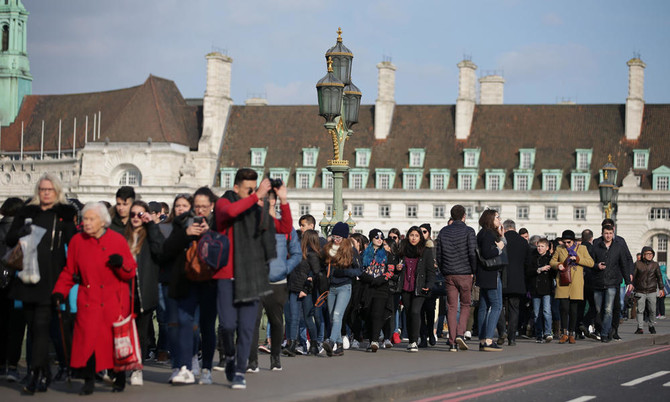
During five minutes of mayhem in the heart of London on Wednesday, Masood sped across Westminster Bridge in a car, mowing down pedestrians. He then ran through the gates of the nearby parliamentary precinct and fatally stabbed an unarmed policeman, Keith Palmer, before being shot dead.
“He will be deeply missed. We love him so much,” Palmer’s family said in a statement. The 48-year-old was married with a five-year-old daughter.
About 40 people were injured, of whom some were in critical condition. May visited some of them, her spokesman said.
Police arrested eight people at six locations in London and Birmingham in the investigation into the attack, which May said was inspired by a warped Islamist ideology. All were suspected of preparing terrorist acts, police later confirmed.
The Enterprise rental car company said the vehicle used had been rented from its Spring Hill branch in Birmingham, which is in the West Midlands.
The bloodshed took place on the first anniversary of attacks that killed 32 people in Brussels. A minute’s silence was held in parliament and outside police headquarters on Thursday morning.
As dusk fell, hundreds gathered in London’s Trafalgar Square in a vigil to remember the victims. With traffic diverted away, volunteers handed out candles in an eerie silence.
Helen Pallot, 26, from just outside London, was holding a bunch of flowers she planned to lay nearby.
“I have got a lot of friends and family that work five minutes away from there, so it just makes you think,” she said. “It made me angry and sad and I wanted to come here and show that we can still all be here together.”
Speaking at the United Nations in New York, British Foreign Secretary Boris Johnson urged Internet providers and social media networks to do more to curb extremist propaganda.
“They’ve got to look at the stuff that’s going up on their sites, they’ve got to take steps to invigilate it, to take it down where they can,” he said.
“LONE-WOLF ATTACK“
The casualties included 12 Britons, three French children, two Romanians, four South Koreans, one German, one Pole, one Chinese, one American and two Greeks, May said.
Queen Elizabeth released a message saying: “My thoughts, prayers and deepest sympathy are with all those who have been affected by yesterday’s awful violence.”
US tourist Kurt Cochran was named as one of the dead in a Facebook post by family member Shantell Payne.
“With a heavy heart I must pass the sad news of our beautiful brother, father, husband, son and friend Kurt Cochran, he could not overcome the injuries he received in the London terror attacks,” Payne wrote.
Her post said Cochran’s wife, Melissa Payne Cochran, was in hospital with a broken leg and rib and a cut on her head.
The couple were in Europe to celebrate their 25th wedding anniversary.
US President Donald Trump paid tribute to Cochran in a tweet, calling him “a great American.”
Many have been shocked that the attacker was able to cause such mayhem in the heart of the capital equipped with nothing more than a hired car and a knife.
“This kind of attack, this lone-wolf attack, using things from daily life, a vehicle, a knife, are much more difficult to forestall,” Defense Secretary Michael Fallon told the BBC.
Three French high-school students on a school trip to London were among the injured. French Foreign Minister Jean-Marc Ayrault met some of their fellow students near the hospital where they were being treated. Their lives were not in danger.


